
Backed by market attractiveness analysis, total addressable market sizing, company benchmarking matrices, interactive Excel dashboards, wider supply chain intelligence, emerging startup coverage, and detailed product-level insights, The Business Research Company’s 2026 market reports are designed to offer research that is more actionable and strategically valuable than ever.
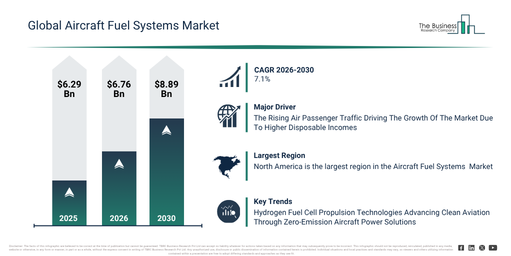
Aircraft Fuel Systems Market Growth From $6.77 Billion In 2026 To $8.9 Billion By 2030 At A CAGR Of 7.1%
The market size for aircraft fuel systems has demonstrated robust expansion in recent years. Its valuation is projected to increase from $6.3 billion in 2025 to $6.77 billion in 2026, advancing at a compound annual growth rate (CAGR) of 7.5%. This historical development is linked to factors such as the expansion of aircraft fleets, an uptick in commercial air passenger traffic, enhanced military aircraft procurement, the rise in long-haul aviation operations, and stringent aviation fuel safety regulations.
The aircraft fuel systems market is projected to experience substantial expansion in the coming years. This market is anticipated to reach a valuation of $8.9 billion by 2030, demonstrating a compound annual growth rate (CAGR) of 7.1%. Key factors driving this growth during the forecast period include the increasing adoption of sustainable aviation fuel, a rise in the production of next-generation aircraft, heightened investment in sophisticated fuel management systems, the expansion of unmanned aerial vehicle fleets, and a growing need for lightweight aircraft components. Significant trends expected over the forecast horizon encompass the increasing use of lightweight fuel system components, a growing demand for advanced fuel tank safety systems, the rising incorporation of modular fuel management architectures, the broadening of biofuel-compatible fuel system designs, and an intensified focus on optimizing fuel delivery efficiency.
Get A Free Sample Report With In-Depth Market Insights:
Aircraft Fuel Systems Market Growth Drivers: What’s Behind The Acceleration?
The growth of the aircraft fuel systems market is anticipated to be driven by the increasing volume of air passenger traffic. This traffic represents the overall count of individuals transported by airlines on both domestic and international routes within a defined timeframe, acting as a crucial metric for air travel demand. The surge in air passenger traffic stems from increased disposable incomes, enabling a greater number of individuals to undertake air travel for both professional and recreational purposes. This increase in passenger numbers necessitates fleet expansion and greater aircraft utilization, consequently boosting the need for sophisticated and effective aircraft fuel systems. These systems are vital for guaranteeing dependable fuel management, enhancing safety, and improving fuel efficiency throughout commercial and military aviation operations. As an illustration, in October 2024, data from the Department of Transportation, a US-based government department, indicated that August 2024 saw 647,205 flights operational, marking a 2.61% increase from the 630,761 flights recorded in August 2023. Thus, the rising air passenger traffic is a significant catalyst for the growth of the aircraft fuel systems market.
Aircraft Fuel Systems Market Segment Analysis: What Are The Core Market Categories?
The aircraft fuel systems market covered in this report is segmented –
1) By Component: Piping, Inerting Systems, Pumps, Valves, Gauges, Filters, Other Components
2) By Technology: Gravity Feed Fuel System, Fuel Injection System, Pump Feed System
3) By Fuel Type: Jet Fuel, Aviation Gasoline, Biofuel, Other Fuel Types
4) By End User: Civil Aviation, Military Aviation, Other End Users
Subsegments:
1) By Piping: Rigid Fuel Pipes, Flexible Fuel Hoses, Metallic Fuel Lines, Composite Fuel Lines, Fuel Transfer Lines
2) By Inerting Systems: Nitrogen Generation Systems, Onboard Inert Gas Generation Systems, Hollow Fiber Membrane Systems, Fuel Tank Inerting Systems, Center Wing Tank Inerting Systems
3) By Pumps: Electric Fuel Pumps, Engine Driven Fuel Pumps, Booster Fuel Pumps, Transfer Fuel Pumps, Auxiliary Fuel Pumps
4) By Valves: Fuel Shutoff Valves, Fuel Transfer Valves, Check Valves, Pressure Relief Valves, Crossfeed Valves
5) By Gauges: Fuel Quantity Gauges, Fuel Pressure Gauges, Fuel Flow Gauges, Fuel Level Indicators, Digital Fuel Monitoring Gauges
6) By Filters: Fuel Strainer Filters, Cartridge Fuel Filters, Inline Fuel Filters, Water Separator Filters, Fine Particle Fuel Filters
7) By Other Components: Fuel Tanks, Fuel Sensors, Fuel Meters, Fuel Vent Systems, Fuel Management Control Units
Aircraft Fuel Systems Market Trends: What’s Defining The Industry’s Next Phase?
Leading companies within the aircraft fuel systems market are concentrating on developing innovative approaches, particularly hydrogen-based fuel cell propulsion systems, to boost fuel efficiency, decrease emissions, and support the aviation sector’s move towards zero-emission flight. Hydrogen fuel cell-based propulsion systems are sophisticated aircraft power solutions that transform liquid hydrogen into electrical energy through electrochemical reactions, subsequently powering electric motors for aircraft propulsion. This provides a cleaner alternative to traditional jet fuel systems, which operate through combustion and release CO2, NOx, and particulate emissions. For example, in June 2023, MTU Aero Engines AG, a Germany-based aerospace propulsion firm, introduced the Flying Fuel Cell (FFC) concept, an aviation fuel cell technology crafted to convert liquid hydrogen into electricity for aircraft propulsion systems. This system utilizes fuel cells to generate electrical energy that powers high-efficiency electric motors linked to propellers, facilitating near-zero emissions flight with only water as a byproduct. Additionally, the concept is initially aimed at short-haul and regional aircraft, with plans for more widespread implementation in short- and medium-haul aviation over the coming decades, thus supporting long-term decarbonization goals in the aviation industry.
Aircraft Fuel Systems Market Top Companies Driving Competitive Growth
Major companies operating in the aircraft fuel systems market report are RTX Corporation, Honeywell International Inc., Safran S.A., Eaton Corporation plc, Thales Group, Parker-Hannifin Corporation, Liebherr-International AG, TransDigm Group Incorporated, GKN Aerospace Services Limited, AMETEK Inc., Curtiss-Wright Corporation, HEICO Corporation, ITT Inc., Moog Inc., Woodward Inc., Crane Company, Triumph Group Inc., Senior plc, Astronics Corporation, Marotta Controls Inc., Metalcraft Technologies Inc., Hartwig Aircraft Fuel Cell Repair Inc.
View The Full Aircraft Fuel Systems Market Report:
Aircraft Fuel Systems Market Regional Analysis And Top Geography
North America was the largest region in the aircraft fuel systems market in 2025. Asia-Pacific is expected to be the fastest-growing region in the forecast period. The regions covered in the aircraft fuel systems market report are Asia-Pacific, South East Asia, Western Europe, Eastern Europe, North America, South America, Middle East, Africa.
Reach Out To Our Team:
The Business Research Company: https://www.thebusinessresearchcompany.com/
Americas: +1 310-496-7795
Asia: +44 7882 955267 & +91 8897263534
Europe: +44 7882 955267
Email us at: marketing@tbrc.info
Follow us on:
LinkedIn: https://in.linkedin.com/company/the-business-research-company
YouTube: https://www.youtube.com/channel/UC24_fI0rV8cR5DxlCpgmyFQ
Global Market Model: https://www.thebusinessresearchcompany.com/global-market-model

Wasay has over a decade of experience in market research, data modelling, and analytics, with prior experience at GlobalData and Decision Tree Consulting Services. At The Business Research Company , he leads research operations across syndicated studies, customized consulting engagements, and the Global Market Model platform. His professional experience includes supporting organizations such as Boston Consulting Group, KPMG, and Ernst & Young. Wasay holds a degree in Electronics and Communications Engineering, postgraduate management qualifications from International Management Institute Belgium and Indian School of Business and Entrepreneurship, and completed the Integrated Program in Business Analytics from Indian Institute of Management Indore.