Backed by market attractiveness analysis, total addressable market sizing, company benchmarking matrices, interactive Excel dashboards, wider supply chain intelligence, emerging startup coverage, and detailed product-level insights, The Business Research Company’s 2026 market reports are designed to offer research that is more actionable and strategically valuable than ever.
Deployable Military Shelter Systems Market Size Forecast: How Big Could The Market Get By 2030?
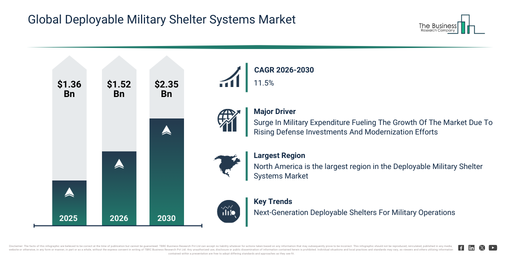
The deployable military shelter systems market has experienced significant expansion in recent years. Its valuation is predicted to increase from $1.36 billion in 2025 to $1.52 billion in 2026, demonstrating a compound annual growth rate (CAGR) of 11.3%. This historical growth can be attributed to factors such as military modernization initiatives, the necessity for expeditionary warfare, demands for disaster response capabilities, advancements in defense logistics mobility, and the continuous need for temporary infrastructure.
The market size for deployable military shelter systems is projected to experience substantial growth over the next few years. This sector is anticipated to expand to $2.35 billion in 2030, achieving a compound annual growth rate (CAGR) of 11.5%. This growth in the forecast period is primarily driven by factors such as increased defense spending, the demand for rapid response capabilities, the development of modular battlefield infrastructure, the expansion of humanitarian missions, and the adoption of advanced materials. Prominent trends observed during this period include rapid deployment shelter systems, modular defense infrastructure, the use of lightweight composite materials, the establishment of mobile command facilities, and the creation of climate-resilient military shelters.
Get A Free Sample Report With In-Depth Market Insights:
Deployable Military Shelter Systems Market Opportunity Drivers: What’s Unlocking New Revenue Potential?
The anticipated rise in military spending is projected to boost the expansion of the deployable military shelter systems market moving forward. Military expenditure refers to the aggregate financial investment a nation dedicates to its defense and armed forces. This spending is on an upward trend, largely attributed to the modernization of defense equipment that consumes significant fuel, thereby elevating operational expenses and imposing a heavier financial strain on national budgets. Such expenditure facilitates the creation and deployment of sophisticated, quickly deployable military shelter systems through financing the research, manufacturing, and upkeep of adaptable, robust structures that improve troop preparedness and operational adaptability across various demanding settings. For example, the Stockholm International Peace Research Institute (SIPRI), a Sweden-based research institute, reported in April 2024 that worldwide military spending reached $2,443 billion in 2023, reflecting a 6.8% real-term increase compared to 2022. Consequently, the rising military expenditure is poised to stimulate the growth of the deployable military shelter systems market.
Deployable Military Shelter Systems Market Segmentation: How Does The Market Break Down By Category?
The deployable military shelter systems market covered in this report is segmented –
1) By Type: Soft Wall Shelters, Hard Wall Shelters, Hybrid Shelters, Inflatable Shelters, Containerized Shelters
2) By Material: Composite Materials, Fabric Materials, Metal And Alloy Structures
3) By Size: Small Shelters, Medium Shelters, Large Shelters
4) By Application: Command And Control Centers, Medical Facilities, Maintenance Facilities, Humanitarian, Living Quarters, Other Application
5) By End-User: Defense Forces, Non-Governmental Organizations, Civilian Agencies
Subsegments:
1) By Soft Wall Shelters: Tent Structures, DRASH Systems, Frame Supported Canopies, Collapsible Fabric Units, Tension Fabric Shelters
2) By Hard Wall Shelters: Rigid Panel Systems, Modular Block Units, Pre-Fabricated Wall Assemblies, Aluminum Frame Enclosures, Composite Hardwall Containers
3) By Hybrid Shelters: Combined Wall Configurations, Expandable Hybrid Modules, Soft-Hard Integrated Designs, Convertible Wall Systems, Multi-Mode Shelter Units
4) By Inflatable Shelters: Air Beam Structures, Pressure Inflated Envelopes, Rapid Inflate Tents, Self-Supporting Bladders, Bellows Type Inflatable Units
5) By Containerized Shelters: ISO-Container Conversions, Stackable Shipping Units, Twenty Foot Equivalent Units, Forty Foot Equivalent Units, Intermodal Shelter Modules
Deployable Military Shelter Systems Market Innovation Trends Shaping Future Development
Major companies operating in the deployable military shelter systems market are concentrating on developing innovative solutions, such as lightweight shelters with integrated communications and rapid-deployment capabilities, to bolster operational readiness and flexibility in field missions. These lightweight shelters, featuring integrated communications and rapid-deployment capabilities, are portable, easily assembled units equipped with embedded communication systems, designed for swift deployment in the field. This helps military units establish secure command and control operations anywhere while conserving time and logistical resources. For instance, in June 2025, Indra, a Spain-based defense and technology company, unveiled an advanced modular command, control, and communications shelter, thereby enhancing operational readiness and connectivity for military units. The shelter is constructed from lightweight, durable materials, incorporating integrated communications systems, climate control, and power management, which allows for rapid deployment and high mobility. Its distinctive attributes include modular expandability, strengthened protection against environmental and operational hazards, and the capability to support multiple command and communication functions concurrently, making it ideal for field headquarters, disaster response, and tactical operations.
Deployable Military Shelter Systems Market Competitive Landscape: Who Leads The Industry?
Major companies operating in the deployable military shelter systems market are General Dynamics Corporation, Saab AB, AAR CORP., Sioen Industries NV, Marshall Aerospace and Defence Group Ltd., Sprung Structures Inc., Liri Architecture Technology (Guangdong) Co. Ltd., AKS Industries Inc., Camel Manufacturing Company, Deployed Logix LLC, Metecno India Private Limited, Rubb Buildings Ltd., UTS Systems, Kärcher Futuretech GmbH, Anchor Industries Inc., HTS TENTIQ GmbH, Nordic Shelter AS, Litefighter Systems LLC, Design Shelter Inc., Celina Tent Inc., RedGuard Inc.
View The Full Deployable Military Shelter Systems Market Report:
Deployable Military Shelter Systems Market Geographic Landscape: Which Region Dominates Industry Growth?
North America was the largest region in the deployable military shelter systems market in 2025. Asia-Pacific is expected to be the fastest-growing region in the forecast period. The regions covered in the deployable military shelter systems market report are Asia-Pacific, South East Asia, Western Europe, Eastern Europe, North America, South America, Middle East, Africa.
Reach Out To Our Team:
The Business Research Company: https://www.thebusinessresearchcompany.com/
Americas: +1 310-496-7795
Asia: +44 7882 955267 & +91 8897263534
Europe: +44 7882 955267
Email us at: marketing@tbrc.info
Follow us on:
LinkedIn: https://in.linkedin.com/company/the-business-research-company
YouTube: https://www.youtube.com/channel/UC24_fI0rV8cR5DxlCpgmyFQ
Global Market Model: https://www.thebusinessresearchcompany.com/global-market-model

Wasay has over a decade of experience in market research, data modelling, and analytics, with prior experience at GlobalData and Decision Tree Consulting Services. At The Business Research Company , he leads research operations across syndicated studies, customized consulting engagements, and the Global Market Model platform. His professional experience includes supporting organizations such as Boston Consulting Group, KPMG, and Ernst & Young. Wasay holds a degree in Electronics and Communications Engineering, postgraduate management qualifications from International Management Institute Belgium and Indian School of Business and Entrepreneurship, and completed the Integrated Program in Business Analytics from Indian Institute of Management Indore.