Built to provide research that’s more actionable and strategically valuable, The Business Research Company’s 2026 market reports include market attractiveness analysis, total addressable market sizing, company benchmarking matrices, interactive Excel dashboards, broader supply chain intelligence, emerging startup tracking, and in-depth product insights.
Gliders Market Expansion Outlook: What Revenue Opportunities Are Ahead?
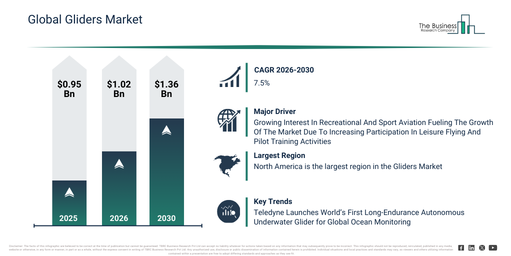
The gliders market has seen substantial growth over recent years. This market is projected to expand from $0.95 billion in 2025 to $1.02 billion in 2026, demonstrating a compound annual growth rate (CAGR) of 7.2%. The historical expansion can be attributed to several factors, including a growing interest in recreational aviation, the evolution of lightweight composite materials, an increase in flight training schools, the rising appeal of gliding sports, and early breakthroughs in sailplane design.
The gliders market is projected to experience robust expansion in the coming years. It is anticipated to reach $1.36 billion by 2030, demonstrating a compound annual growth rate (CAGR) of 7.5%. This expansion during the projected timeframe is primarily driven by factors such as the integration of AI-assisted flight performance optimization, an increase in military glider applications, the broadening of commercial sightseeing glider operations, a heightened need for environmentally friendly gliders, and advancements in motor glider technology. Noteworthy developments expected throughout this period encompass the use of sophisticated composite materials, efforts to optimize aerodynamic efficiency, an increase in flight training programs, the growing appeal of gliders for recreation and sports, and the expanded adoption of gliders for military and commercial uses.
Get A Free Sample Report With In-Depth Market Insights:
Gliders Market Demand Drivers: What’s Powering Industry Growth?
The increasing engagement in recreational and sport aviation is projected to boost the expansion of the gliders market in the future. This type of aviation involves operating aircraft primarily for personal enjoyment, leisure pursuits, or non-commercial sports, differentiating it from transport or business applications. Its growth stems from rising disposable incomes, which allow more people to engage in private flying and various aerial leisure pursuits. Gliders contribute to recreational and sport aviation by providing a flight experience that is accessible, economical, and demanding in terms of skill, thereby attracting aviation enthusiasts and facilitating pilot training as well as recreational flights. For example, the Federal Aviation Administration (FAA), a US government aviation body, anticipates that the recreational small drone fleet will maintain its strong presence with consistent growth, increasing from the present 1.87 million units to approximately 1.93 million units by 2029, showing an average annual growth rate of 0.66 percent between 2024 and 2029. Consequently, the increasing appeal of recreational and sport aviation is a key factor propelling the expansion of the gliders market.
Gliders Market Segment Analysis: What Are The Core Market Categories?
The gliders market covered in this report is segmented –
1) By Product Type: Hang Gliders, Paragliders, Sailplanes, Motor Gliders
2) By Structure: Perfect Competition, Monopolistic Competition, Oligopoly, Monopoly
3) By Distribution Channel: Online Stores, Specialty Stores, Direct Sales
4) By Application: Recreational, Commercial, Military
Subsegments:
1) By Hang Gliders: Standard Hang Gliders, Flex Wing Hang Gliders, Rigid Wing Hang Gliders
2) By Paragliders: Recreational Paragliders, Performance Paragliders, Tandem Paragliders, Powered Paragliders
3) By Sailplanes: Standard Class Sailplanes, 15 Meter Class Sailplanes, 18 Meter Class Sailplanes, Open Class Sailplanes, Club Class Sailplanes
4) By Motor Gliders: Self Launching Motor Gliders, Sustainer Motor Gliders, Touring Motor Gliders
Gliders Market Innovation Trends: What Developments Are Reshaping The Industry?
Major companies engaged in the gliders market are concentrating on developing advanced solutions, such as long-endurance autonomous underwater gliders equipped with satellite data transmission, to transform global ocean monitoring and improve capabilities for climate and weather forecasting. These long-endurance autonomous underwater gliders with satellite data transmission refer to uncrewed underwater vehicles engineered to navigate ocean currents for prolonged periods while collecting environmental data and relaying it in near real time via satellite networks. For example, in October 2025, Teledyne Marine, a US-based provider of marine robotics, oceanographic, and subsea systems, collaborated with Rutgers University-New Brunswick, a US-based university, to launch the Slocum Sentinel “Redwing” glider, which is the world’s first next-generation autonomous underwater glider designed to circumnavigate the globe on a five-year mission. The Redwing glider features a carbon-fiber hull for durability, buoyancy-driven propulsion for ultra-long endurance, and a set of environmental sensors that measure parameters such as salinity, temperature, and depth, sending data back via satellite every 8–12 hours. It also carries technology to detect tagged marine life and can navigate extensive distances by riding ocean currents, thereby assisting scientists in refining weather models, understanding ocean dynamics, and contributing to climate research. This pioneering deployment signifies a substantial technological advancement in ocean observation systems and paves the way for future global fleets of autonomous gliders.
Gliders Market Company Landscape And Competitive Strategy
Major companies operating in the gliders market are L3Harris Technologies Inc., Huntington Ingalls Industries Inc., Teledyne Technologies Incorporated, Kongsberg Gruppen ASA, MRV Communications Inc., Aeros Ltd., Liquid Robotics Inc., Schempp-Hirth Flugzeugbau GmbH, Stemme GmbH, Alseamar S.A.S., Grob Aircraft SE, Jonker Sailplanes, Lange Aviation GmbH, HPH Sailplanes s.r.o., GP Gliders ApS, AMS-Flight d.o.o., DG Flugzeugbau GmbH, Avionic spol. s r.o., Allstar PZL Glider Sp. z o.o., Sportinė Aviacija UAB
View The Full Gliders Market Report:
Gliders Market Largest Region: Which Geography Holds The Biggest Share?
North America was the largest region in the gliders market in 2025. Asia-Pacific is expected to be the fastest-growing region in the forecast period. The regions covered in the gliders market report are Asia-Pacific, South East Asia, Western Europe, Eastern Europe, North America, South America, Middle East, Africa.
Reach Out To Our Team:
The Business Research Company: https://www.thebusinessresearchcompany.com/
Americas: +1 310-496-7795
Asia: +44 7882 955267 & +91 8897263534
Europe: +44 7882 955267
Email us at: marketing@tbrc.info
Follow us on:
LinkedIn: https://in.linkedin.com/company/the-business-research-company
YouTube: https://www.youtube.com/channel/UC24_fI0rV8cR5DxlCpgmyFQ
Global Market Model: https://www.thebusinessresearchcompany.com/global-market-model

Wasay has over a decade of experience in market research, data modelling, and analytics, with prior experience at GlobalData and Decision Tree Consulting Services. At The Business Research Company , he leads research operations across syndicated studies, customized consulting engagements, and the Global Market Model platform. His professional experience includes supporting organizations such as Boston Consulting Group, KPMG, and Ernst & Young. Wasay holds a degree in Electronics and Communications Engineering, postgraduate management qualifications from International Management Institute Belgium and Indian School of Business and Entrepreneurship, and completed the Integrated Program in Business Analytics from Indian Institute of Management Indore.