
Backed by market attractiveness analysis, total addressable market sizing, company benchmarking matrices, interactive Excel dashboards, wider supply chain intelligence, emerging startup coverage, and detailed product-level insights, The Business Research Company’s 2026 market reports are designed to offer research that is more actionable and strategically valuable than ever.
Low Earth Orbit (LEO) And Geostationary Earth Orbit (GEO) Satellite Market Size Outlook: How Quickly Will Revenue Expand Through 2030?
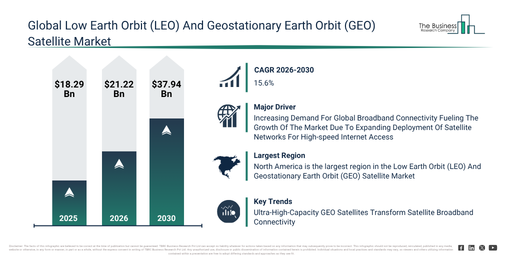
The low earth orbit (leo) and geostationary earth orbit (geo) satellite market has seen rapid expansion in recent years. It is anticipated to increase from $18.29 billion in 2025 to $21.22 billion in 2026, achieving a compound annual growth rate (CAGR) of 16.1%. This historical growth can be attributed to factors such as increasing demand for satellite communications, the expansion of broadband connectivity, a rising need for earth observation data, growing requirements for satellite-based navigation, and an increase in television broadcasting services.
The low earth orbit (leo) and geostationary earth orbit (geo) satellite market size is projected to experience swift expansion over the coming years. This market is anticipated to reach $37.94 billion by 2030, exhibiting a compound annual growth rate (CAGR) of 15.6%. Factors contributing to this growth during the forecast period include a rising need for global internet access, the expanding embrace of direct-to-device communication, an escalating requirement for real-time earth observation, greater government expenditure on satellite infrastructure, and the proliferation of commercial satellite constellations. Key trends expected over this period involve the heightened deployment of high-throughput satellites, an increasing appetite for low-latency satellite connections, the enlargement of broadband internet satellite constellations, broader acceptance of direct-to-device satellite connectivity, and the escalating creation of multi-orbit satellite networks.
Get A Free Sample Report With In-Depth Market Insights:
Low Earth Orbit (LEO) And Geostationary Earth Orbit (GEO) Satellite Market Growth Backed By Core Demand Fundamentals
The rising need for worldwide broadband connectivity is anticipated to fuel the expansion of the low earth orbit (LEO) and geostationary earth orbit (GEO) satellite market moving ahead. This global connectivity involves delivering dependable, rapid internet access, allowing individuals, enterprises, and public bodies to interact and share information across various geographical areas. The need for global broadband connectivity is growing because of the swift progression of digital transformation efforts, which necessitate uninterrupted, high-capacity internet services. This escalating demand for global broadband connectivity aids the low Earth orbit (LEO) and geostationary Earth orbit (GEO) satellite sector by spurring the rollout of satellite networks, providing high-speed internet to regions that are unserved or distant. As an illustration, in November 2025, the International Telecommunication Union, a UN agency located in Switzerland, reported that 5.5 billion people (68% of the global population) accessed the Internet in 2024, an increase from 5.27 billion people (65%) in 2023. This indicates a growth of 227 million users, roughly 4.3% year over year. Consequently, the heightened demand for global broadband connectivity is propelling the expansion of the low earth orbit (LEO) and geostationary earth orbit (GEO) satellite market.
Low Earth Orbit (LEO) And Geostationary Earth Orbit (GEO) Satellite Market Segment Analysis Spotlighting Growth Areas
The low earth orbit (leo) and geostationary earth orbit (GEO) satellite market covered in this report is segmented –
1) By Orbit Type: Low Earth Orbit Satellites, Geostationary Earth Orbit Satellites
2) By Satellite Mass: Small Satellites, Medium Satellites, Large Satellites
3) By Frequency Band: L Band, S Band, C Band, X Band, Ku Band, Ka Band
4) By Application: Communication, Earth Observation And Remote Sensing, Navigation And Positioning, Scientific Research, Weather Monitoring
5) By End User: Commercial, Government And Civil, Defense And Military, Research And Academic Institutions
Subsegments:
1) By Low Earth Orbit Satellites: Communication Satellites, Earth Observation Satellites, Remote Sensing Satellites, Navigation Satellites, Scientific Research Satellites, Technology Demonstration Satellites, Defense And Surveillance Satellites, Broadband Internet Satellites, Synthetic Aperture Radar Imaging Satellites, Direct To Device Communication Satellites
2) By Geostationary Earth Orbit Satellites: Broadcasting Satellites, Weather Monitoring Satellites, High Throughput Satellites, Navigation Augmentation Satellites, Data Relay Satellites, Meteorological Satellites, Disaster Monitoring Satellites, Government Communication Satellites
Low Earth Orbit (LEO) And Geostationary Earth Orbit (GEO) Satellite Market Growth Trends Reshaping The Competitive Landscape
Key players within the low earth orbit (LEO) and geostationary earth orbit (GEO) satellite market are actively focusing on developing advanced satellite technologies, including ultra-high-capacity geostationary satellites, to extend broadband reach, increase network bandwidth, enhance connectivity efficiency, and cater to growing data needs across various regions. Ultra-high-capacity geostationary satellites are defined as sophisticated communication satellites engineered to deliver substantially higher data throughput and broadband capabilities from geostationary orbit by employing high-capacity payload and communication technologies. As an illustration, in April 2026, Viasat Inc., a satellite communications company from the US, successfully launched its ViaSat-3 Flight 3 (F3) satellite aboard a SpaceX Falcon Heavy rocket. This particular satellite is designed to function in geostationary orbit (GEO) and is projected to provide around 1 terabit per second (Tbps) of capacity, thereby expanding high-speed connectivity throughout the Asia-Pacific region and finalizing the three-satellite ViaSat-3 ultra-high-capacity GEO constellation.
Low Earth Orbit (LEO) And Geostationary Earth Orbit (GEO) Satellite Market Top Companies Driving Competitive Growth
Major companies operating in the low earth orbit (leo) and geostationary earth orbit (GEO) satellite market are The Boeing Company, Airbus SE, Lockheed Martin Corporation, Northrop Grumman Corporation, Mitsubishi Electric Corporation, Eutelsat Communications SA, Space Exploration Technologies Corp., Viasat Inc., Thales Alenia Space SAS, Telesat Corporation, Planet Labs PBC, Israel Aerospace Industries Ltd., China Academy of Space Technology, Indian Space Research Organisation, Arab Satellite Communications Organization, Sierra Space Corporation, Satellogic Inc., NewSpace India Limited, Sidus Space Inc., Dhruva Space Private Limited, AAC Clyde Space AB, Astro Digital US Inc., Reflex Aerospace GmbH
View The Full Low Earth Orbit (LEO) And Geostationary Earth Orbit (GEO) Satellite Market Report:
Low Earth Orbit (LEO) And Geostationary Earth Orbit (GEO) Satellite Market Global Footprint: Which Region Leads The Market?
North America was the largest region in the low earth orbit (LEO) and geostationary earth orbit (GEO) satellite market in 2025. Asia-Pacific is expected to be the fastest-growing region in the forecast period. The regions covered in the low earth orbit (leo) and geostationary earth orbit (GEO) satellite market report are Asia-Pacific, South East Asia, Western Europe, Eastern Europe, North America, South America, Middle East, Africa.
Reach Out To Our Team:
The Business Research Company: https://www.thebusinessresearchcompany.com/
Americas: +1 310-496-7795
Asia: +44 7882 955267 & +91 8897263534
Europe: +44 7882 955267
Email us at: marketing@tbrc.info
Follow us on:
LinkedIn: https://in.linkedin.com/company/the-business-research-company
YouTube: https://www.youtube.com/channel/UC24_fI0rV8cR5DxlCpgmyFQ
Global Market Model: https://www.thebusinessresearchcompany.com/global-market-model

Wasay has over a decade of experience in market research, data modelling, and analytics, with prior experience at GlobalData and Decision Tree Consulting Services. At The Business Research Company , he leads research operations across syndicated studies, customized consulting engagements, and the Global Market Model platform. His professional experience includes supporting organizations such as Boston Consulting Group, KPMG, and Ernst & Young. Wasay holds a degree in Electronics and Communications Engineering, postgraduate management qualifications from International Management Institute Belgium and Indian School of Business and Entrepreneurship, and completed the Integrated Program in Business Analytics from Indian Institute of Management Indore.