
Backed by market attractiveness analysis, total addressable market sizing, company benchmarking matrices, interactive Excel dashboards, wider supply chain intelligence, emerging startup coverage, and detailed product-level insights, The Business Research Company’s 2026 market reports are designed to offer research that is more actionable and strategically valuable than ever.
Next-Gen Military Avionics Market CAGR Outlook And Future Development
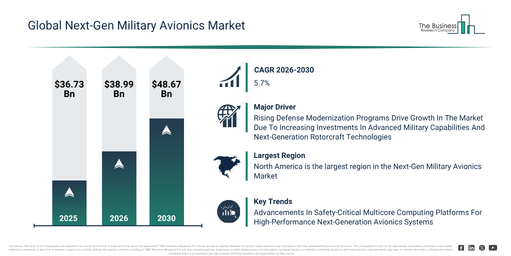
The next-gen military avionics market has shown robust expansion in recent years. This market is projected to expand from $36.73 billion in 2025 to $38.99 billion in 2026, exhibiting a compound annual growth rate (CAGR) of 6.1%. Historically, this growth has been driven by the ongoing modernization of military aircraft fleets, a heightened demand for sophisticated electronic warfare capabilities, the increasing integration of digital avionics systems, a greater necessity for enhanced aircraft situational awareness, and the broader deployment of advanced mission systems.
The next-gen military avionics market is projected to experience robust expansion over the coming years, anticipated to reach $48.67 billion in 2030, exhibiting a compound annual growth rate (CAGR) of 5.7%. This expansion during the forecast period is driven by several factors, including a heightened demand for mission-adaptive avionics architectures, a rising necessity for advanced onboard processing capabilities, an increasing call for integrated multi-mission avionics systems, a growing requirement for resilient and dependable avionics, and the expanding modernization efforts for next-generation military aircraft. Key trends anticipated over the same period encompass the rising adoption of advanced digital avionics architectures, a growing demand for high-performance onboard computing, the increasing integration of interconnected avionics systems, an escalating demand for modular and upgradeable avionics, and a heightened emphasis on improved avionics reliability and mission adaptability.
Get A Free Sample Report With In-Depth Market Insights:
Next-Gen Military Avionics Market Growth Drivers: What’s Behind The Acceleration?
The expansion of defense modernization initiatives is projected to boost the next-gen military avionics market. These programs involve governmental efforts to enhance military capacities with cutting-edge technologies, contemporary equipment, and refined defense systems, aiming to bolster national security and readiness for combat. The rise in these modernization programs stems from the escalating danger of advanced and asymmetric warfare, compelling governments to put resources into next-generation military technologies and defense systems. Defense modernization stimulates next-generation military avionics by channeling greater investments into sophisticated aircraft improvements and novel defense platforms. These platforms demand features such as integrated digital avionics, AI-powered mission systems, secure communication methods, advanced sensors, and electronic warfare functionalities. As an illustration, in March 2023, the Offices of the Under Secretaries of Defense (OUSD), a US-based defense authority, announced the FY 2024 Cybersecurity and Acquisition budget of $13.5 billion. This budget, aligned with the 2022 National Defense Strategy, is intended to reinforce current endeavors under the Digital Modernization Strategy and the Department of Defense Cyber Strategy framework. Consequently, the increasing defense modernization programs are propelling the expansion of the next-gen military avionics market.
Next-Gen Military Avionics Market Segmentation: How Does The Market Break Down By Category?
The next-gen military avionics market covered in this report is segmented –
1) By Component: Hardware, Software, Services
2) By Technology Architecture: Federated Avionics Architecture, Edge Computing In Avionics, Artificial Intelligence (AI)-Embedded Avionics, Cloud-Connected Avionics, Modular Open Systems Approach (MOSA), Digital Twin Enabled Systems, Other Technology Architectures
3) By Installation Type: Line Fit, Retrofit, Mid-Life Upgrade Programs
4) By Operational Capability: Network-Centric Warfare Avionics, Multi-Domain Operations Integration, Swarm Coordination System, Autonomous Navigation, Stealth-Optimized Avionics
Subsegments:
1) By Hardware: Flight Control Computers, Mission Computers, Avionics Processors, Cockpit Displays, Navigation Systems, Communication Systems, Sensor Systems, Radar Systems, Electronic Warfare Systems, Data Recorders, Power Management Units, Aircraft Network Hardware
2) By Software: Flight Management Software, Mission Planning Software, Navigation Software, Communication Management Software, Sensor Fusion Software, Electronic Warfare Software, Aircraft Health Monitoring Software, Cybersecurity Software, Data Analytics Software, Artificial Intelligence Software, Autonomous Flight Software, System Integration Software
3) By Services: Avionics System Integration, Flight Control Software Development, Mission System Integration, Navigation System Integration, Communication System Integration, Installation Services, Maintenance Services, Repair Services, Upgrade Services, Testing Services, Certification Services, Training Services
Next-Gen Military Avionics Market Trends: What’s Defining The Industry’s Next Phase?
Major companies in the next-gen military avionics market are concentrating on creating advanced systems, specifically safety-critical multicore computing platforms, to elevate processing performance, enable real-time parallel workload execution, bolster system reliability, and facilitate the certification of mission-critical avionics applications. These platforms represent sophisticated computing systems that leverage multiple processor cores to simultaneously execute critical avionics workloads, thereby enhancing processing speed, real-time performance, reliability, power efficiency, and safety certification for vital aerospace and defense applications. For example, in January 2026, Curtiss-Wright Corporation teamed up with Green Hills Software LLC to roll out a high-performance commercial off-the-shelf solution for safety-critical avionics systems. This solution integrates Curtiss-Wright’s V3-1222 3U VPX processing module, which features a 13th Gen Intel Core i7 processor, with Green Hills Software’s FACE-certified INTEGRITY-178 tuMP real-time operating system. The combined platform offers support for multicore processing, parallel workload execution, high-bandwidth data throughput, trusted computing, and multiple security levels, catering to applications such as tactical radar, flight-control computers, and sensor fusion. This collaboration is anticipated to reduce integration complexity, expedite deployment, and deliver dependable, high-performance computing capabilities for next-generation military avionics systems.
Next-Gen Military Avionics Market Competitive Analysis Of Leading Industry Participants
Major companies operating in the next-gen military avionics market are RTX Corporation, Lockheed Martin Corporation, Northrop Grumman Corporation, BAE Systems plc, General Dynamics Corporation, Thales Group, L3Harris Technologies, Honeywell International Inc., Safran, Leonardo S.p.A., Mitsubishi Electric Corporation, Elbit Systems Ltd., Saab AB, Israel Aerospace Industries Ltd., Moog Inc., Parker Hannifin Corporation, Aselsan Elektronik Sanayi ve Ticaret A.S., Bharat Electronics Limited, Curtiss-Wright Corporation, Hensoldt AG, General Atomics, Mercury Systems Inc., Diehl Stiftung & Co. KG
View The Full Next-Gen Military Avionics Market Report:
Next-Gen Military Avionics Market Geographic Distribution And Regional Opportunities
North America was the largest region in the next-gen military avionics market in 2025. Europe is expected to be the fastest-growing region in the forecast period. The regions covered in the next-gen military avionics market report are Asia-Pacific, South East Asia, Western Europe, Eastern Europe, North America, South America, Middle East, Africa.
Reach Out To Our Team:
The Business Research Company: https://www.thebusinessresearchcompany.com/
Americas: +1 310-496-7795
Asia: +44 7882 955267 & +91 8897263534
Europe: +44 7882 955267
Email us at: marketing@tbrc.info
Follow us on:
LinkedIn: https://in.linkedin.com/company/the-business-research-company
YouTube: https://www.youtube.com/channel/UC24_fI0rV8cR5DxlCpgmyFQ
Global Market Model: https://www.thebusinessresearchcompany.com/global-market-model

Wasay has over a decade of experience in market research, data modelling, and analytics, with prior experience at GlobalData and Decision Tree Consulting Services. At The Business Research Company , he leads research operations across syndicated studies, customized consulting engagements, and the Global Market Model platform. His professional experience includes supporting organizations such as Boston Consulting Group, KPMG, and Ernst & Young. Wasay holds a degree in Electronics and Communications Engineering, postgraduate management qualifications from International Management Institute Belgium and Indian School of Business and Entrepreneurship, and completed the Integrated Program in Business Analytics from Indian Institute of Management Indore.