
Built to provide research that’s more actionable and strategically valuable, The Business Research Company’s 2026 market reports include market attractiveness analysis, total addressable market sizing, company benchmarking matrices, interactive Excel dashboards, broader supply chain intelligence, emerging startup tracking, and in-depth product insights.
Tactical Unmanned Aerial Vehicle (UAV) Market Growth Potential: How Will Market Size Shift Through 2030?
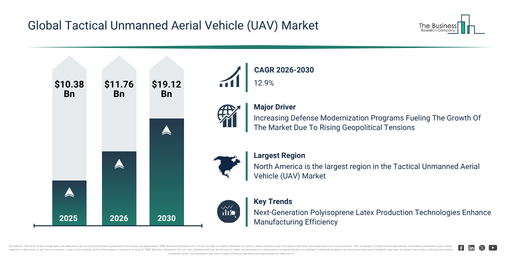
The tactical unmanned aerial vehicle (UAV) market has experienced substantial expansion in recent years. Its valuation is predicted to rise from $10.38 billion in 2025 to $11.76 billion in 2026, demonstrating a compound annual growth rate (CAGR) of 13.3%. This historical growth can be attributed to factors like increasing military expenditures, a heightened demand for battlefield intelligence, escalating border security requirements, the greater adoption of unmanned military systems, and the pressing need to reduce risks to military personnel.
The tactical unmanned aerial vehicle (uav) market size is anticipated to experience substantial growth over the next few years, projected to reach $19.12 billion in 2030 with a compound annual growth rate (CAGR) of 12.9%. This expansion during the forecast period can be attributed to several factors, including increasing demand for autonomous tactical operations, the progression of defense modernization programs, escalating geopolitical tensions, a rising need for persistent surveillance capabilities, and the growth of tactical UAV procurement programs. Moreover, major trends expected in this period encompass the increasing adoption of autonomous flight capabilities, advancements in real-time ISR technologies, the growing integration of advanced sensor systems, a rising demand for secure tactical communication systems, and the increased use of lightweight and high-endurance UAV platforms.
Get A Free Sample Report With In-Depth Market Insights:
Tactical Unmanned Aerial Vehicle (UAV) Market Growth Catalysts And Demand Drivers
Growing defense modernization initiatives are projected to fuel the expansion of the tactical unmanned aerial vehicle (UAV) market in the future. These programs represent government efforts focused on enhancing military capabilities by incorporating advanced technologies, better equipment, and improved defense infrastructure. The rise in defense modernization stems from escalating geopolitical tensions, with increasing security threats and military rivalry prompting governments to bolster their defense capacities and replace outdated military systems. Such modernization endeavors support tactical unmanned aerial vehicles by allowing armed forces to enhance their operational capacities through the incorporation of sophisticated unmanned systems, advanced sensors, and improved mission execution. For example, in March 2023, the Offices of the Under Secretaries of Defense (OUSD), a US-based Department of Defense entity, reported a fiscal year 2024 Cybersecurity and Acquisition budget of $13.5 billion, consistent with the 2022 National Defense Strategy, earmarked to reinforce current undertakings within the Digital Modernization Strategy and the Department of Defense cyber strategy framework. Consequently, the increasing defense modernization programs are propelling the growth of the tactical unmanned aerial vehicle (UAV) market.
Tactical Unmanned Aerial Vehicle (UAV) Market Segment Landscape: Which Areas Lead Development?
The tactical unmanned aerial vehicle (uav) market covered in this report is segmented –
1) By Type: Fixed Wing Tactical Unmanned Aerial Vehicles, Rotary Wing Tactical Unmanned Aerial Vehicles, Hybrid Vertical Takeoff And Landing Tactical Unmanned Aerial Vehicles, Other Types
2) By Range: Short Range Tactical Unmanned Aerial Vehicles, Medium Range Tactical Unmanned Aerial Vehicles, Extended Range Tactical Unmanned Aerial Vehicles
3) By Payload: Electro Optical And Infrared Payloads, Synthetic Aperture Radar Payloads, Electronic Intelligence Payloads, Communication Relay Payloads
4) By Application: Intelligence, Surveillance, And Reconnaissance, Target Acquisition, Border Security, Battlefield Monitoring, Communication Relay, Tactical Combat Support
5) By End User: Army, Navy, Air Force, Special Operations Forces, Other End Users
Subsegments:
1) By Fixed Wing Tactical Unmanned Aerial Vehicles: Conventional Fixed Wing, Hand Launched Fixed Wing, Catapult Launched Fixed Wing, Runway Launched Fixed Wing, Rail Launched Fixed Wing
2) By Rotary Wing Tactical Unmanned Aerial Vehicles: Single Rotor, Coaxial Rotor, Tandem Rotor, Multi Rotor, Intermeshing Rotor
3) By Hybrid Vertical Takeoff And Landing Tactical Unmanned Aerial Vehicles: Tilt Rotor, Tilt Wing, Lift Plus Cruise, Tail Sitting, Ducted Fan Hybrid
4) By Other Types: Flapping Wing, Powered Parachute, Airship, Convertible Wing, Experimental Configurations
Tactical Unmanned Aerial Vehicle (UAV) Market Trends Shaping Long-Term Demand
Major companies engaged in the tactical unmanned aerial vehicle (UAV) market are concentrating on developing innovative solutions, such as autonomous unmanned aerial systems, to bolster mission flexibility, operational efficiency, and advanced defense capabilities. Autonomous unmanned aerial systems are drone platforms that employ artificial intelligence, sensors, and automated flight technologies to carry out missions with minimal human supervision. For instance, in October 2025, Lockheed Martin Corporation, a US-based defense technology company, unveiled Nomad, a long-endurance, runway-independent drone, which is a vertical take-off and landing (VTOL) unmanned aerial system. This product is engineered to provide autonomous flight operations with extended endurance and flexible deployment from both land and sea environments. It offers benefits like runway-independent operation, scalable mission capabilities, and improved operational efficiency. The launch aims to assist customers in enhancing tactical mobility and mission readiness while supporting the advancement of autonomous defense technologies.
Tactical Unmanned Aerial Vehicle (UAV) Market Competitive Landscape: Who Leads The Industry?
Major companies operating in the tactical unmanned aerial vehicle (uav) market are Lockheed Martin Corporation, The Boeing Company, Northrop Grumman Corporation, BAE Systems plc, Thales Group, Safran SA, Leonardo S.p.A., General Atomics Aeronautical Systems Inc., Textron Inc., Israel Aerospace Industries Ltd., Saab AB, EDGE Group PJSC, Elbit Systems Ltd., Kratos Defense & Security Solutions Inc., Baykar Teknoloji Anonim Sirketi, AeroVironment Inc., Anduril Industries Inc., Quantum Systems GmbH, Skydio Inc., Parrot SA, Shield AI Inc., STM Savunma Teknolojileri Mühendislik ve Ticaret A.S., Schiebel Elektronische Geräte GmbH, ideaForge Technology Limited
View The Full Tactical Unmanned Aerial Vehicle (UAV) Market Report:
Tactical Unmanned Aerial Vehicle (UAV) Market Geographic Landscape: Which Region Leads Industry Growth?
North America was the largest region in the tactical unmanned aerial vehicle (UAV) market in 2025. Asia-Pacific is expected to be the fastest-growing region in the forecast period. The regions covered in the tactical unmanned aerial vehicle (uav) market report are Asia-Pacific, South East Asia, Western Europe, Eastern Europe, North America, South America, Middle East, Africa.
Reach Out To Our Team:
The Business Research Company: https://www.thebusinessresearchcompany.com/
Americas: +1 310-496-7795
Asia: +44 7882 955267 & +91 8897263534
Europe: +44 7882 955267
Email us at: marketing@tbrc.info
Follow us on:
LinkedIn: https://in.linkedin.com/company/the-business-research-company
YouTube: https://www.youtube.com/channel/UC24_fI0rV8cR5DxlCpgmyFQ
Global Market Model: https://www.thebusinessresearchcompany.com/global-market-model

Wasay has over a decade of experience in market research, data modelling, and analytics, with prior experience at GlobalData and Decision Tree Consulting Services. At The Business Research Company , he leads research operations across syndicated studies, customized consulting engagements, and the Global Market Model platform. His professional experience includes supporting organizations such as Boston Consulting Group, KPMG, and Ernst & Young. Wasay holds a degree in Electronics and Communications Engineering, postgraduate management qualifications from International Management Institute Belgium and Indian School of Business and Entrepreneurship, and completed the Integrated Program in Business Analytics from Indian Institute of Management Indore.