
Featuring market attractiveness scoring, total addressable market sizing, company benchmarking matrices, interactive Excel dashboards, deeper supply chain intelligence, emerging startup tracking, and granular product-level insights, The Business Research Company’s 2026 market reports are built to deliver research that is both more actionable and more strategically valuable.
#Artificial Intelligence (AI)-Driven Smart Grid Intrusion Detection Market CAGR Outlook And Future Development#_x000D_
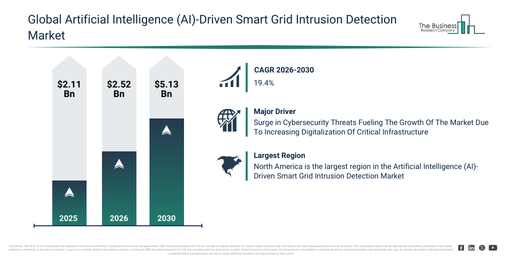
The artificial intelligence (AI)-driven smart grid intrusion detection market has experienced significant expansion in recent years. Projections indicate a rise from $2.11 billion in 2025 to $2.52 billion in 2026, demonstrating a compound annual growth rate (CAGR) of 19.4%. This historical growth can be attributed to the broadening of smart grid infrastructure, an increase in cyberattack incidents targeting utilities, the adoption of digital substations, enhanced connectivity of grid assets, and initial deployments of network security solutions._x000D_
_x000D_
The market for artificial intelligence (AI)-driven smart grid intrusion detection is projected to experience swift expansion over the coming years. This market is forecast to reach $5.13 billion by 2030, exhibiting a compound annual growth rate (CAGR) of 19.4%. Key factors contributing to this growth during the projection period include escalating investments in critical infrastructure cybersecurity, the increasing embrace of AI-driven threat intelligence, the proliferation of distributed energy resources, an intensifying regulatory emphasis on grid security compliance, and the expanded deployment of advanced analytics platforms. Significant trends anticipated throughout the forecast horizon encompass the wider implementation of AI-based intrusion detection platforms, the heightened integration of real-time grid monitoring systems, a rising uptake of cloud-based security analytics, the broadening of machine learning threat detection models, and a greater emphasis on grid cyber resilience._x000D_
_x000D_
#Get A Free Sample Report With In-Depth Market Insights:#_x000D_
_x000D_
#Artificial Intelligence (AI)-Driven Smart Grid Intrusion Detection Market Growth Factors: What’s Supporting Expansion?#_x000D_
The market for artificial intelligence (AI)-driven smart grid intrusion detection is projected to expand due to an increase in cybersecurity threats. Cybersecurity threats encompass malicious acts or occurrences designed to compromise the confidentiality, integrity, or availability of digital infrastructure, networks, or data. This rise in threats primarily stems from escalating digitalization, which broadens the potential attack surface by bringing more data, systems, and services online, thereby making them susceptible to malicious actors. AI-driven smart grid intrusion detection systems help counter these threats by continuously monitoring the grid, identifying anomalies in real-time, and preventing potential attacks before they can disrupt crucial infrastructure. For instance, in November 2023, according to the Australian Signals Directorate, an Australia-based government agency, during the 2022-23 financial year, nearly 94,000 cybercrime reports were submitted to report cyber, reflecting a 23% increase compared to the previous financial year, with an average of one report being received every 6 minutes. Consequently, the growing prevalence of cybersecurity threats is fueling the expansion of the artificial intelligence (AI)-driven smart grid intrusion detection market. The artificial intelligence (AI)-driven smart grid intrusion detection market is expected to grow as the number of connected devices increases. Connected devices are physical objects integrated with sensors, software, and other technologies that facilitate data collection and exchange via the internet. The proliferation of these devices is largely driven by advancements in communication technologies, enabling faster, more dependable, and seamless data transfer across networks. AI-driven smart grid intrusion detection systems assist connected devices by constantly monitoring network activity to detect and respond to potential security risks in real-time, thereby ensuring secure and reliable operation. For instance, in July 2025, the European Commission, a Belgium-based governing body, reported that in 2023, the number of installed IoT-connected devices was around 40 billion and is projected to grow to 49 billion by 2026, representing an annual growth rate of 7%. Hence, the rising count of connected devices is stimulating the growth of the artificial intelligence (AI)-driven smart grid intrusion detection market._x000D_
_x000D_
#Artificial Intelligence (AI)-Driven Smart Grid Intrusion Detection Market Segment Outlook: Which Categories Are Growing Fastest?#_x000D_
The artificial intelligence (ai)-driven smart grid intrusion detection market covered in this report is segmented – _x000D_
_x000D_
1) By Component: Software, Hardware, Services_x000D_
2) By Deployment Mode: On-Premises, Cloud_x000D_
3) By Security Type: Network Security, Endpoint Security, Application Security, Other Security Types_x000D_
4) By Application: Energy Management, Critical Infrastructure Protection, Fraud Detection, Other Applications_x000D_
5) By End-User: Utilities, Industrial, Commercial, Residential, Other End-Users_x000D_
_x000D_
Subsegments:_x000D_
1) By Software: Intrusion Detection Systems, Security Information And Event Management, Network Monitoring Tools, Data Analytics Platforms, Machine Learning Algorithms_x000D_
2) By Hardware: Sensors, Servers, Network Devices, Gateways, Storage Devices_x000D_
3) By Services: Consulting Services, Managed Security Services, Support And Maintenance, Training And Education, System Integration_x000D_
_x000D_
_x000D_
_x000D_
_x000D_
#Artificial Intelligence (AI)-Driven Smart Grid Intrusion Detection Market Leading Companies And Competitive Benchmarking#_x000D_
Major companies operating in the artificial intelligence (ai)-driven smart grid intrusion detection market are Siemens AG, Hitachi Energy Ltd, IBM Corporation, Cisco Systems Inc, ABB Ltd, BAE Systems plc, Palo Alto Networks Inc, Fortinet Inc, Splunk Inc, Trend Micro Incorporated, Tenable Holdings Inc, Honeywell International Inc, Darktrace plc, Dragos Inc, Nozomi Networks Inc, Claroty Ltd, Trellix, Schneider Electric SE, Mitsubishi Electric Corporation, ReliaQuest. _x000D_
_x000D_
#View The Full Artificial Intelligence (AI)-Driven Smart Grid Intrusion Detection Market Report:#_x000D_
_x000D_
#Artificial Intelligence (AI)-Driven Smart Grid Intrusion Detection Market Top Region By Revenue And Market Share#_x000D_
North America was the largest region in the artificial intelligence-driven smart grid intrusion detection market in 2025. Asia-Pacific is expected to be the fastest-growing region in the forecast period. The regions covered in the artificial intelligence (ai)-driven smart grid intrusion detection market report are Asia-Pacific, South East Asia, Western Europe, Eastern Europe, North America, South America, Middle East, Africa._x000D_
_x000D_
#Reach Out To Our Team:#_x000D_
_x000D_
The Business Research Company: https://www.thebusinessresearchcompany.com/_x000D_
Americas: +1 310-496-7795_x000D_
Asia: +44 7882 955267 & +91 8897263534_x000D_
Europe: +44 7882 955267_x000D_
Email us at: marketing@tbrc.info_x000D_
_x000D_
#Follow us on:#_x000D_
_x000D_
LinkedIn: https://in.linkedin.com/company/the-business-research-company_x000D_
YouTube: https://www.youtube.com/channel/UC24_fI0rV8cR5DxlCpgmyFQ_x000D_
Global Market Model: https://www.thebusinessresearchcompany.com/global-market-model

Wasay has over a decade of experience in market research, data modelling, and analytics, with prior experience at GlobalData and Decision Tree Consulting Services. At The Business Research Company , he leads research operations across syndicated studies, customized consulting engagements, and the Global Market Model platform. His professional experience includes supporting organizations such as Boston Consulting Group, KPMG, and Ernst & Young. Wasay holds a degree in Electronics and Communications Engineering, postgraduate management qualifications from International Management Institute Belgium and Indian School of Business and Entrepreneurship, and completed the Integrated Program in Business Analytics from Indian Institute of Management Indore.