
Delivering more actionable and strategically valuable research, The Business Research Company’s 2026 market reports feature market attractiveness analysis, total addressable market evaluation, company benchmarking matrices, interactive Excel dashboards, expanded supply chain intelligence, emerging startup coverage, and detailed product insights.
Artificial Intelligence (AI) In Nuclear Energy Market Forecast: What Market Value Is Expected By 2030?
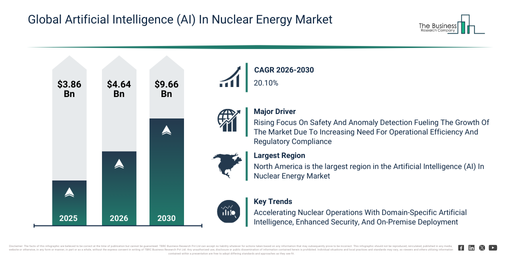
The artificial intelligence in nuclear energy market has experienced significant expansion in recent years. Its value is projected to increase from $3.86 billion in 2025 to $4.64 billion by 2026, demonstrating a compound annual growth rate (CAGR) of 20.4%. Historically, this growth can be ascribed to a heightened emphasis on enhancing nuclear safety through real-time observation, a rising demand for automation to minimize operational hazards in nuclear facilities, the increasing adoption of predictive maintenance to prevent equipment malfunctions, the growing deployment of digital systems for optimizing plant performance, and an escalating need for efficient radiation detection and analysis.
The artificial intelligence in nuclear energy market is projected to experience rapid expansion in the coming years. This market is forecast to reach $9.66 billion by 2030, driven by a compound annual growth rate (CAGR) of 20.1%. The expansion during this period stems from several factors, including increasing capital allocation for updating nuclear facilities with digital innovations, a heightened demand for precise monitoring systems in advanced reactors, wider acceptance of AI-powered simulation instruments for optimizing the fuel cycle, greater dependence on self-governing inspection apparatus to boost operational performance, and augmented governmental backing for secure and sophisticated nuclear power initiatives. Key developments anticipated in the forecast timeframe encompass improvements in AI-driven digital twin technology for reactor simulation, breakthroughs in self-operating robotic inspection devices for dangerous settings, the incorporation of machine learning algorithms to refine radiation prediction, progress in smart control mechanisms for small modular reactors, and the implementation of AI-enhanced cybersecurity protocols to safeguard nuclear installations.
Download A Free Sample Report For Comprehensive Market Insights:
Artificial Intelligence (AI) In Nuclear Energy Market Development Factors: Which Trends Are Supporting Demand?
An increasing emphasis on safety and anomaly detection is anticipated to fuel the expansion of the artificial intelligence (AI) in nuclear energy market in the future. This involves utilizing sophisticated technologies to pinpoint unusual patterns, equipment failures, or operational irregularities that might signal potential safety hazards within nuclear facilities. This heightened attention stems from the necessity for real-time monitoring and proactive risk mitigation to avert equipment malfunctions, radiation escapes, or unscheduled outages. Artificial intelligence (AI) in nuclear energy improves safety and anomaly detection by processing extensive operational data instantly, enabling the prediction of potential problems prior to their manifestation, thereby guaranteeing greater reliability and adherence to safety protocols. For example, in July 2024, Microsoft, a US-based technology and cybersecurity company, reported processing 78 trillion security signals daily from its cloud, endpoints, software tools, and partner ecosystem in 2024, an increase from 65 trillion signals per day in 2023, aimed at safeguarding against digital threats and cybercriminal actions. Consequently, the intensified focus on safety and anomaly detection is propelling the expansion of the artificial intelligence (AI) in nuclear energy market.
Artificial Intelligence (AI) In Nuclear Energy Market Segmentation: How Is The Market Structured Across Key Categories?
The artificial intelligence (AI) in nuclear energy market covered in this report is segmented –
1) By Component: Software, Hardware, Services, Data, Application Programming Interfaces and Middleware
2) By Deployment Mode: Cloud-Based, On-Premises
3) By Technology: Machine Learning, Deep Learning, Computer Vision, Natural Language Processing, Robotics and Automation, Other Technologies
4) By Application: Asset Management and Predictive Maintenance, Reactor Operation and Control, Fuel Management and Waste Reduction, Safety and Security Monitoring, Radiation Monitoring and Dose Management, Supply Chain and Project Management, Other Applications
5) By End User: Nuclear Power Utilities or Operators, Engineering, Procurement and Construction (EPC) Firms, Plant Original Equipment Manufacturer and Vendors, Regulatory Bodies and Safety Agencies, Research Institutions and National Labs, Service Providers and Third-Party Inspectors
Subsegments:
1) By Software: AI Modeling Software, Predictive Maintenance Software, Reactor Simulation Software, Data Analytics and Visualization Tools, Safety Monitoring Software, Workflow Automation Platforms, Cybersecurity Software for Nuclear Systems
2) By Hardware: Sensors (Temperature, Pressure, Radiation, Vibration), Edge Devices and Controllers, AI Chips and Processors, Robotics Hardware, Monitoring and Inspection Devices, Industrial Servers and Storage Units
3) By Services: Consulting Services, System Integration Services, Predictive Maintenance Services, Training and Support Services, Managed AI Services, Installation and Commissioning
4) By Data: Operational Data, Environmental and Radiation Data, Safety and Compliance Data, Predictive Maintenance Datasets, Historical Reactor Performance Data, Real-Time Monitoring Data Streams
5) By APIs and Middleware: Integration APIs, Data Exchange APIs, Machine-Learning Model APIs, Security and Authentication Middleware, Cloud Connectivity Middleware, Workflow Orchestration Middleware
Artificial Intelligence (AI) In Nuclear Energy Market Trends: What Is Shaping Future Industry Growth?
Major companies active in the artificial intelligence (AI) in nuclear energy market are prioritizing cutting-edge technologies, such as nuclear-focused large language models, to streamline technical workflows, enhance knowledge discovery, and improve operational decision-making in highly regulated environments. Nuclear-focused large language models denote the capability of artificial intelligence (AI) systems to interpret, process, and generate content specific to nuclear power operations, including regulatory, technical, design, and operational documentation. For instance, in May 2024, NuclearN.ai, a US-based nuclear artificial intelligence (AI) company, unveiled SPARK-mini, the first openly accessible large language model specifically trained for the nuclear power domain. The model is deployable on-premise, ensuring secure access for researchers, practitioners, and nuclear service providers with strict data security requirements. SPARK-mini powers NuclearN’s AtomAssist platform, enabling capabilities like information discovery, questions and answers, chat functions, and document preparation, having been trained on millions of regulatory and technical records sourced from the Nuclear Regulatory Commission’s Automated Dynamic Analysis of Mechanical Systems (ADAMS) Public Library. This specialized domain training allows SPARK-mini to accurately interpret complex nuclear terminology and deliver actionable insights for nuclear operators and service providers.
Artificial Intelligence (AI) In Nuclear Energy Market Competitive Landscape And Leading Companies
Major companies operating in the artificial intelligence (AI) in nuclear energy market are Rosatom State Atomic Energy Corporation, Palantir Technologies Inc., Cameco Corporation, Hitachi Ltd., Veolia Nuclear Solutions, Honeywell International Inc., Siemens Energy AG, GE Vernova Inc., Asea Brown Boveri Ltd., Mitsubishi Heavy Industries Ltd., Toshiba Corporation, Jacobs Solutions Inc., Framatome SAS, BWX Technologies Inc., Mirion Technologies Inc., Assystem S.A., Kinectrics Inc., TerraPower LLC., X-energy LLC., NuScale Power Corporation
Access The Complete Artificial Intelligence (AI) In Nuclear Energy Market Report:
Artificial Intelligence (AI) In Nuclear Energy Market Regional Analysis And Leading Geography
North America was the largest region in the artificial intelligence in nuclear energy market in 2025. Asia-Pacific is expected to be the fastest-growing region in the forecast period. The regions covered in the artificial intelligence (AI) in nuclear energy market report are Asia-Pacific, South East Asia, Western Europe, Eastern Europe, North America, South America, Middle East, Africa.
Get in touch with us:
The Business Research Company: https://www.thebusinessresearchcompany.com/
Americas: +1 310-496-7795
Asia: +44 7882 955267 & +91 8897263534
Europe: +44 7882 955267
Email us at: marketing@tbrc.info
Follow us on:
LinkedIn: https://in.linkedin.com/company/the-business-research-company
YouTube: https://www.youtube.com/channel/UC24_fI0rV8cR5DxlCpgmyFQ
Global Market Model: https://www.thebusinessresearchcompany.com/global-market-model

Wasay has over a decade of experience in market research, data modelling, and analytics, with prior experience at GlobalData and Decision Tree Consulting Services. At The Business Research Company , he leads research operations across syndicated studies, customized consulting engagements, and the Global Market Model platform. His professional experience includes supporting organizations such as Boston Consulting Group, KPMG, and Ernst & Young. Wasay holds a degree in Electronics and Communications Engineering, postgraduate management qualifications from International Management Institute Belgium and Indian School of Business and Entrepreneurship, and completed the Integrated Program in Business Analytics from Indian Institute of Management Indore.