Built to provide research that’s more actionable and strategically valuable, The Business Research Company’s 2026 market reports include market attractiveness analysis, total addressable market sizing, company benchmarking matrices, interactive Excel dashboards, broader supply chain intelligence, emerging startup tracking, and in-depth product insights.
Biomass Electricity Market Revenue Growth On Track For A 5.8% CAGR Through 2030
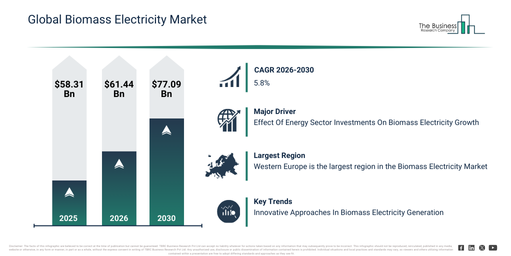
The biomass electricity market has experienced substantial growth in recent years. It is projected to expand from $58.31 billion in 2025 to $61.44 billion in 2026, at a compound annual growth rate (CAGR) of 5.4%. This historical expansion can be attributed to factors such as government incentives for renewable electricity, the adoption of biomass combustion technologies, the development of energy crop cultivation, an increase in waste-to-energy projects, and growing awareness of fossil fuel alternatives.
The biomass electricity market is anticipated to show significant expansion in the upcoming years. It is projected to reach $77.09 billion in 2030, at a compound annual growth rate (CAGR) of 5.8%. This growth during the forecast period is driven by advancements in gasification and co-firing technologies, the expansion of industrial-scale biomass electricity plants, integration with smart grids, the growth of municipal solid waste management programs, and increasing demand for sustainable biofuels. Noteworthy trends for the forecast period include the increasing adoption of solid biomass feedstock for electricity generation, a rise in the utilization of biogas and anaerobic digestion technologies, the expansion of municipal solid waste-to-energy projects, the integration of liquid biomass for biofuel-based power generation, and a growing focus on combined heat and power (chp) systems.
Get A Free Sample Report With In-Depth Market Insights:
Biomass Electricity Market Development Factors: What’s Supporting Demand?
The increasing financial commitment within the energy sector is anticipated to propel the growth of the biomass electricity market in the future. This sector encompasses the segment of the economy dedicated to the production, generation, distribution, and consumption of diverse energy forms. Enhanced investment in the energy sector supports biomass energy by fostering the establishment and expansion of sustainable biomass projects, contributing to greater renewable energy output and decreased dependence on fossil fuels. For instance, in June 2025, the International Energy Agency, a France-based intergovernmental organization, projected that global investment in solar energy, covering both utility-scale and rooftop installations, would reach $450 billion in 2025. Consequently, the rising investment in the energy sector is driving the expansion of the biomass electricity market.
Biomass Electricity Market Segmentation And Category Overview
The biomass electricity market covered in this report is segmented –
1) By Feedstock: Solid Biomass, Biogas, Municipal Solid Waste
2) By Technology: Anaerobic Digestion, Combustion, Co-Firing, Gasification, Landfill Gas
3) By End-User: Industrial Sector, Government Sector, Other End Users
Subsegments:
1) By Solid Biomass: Wood Pellets, Agricultural Residues, Wood Chips, Energy Crops
2) By Biogas: Landfill Gas, Wastewater Treatment Biogas
3) By Municipal Solid Waste: Organic Waste, Non-recyclable Residuals
Biomass Electricity Market Transformation Trends: What Innovations Are Driving Change?
Major companies operating within the biomass electricity market are concentrating on advancing innovative power generation technologies, including biogas-based combined heat and power (CHP) systems. This effort seeks to boost energy efficiency, lessen waste, and support sustainable energy objectives. Biogas CHP systems facilitate the production of electricity and heat from organic waste via anaerobic digestion, thereby enabling companies to convert agricultural and food waste into renewable energy and feed surplus electricity to the grid. For instance, in August 2023, HoSt Group Japan-based company unveiled its 530 kWe ‘Sagamihara Biogas Power’ biogas plant. This plant annually yields 1.9 million Nm3 biogas from pig feed waste and food waste using anaerobic digestion. The facility utilizes a combined heat and power (CHP) system to create electricity and heat, which is then supplied to the grid and employed for the plant’s operational needs.
Biomass Electricity Market Company Landscape And Competitive Strategy
Major companies operating in the biomass electricity market are Drax Group, Engie, EDF, RWE, Ørsted A/S, Ameresco Inc, CEZ Group, Xcel Energy Inc, Salzburg AG, Vattenfall AB, Dominion Energy, Acciona SA, Fortum Oyj, E.ON (biomass electricity division), Statkraft, NextEra Energy (biomass portfolio), China Energy Investment Corporation, Japan Renewable Energy Company (RENOVA Inc), San Carlos BioPower, Oy Alholmens Kraft Ab
View The Full Biomass Electricity Market Report:
Biomass Electricity Market Largest Region: Which Geography Holds The Highest Market Share?
Western Europe was the largest region in the biomass electricity market in 2025. Asia-Pacific was the second-largest region in the global biomass market analysis. The regions covered in the biomass electricity market report are Asia-Pacific, South East Asia, Western Europe, Eastern Europe, North America, South America, Middle East, Africa.
Reach Out To Our Team:
The Business Research Company: https://www.thebusinessresearchcompany.com/
Americas: +1 310-496-7795
Asia: +44 7882 955267 & +91 8897263534
Europe: +44 7882 955267
Email us at: marketing@tbrc.info
Follow us on:
LinkedIn: https://in.linkedin.com/company/the-business-research-company
YouTube: https://www.youtube.com/channel/UC24_fI0rV8cR5DxlCpgmyFQ
Global Market Model: https://www.thebusinessresearchcompany.com/global-market-model

Wasay has over a decade of experience in market research, data modelling, and analytics, with prior experience at GlobalData and Decision Tree Consulting Services. At The Business Research Company , he leads research operations across syndicated studies, customized consulting engagements, and the Global Market Model platform. His professional experience includes supporting organizations such as Boston Consulting Group, KPMG, and Ernst & Young. Wasay holds a degree in Electronics and Communications Engineering, postgraduate management qualifications from International Management Institute Belgium and Indian School of Business and Entrepreneurship, and completed the Integrated Program in Business Analytics from Indian Institute of Management Indore.