Backed by market attractiveness analysis, total addressable market sizing, company benchmarking matrices, interactive Excel dashboards, wider supply chain intelligence, emerging startup coverage, and detailed product-level insights, The Business Research Company’s 2026 market reports are designed to offer research that is more actionable and strategically valuable than ever.
Compressed Bio-Gas Market Size And Revenue Outlook Through 2030
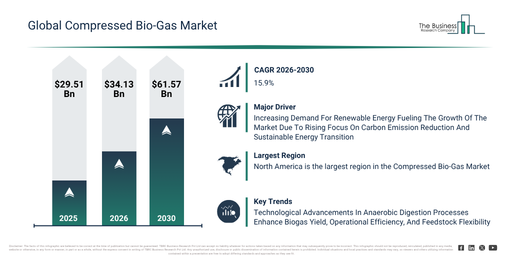
The compressed bio-gas market has experienced substantial growth in recent years. It is forecast to increase from $29.51 billion in 2025 to $34.13 billion in 2026, exhibiting a compound annual growth rate (CAGR) of 15.7%. Historically, this expansion has been driven by several factors, including the greater use of organic waste for renewable energy production, enhanced government backing for clean fuel adoption, a surge in demand for alternative natural gas substitutes, the development of waste management and recycling infrastructure, and a heightened focus on minimizing landfill waste emissions.
The compressed bio-gas market is set for significant expansion over the next few years, with its size projected to reach $61.57 billion by 2030, growing at a compound annual growth rate (CAGR) of 15.9%. This anticipated growth during the forecast period is driven by the increasing adoption of compressed biogas in commercial transportation fleets, rising investments in advanced biogas upgrading technologies, the growing integration of compressed biogas into city gas distribution networks, the expansion of decentralized renewable energy production systems, and the increasing demand for low carbon industrial fuel alternatives. Furthermore, major trends expected in this period include a greater embrace of agricultural waste-based compressed biogas production, surging demand for renewable vehicle fuel alternatives, increasing investment in municipal organic waste-to-biogas conversion facilities, the expansion of industrial-scale anaerobic digestion infrastructure, and enhanced use of upgraded biomethane in residential cooking applications.
Get A Free Sample Report With In-Depth Market Insights:
Compressed Bio-Gas Market Growth Factors Behind Sustained Expansion
The increasing demand for renewable energy is projected to fuel the growth of the compressed biogas market in the future. Renewable energy sources are derived from continuous natural processes like sunlight, wind, and biomass, which are constantly replenished and have a minimal environmental footprint. The rise in renewable energy adoption is attributed to decreasing technology costs, as solar panels and wind turbines have become more affordable due to large-scale production and efficiency gains, accelerating their global uptake. Compressed biogas supports renewable energy initiatives by converting organic waste into clean fuel, thereby improving energy security, reducing greenhouse gas emissions, and promoting effective waste management. For instance, in January 2024, the U.S. Energy Information Administration, a US-based federal agency responsible for collecting and analyzing energy information, indicated that planned solar initiatives are expected to increase the electric power sector’s solar capacity by 38%, climbing from 95 gigawatts (GW) at the end of 2023 to 131 GW by the close of 2024. Therefore, the expanding demand for renewable energy is a key driver for the growth of the compressed bio-gas market.
Compressed Bio-Gas Market Segment Analysis Spotlighting Growth Areas
The compressed bio-gas market covered in this report is segmented –
1) By Feedstock: Agricultural Residues, Animal Manure, Municipal Solid Waste, Industrial Waste, Sewage Sludge
2) By Technology: Water Scrubbing, Pressure Swing Adsorption, Membrane Separation, Chemical Absorption, Other Technologies
3) By Distribution Channel: Direct Supply, Retail Distribution
4) By Application: Vehicle Fuel, Electricity And Heat Generation, Steam Generation, Hot Water Heating, Cooking Gas, Other Applications
5) By End Users: Transportation Sector, Power Generation Companies, Industrial And Manufacturing Facilities, Municipal And Waste Management Authorities, Agriculture Sector, Residential
Subsegments:
1) By Agricultural Residues: Crop Straw, Rice Husk, Corn Stover, Sugarcane Bagasse, Wheat Straw
2) By Animal Manure: Cattle Manure, Poultry Litter, Swine Manure, Sheep Manure, Goat Manure
3) By Municipal Solid Waste: Food Waste, Organic Household Waste, Yard Waste, Market Waste, Commercial Organic Waste
4) By Industrial Waste: Food Processing Waste, Dairy Waste, Distillery Waste, Brewery Waste, Pulp And Paper Waste
5) By Sewage Sludge: Primary Sludge, Secondary Sludge, Tertiary Sludge, Digested Sludge, Undigested Sludge
Compressed Bio-Gas Market Industry Trends Fueling Future Revenue Growth
Leading companies operating in the compressed biogas market are prioritizing technological advancements in anaerobic digestion processes, such as high-capacity membrane separation and carbon recovery systems. These innovations aim to boost gas purity, improve energy efficiency, and optimize overall biogas yield. High-capacity membrane separation is a sophisticated gas purification technology that employs selective membranes to efficiently separate methane from impurities like carbon dioxide, hydrogen sulfide, and moisture, thereby enabling higher throughput and enhanced biogas upgrading efficiency. For instance, in March 2025, Bright Renewables, a Netherlands-based high-tech supplier of renewable gas systems, introduced the PurePac Supra. This product was launched to enhance high-capacity biogas upgrading efficiency through advanced membrane separation, delivering higher methane purity and optimized carbon dioxide recovery. The modular PurePac Supra system is specifically designed for high-flow industrial projects, leveraging a proprietary membrane configuration to achieve a methane recovery rate exceeding 99.5%. Its unique 11-inch design permits a significantly more compact plant footprint by reducing the total number of membrane modules required, while concurrently maintaining a processing capacity of approximately 20,000 $Nm^3/hr$ of biogas.
Compressed Bio-Gas Market Competitive Analysis Of Leading Industry Participants
Major companies operating in the compressed bio-gas market are Verbio Vereinigte BioEnergie AG, Clean Energy Fuels Corp., Sistema.bio, OPAL Fuels Inc, EnviTec Biogas AG, Bright Renewables, Greenlane Renewables Inc., ETW Energietechnik GmbH, Agraferm Technologies AG, Bioenergy DevCo
View The Full Compressed Bio-Gas Market Report:
Compressed Bio-Gas Market Geographic Spread And Regional Opportunities
North America was the largest region in the compressed biogas market in 2025. Asia-Pacific is expected to be the fastest-growing region in the forecast period. The regions covered in the compressed bio-gas market report are Asia-Pacific, South East Asia, Western Europe, Eastern Europe, North America, South America, Middle East, Africa.
Reach Out To Our Team:
The Business Research Company: https://www.thebusinessresearchcompany.com/
Americas: +1 310-496-7795
Asia: +44 7882 955267 & +91 8897263534
Europe: +44 7882 955267
Email us at: marketing@tbrc.info
Follow us on:
LinkedIn: https://in.linkedin.com/company/the-business-research-company
YouTube: https://www.youtube.com/channel/UC24_fI0rV8cR5DxlCpgmyFQ
Global Market Model: https://www.thebusinessresearchcompany.com/global-market-model

Wasay has over a decade of experience in market research, data modelling, and analytics, with prior experience at GlobalData and Decision Tree Consulting Services. At The Business Research Company , he leads research operations across syndicated studies, customized consulting engagements, and the Global Market Model platform. His professional experience includes supporting organizations such as Boston Consulting Group, KPMG, and Ernst & Young. Wasay holds a degree in Electronics and Communications Engineering, postgraduate management qualifications from International Management Institute Belgium and Indian School of Business and Entrepreneurship, and completed the Integrated Program in Business Analytics from Indian Institute of Management Indore.