Built to provide research that’s more actionable and strategically valuable, The Business Research Company’s 2026 market reports include market attractiveness analysis, total addressable market sizing, company benchmarking matrices, interactive Excel dashboards, broader supply chain intelligence, emerging startup tracking, and in-depth product insights.
Distributed Energy Resources Management System (DERMS) Market Poised To Hit $2.2 Billion By 2030 With A 14.5% CAGR
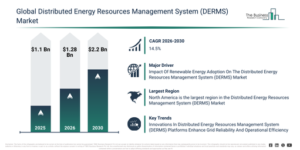
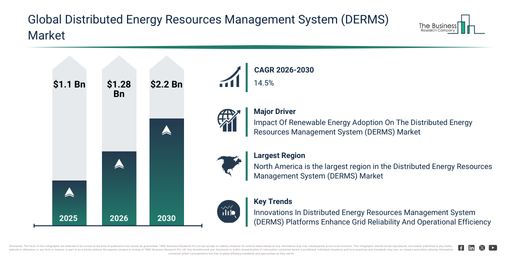
The market for distributed energy resources management systems (derms) has expanded rapidly over recent years. Its value is expected to rise from $1.1 billion in 2025 to $1.28 billion in 2026, reflecting a compound annual growth rate (CAGR) of 16.3%. The expansion observed historically can be attributed to several factors, including the increasing number of renewable energy installations, the wider adoption of solar and wind energy systems, the initial rollout of energy storage solutions, the growing need for grid reliability and resilience, and the early stages of energy management software development.
The distributed energy resources management system (derms) market size is anticipated to expand significantly in the coming years. It is forecast to grow to $2.2 billion in 2030, achieving a compound annual growth rate (CAGR) of 14.5%. The projected increase can be ascribed to several factors, including the growth of electric vehicle (EV) charging infrastructure, the integration of smart grids with DERs, the adoption of AI-based predictive analytics, rising investments in energy trading platforms, and a strong commitment to carbon reduction and sustainability initiatives. Notable trends during this period involve the integration of virtual power plants with DERs, advanced approaches to load forecasting and demand response management, real-time energy monitoring and reporting, optimized scheduling of distributed energy resources, and the application of predictive analytics for energy consumption and efficiency.
Get A Free Sample Report With In-Depth Market Insights:
Distributed Energy Resources Management System (DERMS) Market Growth Drivers: What’s Behind The Acceleration?
The expanding integration of renewable energy sources is projected to drive the future expansion of the distributed energy resources management system (DERMS) market. These energy sources are natural processes or origins that continuously regenerate and can be harnessed to produce electricity or heat, with examples encompassing solar and wind power. Their widespread uptake is notably increasing, driven by factors such as environmental concerns, competitive costs, supportive policies, technological innovations, and public desire for sustainable energy options. Distributed energy resources management systems (DERMS) play a crucial role by optimizing the integration and management of diverse energy sources, including wind turbines and solar panels, thereby enhancing grid reliability and efficiency, and facilitating renewable energy generation. As an illustration, data from the U.S. Energy Information Administration, a US-based statistical and analytical agency, revealed in January 2024 that solar power generation is set to expand by 75%, moving from 163 billion kilowatt-hours (kWh) in 2023 to 286 billion kWh by 2025. Concurrently, wind power generation is anticipated to rise by 11%, from 430 billion kWh in 2023 to 476 billion kWh in 2025. Consequently, the growing integration of renewable energy sources is a key driver for the distributed energy resources management system (DERMS) market.
Distributed Energy Resources Management System (DERMS) Market Segment Trends And Revenue Contributors
The distributed energy resources management system (derms) market covered in this report is segmented –
1) By Software: Virtual Power Plant (VPP), Management And Control, Analytics
2) By Application: Solar, Energy Storage, Wind, Electric Vehicle (EV) Charging Stations
3) By End-User: Residential, Commercial, Industrial And Utilities
Subsegments:
1) By Virtual Power Plant (VPP): Aggregation And Optimization Software, Demand Response Management Software, Energy Trading And Market Integration Software
2) By Management And Control: Grid Management Software, Load Forecasting And Demand-Side Management Software, Asset And Resource Scheduling Software
3) By Analytics: Predictive Analytics Software, Real-Time Monitoring And Reporting Software, Energy Consumption And Efficiency Analytics Software
Distributed Energy Resources Management System (DERMS) Market Trends: What’s Defining The Industry’s Next Phase?
Leading firms within the Distributed Energy Resources Management System (DERMS) market are concentrating on creating novel solutions, including contemporary software and IoT platforms, for real-time monitoring, control, and optimization of distributed energy resources, thereby boosting grid reliability and resilience. These modern software and IoT platforms represent integrated digital systems utilizing linked sensors, devices, and sophisticated analytics to gather data instantaneously, automate controls, and optimize operations throughout various assets and networks. As an example, in November 2024, Parsons Corporation, an engineering and technology solutions provider based in the US, introduced an updated version of its DERMS platform. This platform is engineered to streamline DER scheduling, incorporate advanced metering infrastructure (AMI), and facilitate utility business models like virtual power plants (VPPs), leading to more robust and digitally administered energy grids.
Distributed Energy Resources Management System (DERMS) Market Key Players Shaping Industry Direction
Major companies operating in the distributed energy resources management system (derms) market are Enel S.p.A., Siemens AG, General Electric Company, Oracle Corporation, Mitsubishi Electric Corporation, Schneider Electric SE, ABB Ltd., Generac, Engie SA, Itron Inc., Open Access Technology International Inc., Uplight Inc., AutoGrid Systems, Opus One Solutions, EnergyHub, Spirae LLC, Kitu Systems, PXiSE Energy Solutions, Connected Energy, Blue Pillar
View The Full Distributed Energy Resources Management System (DERMS) Market Report:
Distributed Energy Resources Management System (DERMS) Market Regional Analysis: Which Geography Leads On Revenue?
North America was the largest region in the distributed energy resources management system (DERMS) market in 2025. Asia-Pacific is expected to be the fastest-growing region in the forecast period. The regions covered in the distributed energy resources management system (derms) market report are Asia-Pacific, South East Asia, Western Europe, Eastern Europe, North America, South America, Middle East, Africa.
Reach Out To Our Team:
The Business Research Company: https://www.thebusinessresearchcompany.com/
Americas: +1 310-496-7795
Asia: +44 7882 955267 & +91 8897263534
Europe: +44 7882 955267
Email us at: marketing@tbrc.info
Follow us on:
LinkedIn: https://in.linkedin.com/company/the-business-research-company
YouTube: https://www.youtube.com/channel/UC24_fI0rV8cR5DxlCpgmyFQ
Global Market Model: https://www.thebusinessresearchcompany.com/global-market-model

Wasay has over a decade of experience in market research, data modelling, and analytics, with prior experience at GlobalData and Decision Tree Consulting Services. At The Business Research Company , he leads research operations across syndicated studies, customized consulting engagements, and the Global Market Model platform. His professional experience includes supporting organizations such as Boston Consulting Group, KPMG, and Ernst & Young. Wasay holds a degree in Electronics and Communications Engineering, postgraduate management qualifications from International Management Institute Belgium and Indian School of Business and Entrepreneurship, and completed the Integrated Program in Business Analytics from Indian Institute of Management Indore.