Featuring market attractiveness scoring, total addressable market sizing, company benchmarking matrices, interactive Excel dashboards, deeper supply chain intelligence, emerging startup tracking, and granular product-level insights, The Business Research Company’s 2026 market reports are built to deliver research that is both more actionable and more strategically valuable.
Electric-Bus Depot Charger Energy Management Market Growth Potential: How Will Market Size Shift Through 2030?
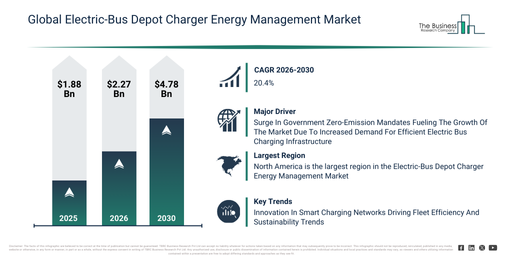
The size of the electric-bus depot charger energy management market has expanded significantly in recent years. The market is expected to increase from $1.88 billion in 2025 to $2.27 billion in 2026, achieving a compound annual growth rate (CAGR) of 20.7%. Factors contributing to its growth during previous periods include the expansion of electric bus fleets, the increase in public transit electrification programs, the rollout of depot charging infrastructure, the adoption of centralized fleet energy management, and the integration of smart grid technologies.
The electric-bus depot charger energy management market is poised for significant expansion in the coming years, with its size projected to reach $4.78 billion in 2030, demonstrating a compound annual growth rate (CAGR) of 20.4%. This projected expansion during the forecast period is driven by factors such as increased investments in zero-emission public transportation, a surging demand for high-capacity depot charging solutions, the wider expansion of vehicle-to-grid integration, a heightened emphasis on optimizing energy costs, and the greater incorporation of renewable-powered depots. Key trends expected within the same period encompass a wider embrace of smart bus depot charging systems, the escalating utilization of AI-based charging scheduling, an expanding integration of energy storage for efficient peak management, the proliferation of high-power DC charging infrastructure, and a sharpened focus on grid-responsive charging strategies.
Get A Free Sample Report With In-Depth Market Insights:
Electric-Bus Depot Charger Energy Management Market Demand Drivers: What’s Powering Industry Growth?
The anticipated expansion of the electric-bus depot charger energy management market is linked to a rise in government efforts and regulations promoting zero-emission transportation. These governmental initiatives and mandates represent official policies and schemes designed to encourage the uptake of electric and environmentally friendly vehicles, aiming to cut down carbon emissions and meet sustainability objectives. Such initiatives are expanding in scope as part of efforts to decrease greenhouse gas emissions and address climate change. Electric bus depot charger energy management supports these zero-emission mandates by enhancing charging efficiency and facilitating the broader adoption of electric buses. An example of this is the Biden-Harris Administration’s establishment of the first national target for a zero-emission freight sector in April 2024, as per an official Biden White House release. This endeavor is consistent with President Biden’s objectives for a carbon-free power sector by 2035 and net-zero transport emissions by 2050, further supporting aims for 30% zero-emission medium- and heavy-duty vehicle sales by 2030 and complete adoption by 2040. Consequently, the rising number of government initiatives and mandates for zero-emission transportation is anticipated to stimulate growth in the electric bus depot charger energy management market.
Electric-Bus Depot Charger Energy Management Market Segment Trends And Revenue Contributors
The electric-bus depot charger energy management market covered in this report is segmented –
1) By Energy Management System: On-Site Energy Storage, Smart Charging, Load Management
2) By Charger Type: Direct Current (DC) Chargers, Wireless Chargers
3) By Power Output: Up To 50 Kilowatt, 51–150 Kilowatt, Above 150 Kilowatt
4) By Application: Public Transit, Private Fleet, School Buses, Other Applications
5) By End User: Municipalities, Private Operators, Transit Agencies, Other End-Users
Subsegments:
1) By On-Site Energy Storage: Battery Energy Storage Systems (BESS), Supercapacitors for Peak Shaving, Hybrid Storage Systems (Battery + Solar/Other Sources), Vehicle-to-Grid (V2G) Enabled Storage
2) By Smart Charging: AI-Based Charging Scheduling Platforms, Mobile App-Based User-Controlled Charging, Dynamic Pricing / Time-of-Use Optimization, Predictive Charging Based on Fleet Operations
3) By Load Management: Depot-Level Load Balancing Systems, Grid-Responsive Charging Control, Peak Demand Management Solutions, Integrated Renewable Energy Load Management
Electric-Bus Depot Charger Energy Management Market Innovation Trends: What Developments Are Reshaping The Industry?
Leading firms within the electric-bus depot charger energy management market are developing sophisticated integrated EV charging network solutions, aiming to boost charging effectiveness, reduce energy expenditures, and optimize fleet operations. These advanced integrated EV charging network solutions are systems that combine intelligent energy management, continuous real-time monitoring, strategic smart scheduling, and grid optimization to efficiently charge electric vehicles while simultaneously elevating operational efficiency and promoting sustainability. For instance, in August 2025, Shell, an energy company headquartered in the UK, introduced an integrated EV charging network for heavy-duty fleets across Europe. This network supports electric buses and trucks through depot charging solutions equipped with intelligent energy management, ongoing real-time monitoring, and grid-optimized charging, all intended to enhance operational efficiency and sustainability. Additionally, the network offers real-time analytics dashboards and AI-driven charge scheduling to ensure high operational uptime and efficient energy utilization throughout various depots.
Electric-Bus Depot Charger Energy Management Market Competitive Landscape: Who Leads The Industry?
Major companies operating in the electric-bus depot charger energy management market are Shell plc, ENGIE SA, Enel S.p.A., BYD Company Limited, Siemens AG, Schneider Electric SE, ABB Ltd, Delta Electronics Inc., Tata Power Company Limited, ChargePoint Holdings Inc., Proterra Inc., Kempower Oyj, Ampcontrol Pty. Ltd., Efacec Power Solutions S.G.P.S., S.A., Tritium DCFC Limited, EVgo Inc., Blink Charging Co., IVU Traffic Technologies AG, The Mobility House GmbH, Heliox Energy B.V.
View The Full Electric-Bus Depot Charger Energy Management Market Report:
Electric-Bus Depot Charger Energy Management Market Geographic Landscape: Which Region Dominates Industry Growth?
North America was the largest region in the electric-bus depot charger energy management market in 2025. Asia-Pacific was the fastest growing region in the forecast period. The regions covered in the electric-bus depot charger energy management market report are Asia-Pacific, South East Asia, Western Europe, Eastern Europe, North America, South America, Middle East, Africa.
Reach Out To Our Team:
The Business Research Company: https://www.thebusinessresearchcompany.com/
Americas: +1 310-496-7795
Asia: +44 7882 955267 & +91 8897263534
Europe: +44 7882 955267
Email us at: marketing@tbrc.info
Follow us on:
LinkedIn: https://in.linkedin.com/company/the-business-research-company
YouTube: https://www.youtube.com/channel/UC24_fI0rV8cR5DxlCpgmyFQ
Global Market Model: https://www.thebusinessresearchcompany.com/global-market-model

Wasay has over a decade of experience in market research, data modelling, and analytics, with prior experience at GlobalData and Decision Tree Consulting Services. At The Business Research Company , he leads research operations across syndicated studies, customized consulting engagements, and the Global Market Model platform. His professional experience includes supporting organizations such as Boston Consulting Group, KPMG, and Ernst & Young. Wasay holds a degree in Electronics and Communications Engineering, postgraduate management qualifications from International Management Institute Belgium and Indian School of Business and Entrepreneurship, and completed the Integrated Program in Business Analytics from Indian Institute of Management Indore.