
Featuring market attractiveness scoring, total addressable market sizing, company benchmarking matrices, interactive Excel dashboards, deeper supply chain intelligence, emerging startup tracking, and granular product-level insights, The Business Research Company’s 2026 market reports are built to deliver research that is both more actionable and more strategically valuable.
First-Life EV Battery Market CAGR Outlook And Future Development
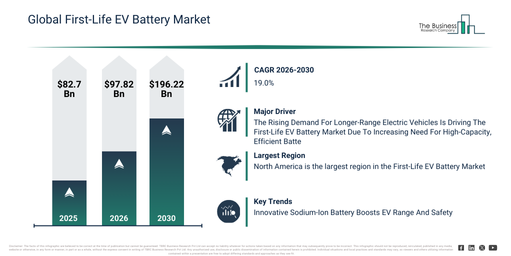
The first-life EV battery market size has experienced swift expansion in recent years. This market is projected to grow from $82.7 billion in 2025 to $97.82 billion in 2026, demonstrating a compound annual growth rate (CAGR) of 18.3%. The historic period’s growth can be attributed to several factors, including the global increase in electric vehicle production, improvements in lithium-ion battery performance, rising investments in battery gigafactories, increasing consumer demand for longer driving ranges, and the availability of diverse battery chemistries.
The first-life EV battery market size is projected for swift expansion in the coming years. It is anticipated to grow to $196.22 billion in 2030, exhibiting a compound annual growth rate (CAGR) of 19.0%. This growth during the forecast period stems from the increasing adoption of solid-state batteries, a heightened focus on cost reduction per kilowatt-hour, the expansion of electric commercial vehicle fleets, growing investments in domestic battery supply chains, and an increasing emphasis on battery sustainability and recyclability. Significant trends in the forecast period include the increasing adoption of high-energy-density battery chemistries, rising use of advanced battery management systems, growing demand for long-cycle-life EV batteries, the expansion of localized battery manufacturing facilities, and an enhanced focus on battery safety and thermal stability.
Get A Free Sample Report With In-Depth Market Insights:
First-Life EV Battery Market Demand Drivers Opening New Revenue Streams
The first-life EV battery market is anticipated to expand due to the escalating demand for longer-range electric vehicles. These vehicles, designed to achieve a significantly extended driving range, often surpassing 400 miles per charge, utilize advanced battery technology, improved aerodynamics, and enhanced energy efficiency. Consumer preference for longer distances without frequent recharges is fueling the surge in demand for these extended-range EVs. Consequently, the first-life EV battery market experiences heightened demand as the swift growth of longer-range EVs compels manufacturers to integrate higher-capacity and more efficient battery solutions. For example, in July 2025, Virta Global, a Finland-based technology firm focused on EV energy digital platforms, reported on government initiatives to lower heavy-duty truck emissions, noting the EU’s targets of 45% cuts by 2030 and 90% by 2040, alongside the global availability of over 800 electric truck models. Furthermore, in 2024, Volvo and Scania introduced long-range electric trucks capable of exceeding 600 km per charge. Thus, the increasing demand for longer-range electric vehicles is a key factor boosting the first-life EV battery market.
First-Life EV Battery Market Breakdown By Product Type And Application
The first-life ev battery market covered in this report is segmented –
1) By Battery Type: Lithium-Ion, Nickel-Metal Hydride, Solid-State, Other Battery Types
2) By Cell Format: Cylindrical Cells, Prismatic Cells, Pouch Cells
3) By Vehicle Type: Passenger Cars, Commercial Vehicles, Two-Wheelers, Other Vehicle Types
4) By Battery Capacity: Less Than 30 Kilowatt-hours, 30–60 Kilowatt-hours, 60–100 Kilowatt-hours, Above 100 Kilowatt-hours
5) By Application: Original Equipment Manufacturer (OEMs), Aftermarket, Energy Storage Systems, Other Applications
Subsegments:
1) By Lithium-Ion: Lithium-Iron Phosphate (LFP), Nickel Cobalt Manganese (NCM), Nickel Cobalt Aluminum (NCA), Lithium Titanate (LTO)
2) By Nickel-Metal Hydride: Nickel Metal Hydride Cylindrical, Nickel Metal Hydride Prismatic, Nickel Metal Hydride Pocket Cell
3) By Solid-State: Lithium Solid-State, Sodium Solid-State, Polymer Solid-State
4) By Other Battery Types: Zinc-Air, Hybrid Batteries
First-Life EV Battery Market Trends Powering Strategic Industry Growth
In the first-life electric vehicle (EV) battery market, prominent companies are concentrating on creating advanced products, like sodium-ion batteries, aimed at enhancing energy density, safety, and cost-efficiency when compared to conventional lithium-ion alternatives. Sodium-ion batteries are rechargeable units that employ sodium ions for storing and releasing energy, providing a more affordable and abundant option than lithium-ion batteries. As an illustration, in September 2025, Contemporary Amperex Technology Co. Limited, a battery production firm from China, launched Naxtra, a sodium-ion EV battery. This cutting-edge battery achieves an energy density of 175 Wh/kg, which supports a pure electric driving range surpassing 500 km. Furthermore, Naxtra exhibits remarkable endurance with more than 10,000 charge-discharge cycles, features industry-leading 5C fast-charging, maintains stable performance across extreme temperatures from -40°C to +70°C, and possesses a safer chemical makeup that significantly reduces fire and explosion risks.
First-Life EV Battery Market Key Players Shaping Industry Direction
Major companies operating in the first-life ev battery market are Contemporary Amperex Technology Co., Limited (CATL), BYD Co. Ltd., LG Energy Solution, Panasonic Holdings Corporation, SK Inc., Samsung SDI Co.,Ltd., China Aviation Lithium Battery (CALB), Gotion Inc., EVE Energy Co.,Ltd., Sunwoda Electronic Co.,Ltd., Farasis Energy, Tesla Inc., Verkor, A123 Systems Corp., Toshiba Corporation, Romeo Power, Exide Industries Ltd., AESC (Automotive Energy Supply Corporation), Solid Power Inc., Beijing WeLion New Energy Technology Co.,Ltd., Invenox, Amprius Technologies Inc., Hitachi High-Tech Corporation, Envites Energy, Northvolt AB, OptimumNano Energy Co.,Ltd., QuantumScape Corporation.
View The Full First-Life EV Battery Market Report:
First-Life EV Battery Market Regional Analysis: Which Geography Leads On Revenue?
North America was the largest region in the first-life electric vehicle (EV) battery market in 2025. Asia-Pacific is expected to be the fastest-growing region in the forecast period. The regions covered in the first-life ev battery market report are Asia-Pacific, South East Asia, Western Europe, Eastern Europe, North America, South America, Middle East, Africa.
Reach Out To Our Team:
The Business Research Company: https://www.thebusinessresearchcompany.com/
Americas: +1 310-496-7795
Asia: +44 7882 955267 & +91 8897263534
Europe: +44 7882 955267
Email us at: marketing@tbrc.info
Follow us on:
LinkedIn: https://in.linkedin.com/company/the-business-research-company
YouTube: https://www.youtube.com/channel/UC24_fI0rV8cR5DxlCpgmyFQ
Global Market Model: https://www.thebusinessresearchcompany.com/global-market-model

Wasay has over a decade of experience in market research, data modelling, and analytics, with prior experience at GlobalData and Decision Tree Consulting Services. At The Business Research Company , he leads research operations across syndicated studies, customized consulting engagements, and the Global Market Model platform. His professional experience includes supporting organizations such as Boston Consulting Group, KPMG, and Ernst & Young. Wasay holds a degree in Electronics and Communications Engineering, postgraduate management qualifications from International Management Institute Belgium and Indian School of Business and Entrepreneurship, and completed the Integrated Program in Business Analytics from Indian Institute of Management Indore.