
Featuring market attractiveness scoring, total addressable market sizing, company benchmarking matrices, interactive Excel dashboards, deeper supply chain intelligence, emerging startup tracking, and granular product-level insights, The Business Research Company’s 2026 market reports are built to deliver research that is both more actionable and more strategically valuable.
Floating Offshore Wind Market Forecast: What Value Will The Market Reach By 2030?
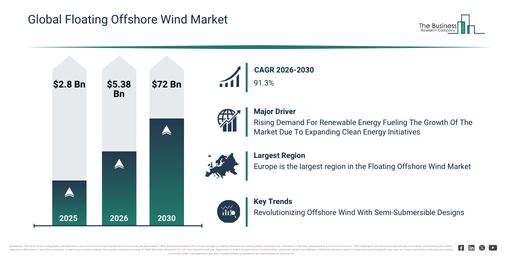
The floating offshore wind market has seen considerable expansion in recent years. It is projected to increase from $2.8 billion in 2025 to $5.38 billion in 2026, at a compound annual growth rate (CAGR) of 92.1%. This historical growth can be linked to factors such as increased investments in offshore wind energy, the restrictions of fixed-bottom turbines in shallow waters, governmental support for renewable energy, progress in wind turbine design, and the escalating global requirement for electricity.
The floating offshore wind market size is anticipated to experience substantial growth in the upcoming years, with projections indicating it will climb to $72 billion by 2030, exhibiting a compound annual growth rate (CAGR) of 91.3%. This expansion during the forecast period is driven by factors such as the proliferation of deep-water wind farm projects, an increasing global focus on carbon neutrality goals, ongoing advancements in floating platform technology, the integration with smart grids and energy storage solutions, and supportive government policies coupled with subsidies. Noteworthy trends expected over this period include the development of high-capacity floating wind turbines, the widespread adoption of semi-submersible and spar-buoy platforms, the integration of sophisticated mooring and ballast systems, the deployment of subsea power and fiber optic cables, and the broader expansion of floating offshore wind farms for commercial power generation.
Get A Free Sample Report With In-Depth Market Insights:
Floating Offshore Wind Market Demand Drivers: What’s Powering Industry Growth?
The expansion of the floating offshore wind market in the future is anticipated to be spurred by the growing need for renewable energy. Renewable energy sources are derived from natural resources that are replenished continuously, such as sunlight, wind, rain, tides, waves, and geothermal heat. This escalating demand for renewable energy is a result of its ability to reduce carbon emissions by replacing fossil fuels like coal, oil, and natural gas, which are major contributors to greenhouse gases (GHGs) including carbon dioxide (CO2). Floating offshore wind technology contributes to renewable energy by capturing wind power in deeper ocean waters, areas where traditional fixed turbines cannot be installed, thus considerably broadening the potential for clean energy generation in regions with strong and consistent winds. For instance, a report published in February 2024 by the Energy Information Administration, a US-based government agency, indicates that in 2024, solar capacity is expected to increase by 30% (31 GW), while U.S. wind capacity is projected to grow by 5% annually, adding 6 GW in 2023 and 7 GW in 2024. Therefore, the elevated demand for renewable energy is a primary driver for the floating offshore wind market.
Floating Offshore Wind Market Segment Analysis Spotlighting Growth Areas
The floating offshore wind market covered in this report is segmented –
1) By Component: Turbines, Floating Structures, Subsea Cables, Other Components
2) By Location: Shallow Water, Deep Water, Transitional Water
3) By Application: Commercial Power Generation, Research And Development, Other Applications
Subsegments:
1) By Turbines: Horizontal Axis Wind Turbines (HAWT), Vertical Axis Wind Turbines (VAWT), Direct-Drive Wind Turbines, Gearbox-based Wind Turbines, High Capacity Wind Turbines
2) By Floating Structures: Spar-Buoy, Semi-Submersible Platform, Tension Leg Platform (TLP), Floating Concrete Structures
3) By Subsea Cables: Power Cables, Fiber Optic Cables, Umbilical Cables
4) By Other Components: Mooring Systems, Anchoring Systems, Ballast Systems, Dynamic Positioning Systems
Floating Offshore Wind Market Innovation Trends: What Developments Are Reshaping The Industry?
Leading companies in the floating offshore wind market are concentrating on technological advancements, such as floating offshore wind technology, to improve efficiency, scalability, and cost-effectiveness. Floating offshore wind technology refers to a method for generating electricity from wind by using turbines mounted on floating structures that are anchored to the seabed. As an illustration, in Mar 2025, Saipem S.p.A., an Italy-based oilfield services company, introduced Star1, a semi-submersible floating wind foundation engineered to support next-generation offshore turbines exceeding 20 MW. This technology features a steel semi-submersible design with three arms, offering enhanced stability, optimized mooring loads, and capability to support turbines over 20 MW, making it ready for FEED and implementation in Sicily’s 7 Seas Med (800 GWh/year) and Sardinia’s Ichnusa Wind Power (1.6 TWh/year) projects.
Floating Offshore Wind Market Competitive Landscape: Which Companies Lead The Industry?
Major companies operating in the floating offshore wind market are Equinor ASA, Hitachi Ltd., Iberdrola S.A., Mitsubishi Heavy Industries, ABB Limited, Ørsted A/S, Prysmian S.p.A., Shanghai Electric Group Company Limited, Siemens Gamesa Renewable Energy S.A., Goldwind Science & Technology Co Ltd., Guangdong Mingyang Smart Energy Group Co Ltd., General Electric Renewable Energy, Aker Solutions ASA, Vattenfall AB, Envision Energy Limited, Principle Power Inc., Naval Energies SAS, Doosan Heavy Industries & Construction Company Limited, BW Ideol AS, Global Energy Group Limited
View The Full Floating Offshore Wind Market Report:
Floating Offshore Wind Market Regional Outlook: Where Is Opportunity Concentrated?
Europe was the largest region in the floating offshore wind market in 2025. The regions covered in the floating offshore wind market report are Asia-Pacific, South East Asia, Western Europe, Eastern Europe, North America, South America, Middle East, Africa.
Reach Out To Our Team:
The Business Research Company: https://www.thebusinessresearchcompany.com/
Americas: +1 310-496-7795
Asia: +44 7882 955267 & +91 8897263534
Europe: +44 7882 955267
Email us at: marketing@tbrc.info
Follow us on:
LinkedIn: https://in.linkedin.com/company/the-business-research-company
YouTube: https://www.youtube.com/channel/UC24_fI0rV8cR5DxlCpgmyFQ
Global Market Model: https://www.thebusinessresearchcompany.com/global-market-model

Wasay has over a decade of experience in market research, data modelling, and analytics, with prior experience at GlobalData and Decision Tree Consulting Services. At The Business Research Company , he leads research operations across syndicated studies, customized consulting engagements, and the Global Market Model platform. His professional experience includes supporting organizations such as Boston Consulting Group, KPMG, and Ernst & Young. Wasay holds a degree in Electronics and Communications Engineering, postgraduate management qualifications from International Management Institute Belgium and Indian School of Business and Entrepreneurship, and completed the Integrated Program in Business Analytics from Indian Institute of Management Indore.