
Featuring market attractiveness scoring, total addressable market sizing, company benchmarking matrices, interactive Excel dashboards, deeper supply chain intelligence, emerging startup tracking, and granular product-level insights, The Business Research Company’s 2026 market reports are built to deliver research that is both more actionable and more strategically valuable.
Fuel Cell Thermal Management System Market Expansion Outlook: What Revenue Opportunities Are Ahead?
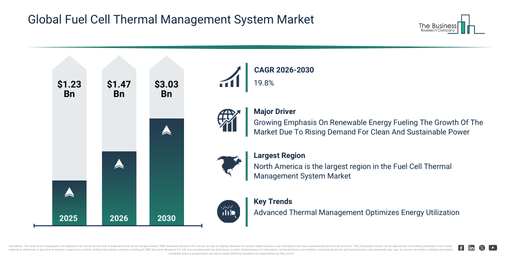
The fuel cell thermal management system market size has experienced rapid growth in recent years. It is projected to increase from $1.23 billion in 2025 to $1.47 billion in 2026, exhibiting a compound annual growth rate (CAGR) of 20.1%. This historical expansion can be attributed to the wider reach of fuel cell vehicle pilot programs, advancements in the efficiency of heat exchangers, the early deployment of stationary fuel cell systems, rising investments in hydrogen infrastructure, and an increasing focus on the reliability of fuel cells.
The market for fuel cell thermal management systems is projected to experience substantial expansion over the upcoming years, with its size anticipated to reach $3.03 billion by 2030, exhibiting a compound annual growth rate (CAGR) of 19.8%. Key factors contributing to this growth during the forecast period include the expanding commercialization of vehicles powered by hydrogen, the increasing use of fuel cells in heavy-duty transportation, the proliferation of distributed power generation setups, a rising need for highly efficient thermal regulation, and the growing integration of intelligent thermal management solutions. Noteworthy trends observed within the forecast timeframe encompass the increasing deployment of liquid-cooled fuel cell systems, the greater integration of sophisticated thermal sensors, an escalating demand for compact thermal management solutions, the broadening of modular cooling designs, and an intensified emphasis on ensuring fuel cell longevity.
Get A Free Sample Report With In-Depth Market Insights:
Fuel Cell Thermal Management System Market Opportunity Drivers: What’s Unlocking New Revenue Potential?
The increased focus on renewable energy is anticipated to fuel the expansion of the fuel cell thermal management system market in the coming years. Renewable energy, which is derived from constantly replenishing natural processes like sunlight, wind, water, geothermal heat, and biomass, offers an eco-friendly alternative that reduces greenhouse gas emissions. This rising emphasis on renewable energy is driven by a growing demand for cleaner, sustainable power that helps minimize carbon emissions, lessens dependence on fossil fuels, and supports environmental preservation for future generations. Fuel cell thermal management systems enhance renewable energy applications by efficiently regulating the temperature of fuel cell stacks, ensuring optimal performance and longevity, thereby improving energy conversion efficiency and system reliability to support clean and sustainable power generation. For instance, in March 2025, the International Renewable Energy Agency (IRENA), a United Arab Emirates-based intergovernmental organization, noted that renewable energy capacity surged from 3,862,881 megawatts (MW) in 2023 to 4,448,051 megawatts (MW) in 2024. Consequently, the growing emphasis on renewable energy is a significant driver for the fuel cell thermal management system market.
Fuel Cell Thermal Management System Market Segment Landscape: Which Areas Lead Development?
The fuel cell thermal management system market covered in this report is segmented –
1) By Type: Air-Cooled, Liquid-Cooled
2) By Component: Heat Exchangers, Cooling Plates, Pumps, Fans, Sensors, Other Components
3) By Fuel Cell Type: Proton Exchange Membrane Fuel Cell (PEMFC), Solid Oxide Fuel Cell (SOFC), Molten Carbonate Fuel Cell (MCFC), Phosphoric Acid Fuel Cell (PAFC), Other Fuel Cell Types
4) By Application: Automotive, Stationary Power, Portable Power, Other Applications
5) By End-User: Transportation, Power Generation, Industrial, Other End-Users
Subsegments:
1) By Air-Cooled: Radiators, Blowers, Ducts, Thermal Insulation
2) By Liquid-Cooled: Coolant Reservoirs, Pipes, Valves, Thermostats, Expansion Tanks
Fuel Cell Thermal Management System Market Innovation Trends Shaping Future Development
Major companies operating in the fuel cell thermal management system market are concentrating on developing innovative products, such as fuel cell heat exchangers, to boost the efficiency and thermal control of fuel cell systems even in challenging operational environments. A fuel cell heat exchanger is an apparatus engineered to facilitate the exchange of thermal energy between gaseous and liquid flows inside fuel cell setups, thereby regulating temperature, optimizing performance, and mitigating energy wastage. An illustrative example is the introduction of AlfaNova GL50 by Alfa Laval, a Sweden-based expert in heat transfer, separation, and fluid management technologies, in March 2023. This product is a compact, asymmetric gas-to-liquid plate heat exchanger designed to manage high-temperature gas flows and condense water vapor, ultimately enhancing energy usage in fuel cell systems. Featuring a durable construction, minimal pressure drops, and high efficiency, it facilitates sophisticated thermal management, rendering it appropriate for industrial-scale fuel cell applications as well as other intensive energy processes like hydrogen cooling and the retrieval of waste heat.
Fuel Cell Thermal Management System Market Leading Companies And Competitive Benchmarking
Major companies operating in the fuel cell thermal management system market are Robert Bosch GmbH, BorgWarner Inc., MAHLE GmbH, Dana Incorporated, Valeo SA, Denso Corporation, Webasto Group SE, Modine Manufacturing Company, Hanon Systems Co. Ltd., Grayson Thermal Systems Ltd., VOSS Automotive GmbH, KELVION Holding GmbH, Kuraray Co. Ltd., Sanhua Automotive Co. Ltd., Laird Thermal Systems, Boyd Corporation, TI Fluid Systems, Advanced Cooling Technologies Inc., API Heat Transfer Inc., SGL Carbon SE
View The Full Fuel Cell Thermal Management System Market Report:
Fuel Cell Thermal Management System Market Largest Region By Revenue And Market Share
North America was the largest region in the fuel cell thermal management system market in 2025. Asia-Pacific is expected to be the fastest-growing region in the forecast period. The regions covered in the fuel cell thermal management system market report are Asia-Pacific, South East Asia, Western Europe, Eastern Europe, North America, South America, Middle East, Africa.
Reach Out To Our Team:
The Business Research Company: https://www.thebusinessresearchcompany.com/
Americas: +1 310-496-7795
Asia: +44 7882 955267 & +91 8897263534
Europe: +44 7882 955267
Email us at: marketing@tbrc.info
Follow us on:
LinkedIn: https://in.linkedin.com/company/the-business-research-company
YouTube: https://www.youtube.com/channel/UC24_fI0rV8cR5DxlCpgmyFQ
Global Market Model: https://www.thebusinessresearchcompany.com/global-market-model

Wasay has over a decade of experience in market research, data modelling, and analytics, with prior experience at GlobalData and Decision Tree Consulting Services. At The Business Research Company , he leads research operations across syndicated studies, customized consulting engagements, and the Global Market Model platform. His professional experience includes supporting organizations such as Boston Consulting Group, KPMG, and Ernst & Young. Wasay holds a degree in Electronics and Communications Engineering, postgraduate management qualifications from International Management Institute Belgium and Indian School of Business and Entrepreneurship, and completed the Integrated Program in Business Analytics from Indian Institute of Management Indore.