Featuring market attractiveness scoring, total addressable market sizing, company benchmarking matrices, interactive Excel dashboards, deeper supply chain intelligence, emerging startup tracking, and granular product-level insights, The Business Research Company’s 2026 market reports are built to deliver research that is both more actionable and more strategically valuable.
Internet of Things (IoT) In Energy Grid Management Market Revenue Growth On Track For A 16.4% CAGR Through 2030
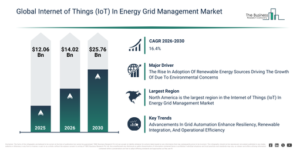
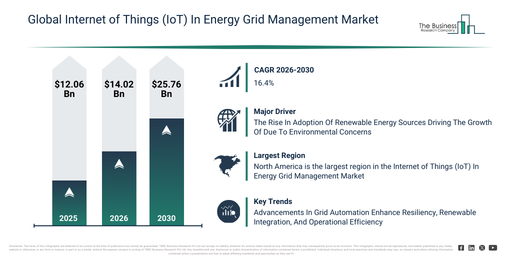
The internet of things (iot) in energy grid management market has experienced significant expansion in recent years. Projections indicate its valuation will increase from $12.06 billion in 2025 to $14.02 billion in 2026, advancing at a compound annual growth rate (CAGR) of 16.2%. Historically, this growth has been attributed to the rising adoption of smart meters, increasing energy demand and grid complexity, early deployment of sensor networks, the integration of communication modules in grids, and initial investment in grid automation.
The internet of things (iot) in energy grid management market is anticipated to experience substantial expansion over the coming years. Projections indicate it will reach a valuation of $25.76 billion by 2030, demonstrating a compound annual growth rate (CAGR) of 16.4%. This projected increase during the forecast period is fueled by several factors, including the proliferation of iot-enabled grid solutions, an increasing need for predictive analytics in energy management, the integration of edge computing for immediate control, a rise in renewable energy source deployment, and a heightened emphasis on energy efficiency and sustainability efforts. Key developments expected during this period encompass real-time grid surveillance, preventative maintenance offerings, optimization of energy management, control and oversight of assets, and remote observation and data analysis.
Get A Free Sample Report With In-Depth Market Insights:
Internet of Things (IoT) In Energy Grid Management Market Development Factors: What’s Supporting Demand?
The expanding integration of renewable energy sources is anticipated to drive the growth of the internet of things (IoT) in energy grid management market in the foreseeable future. These natural resources, such as sunlight, wind, water, and biomass, are naturally replenished and utilized for energy generation. The increasing embrace of renewable energy sources is fundamentally motivated by environmental concerns and climate change, as governments and organizations aim to decrease greenhouse gas emissions, mitigate pollution, and transition to sustainable, low-carbon energy systems. The internet of things (IoT) in energy grid management plays a crucial role by enabling real-time monitoring and intelligent coordination of energy flows, which consequently enhances the integration, efficiency, and reliability of renewable energy sources like solar and wind. For example, in December 2024, Eurostat, a Luxembourg-based government agency, stated that renewable energy accounted for 24.5% of total energy consumption in the EU in 2023, an increase from 23.0% in 2022. Therefore, the increasing adoption of renewable energy sources is a key driver for the internet of things (IoT) in energy grid management market.
Internet of Things (IoT) In Energy Grid Management Market Segment Analysis: What Are The Core Market Categories?
The internet of things (iot) in energy grid management market covered in this report is segmented –
1) By Component: Hardware, Software, Services
2) By Deployment: On-Premises, Cloud-Based
3) By Technology: Wired Communication, Wireless Communication
4) By Application: Smart Meters, Grid Monitoring, Demand Response, Asset Management, Energy Storage Management
5) By End Users: Utilities, Industrial, Commercial, Residential
Subsegments:
1) By Hardware: Sensors And Actuators, Smart Meters, Communication Modules, Edge Computing Devices
2) By Software: Grid Management Software, Energy Analytics Software, Device Management Software, Predictive Maintenance Software
3) By Services: Installation And Integration Services, Network Monitoring Services, Maintenance And Support Services, Data Management And Analytics Services
Internet of Things (IoT) In Energy Grid Management Market Transformation Trends: What Innovations Are Driving Change?
Leading companies operating within the internet of things (IoT) in energy grid management market are concentrating on creating digital intelligence platforms. These platforms aim to boost grid resiliency, incorporate renewable energy sources, and streamline operational efficiency. Digital intelligence platforms are defined as integrated, AI-driven software environments that consolidate grid data and operations, facilitating predictive automation and comprehensive management. For example, in March 2025, Schneider Electric SE, an energy management and automation company based in France, introduced its One Digital Grid Platform. This AI-powered foundational platform is designed for modernizing utility grids. It offers distinct functionalities, including a hybrid-cloud architecture for real-time insights, predictive analytics concerning climate risk and asset management, and automated modules for planning, operations, and customer engagement, all intended to elevate intelligence throughout the entire grid lifecycle. The platform leverages an open, interoperable ecosystem to seamlessly incorporate critical software and IoT data, equipping utilities with actionable intelligence to decrease outage durations by up to 40%, accelerate the connection of distributed energy resources like solar and EV chargers by 25%, and reduce software deployment time by 60%. Furthermore, it integrates smoothly with existing utility systems and partner solutions, enabling grid operators to gain a unified perspective through scalable analytics, optimize grid performance and flexibility, and improve security and affordability while preparing for upcoming energy demands.
Internet of Things (IoT) In Energy Grid Management Market Key Participants And Competitive Landscape
Major companies operating in the internet of things (iot) in energy grid management market are Microsoft Corporation, Huawei Technologies Co. Ltd., Siemens AG, Hitachi Ltd., International Business Machines Corporation, Cisco Systems Inc., Intel Corporation, General Electric Company, Oracle Corporation, Schneider Electric SE, Mitsubishi Electric Corporation, Honeywell International Inc., Toshiba Corporation, ABB Ltd., Fujitsu Limited, Eaton Corporation Plc, Itron Inc., Landis Gyr AG, Schweitzer Engineering Laboratories Inc., Trilliant Holdings Inc., GridPoint Inc.
View The Full Internet of Things (IoT) In Energy Grid Management Market Report:
Internet of Things (IoT) In Energy Grid Management Market Geographic Analysis: Where Is Demand Rising Fastest?
North America was the largest region in the internet of things (IoT) in energy grid management in 2025. Asia-Pacific is expected to be the fastest-growing region in the forecast period. The regions covered in the internet of things (iot) in energy grid management market report are Asia-Pacific, South East Asia, Western Europe, Eastern Europe, North America, South America, Middle East, Africa.
Reach Out To Our Team:
The Business Research Company: https://www.thebusinessresearchcompany.com/
Americas: +1 310-496-7795
Asia: +44 7882 955267 & +91 8897263534
Europe: +44 7882 955267
Email us at: marketing@tbrc.info
Follow us on:
LinkedIn: https://in.linkedin.com/company/the-business-research-company
YouTube: https://www.youtube.com/channel/UC24_fI0rV8cR5DxlCpgmyFQ
Global Market Model: https://www.thebusinessresearchcompany.com/global-market-model

Wasay has over a decade of experience in market research, data modelling, and analytics, with prior experience at GlobalData and Decision Tree Consulting Services. At The Business Research Company , he leads research operations across syndicated studies, customized consulting engagements, and the Global Market Model platform. His professional experience includes supporting organizations such as Boston Consulting Group, KPMG, and Ernst & Young. Wasay holds a degree in Electronics and Communications Engineering, postgraduate management qualifications from International Management Institute Belgium and Indian School of Business and Entrepreneurship, and completed the Integrated Program in Business Analytics from Indian Institute of Management Indore.