
Featuring market attractiveness scoring, total addressable market sizing, company benchmarking matrices, interactive Excel dashboards, deeper supply chain intelligence, emerging startup tracking, and granular product-level insights, The Business Research Company’s 2026 market reports are built to deliver research that is both more actionable and more strategically valuable.
Micro Combined Heat And Power (CHP) Market Value Growth And Long-Term Outlook
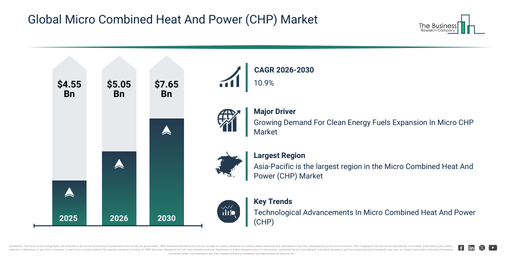
The micro combined heat and power (chp) market has experienced substantial growth in recent years. It is forecast to expand from $4.55 billion in 2025 to $5.05 billion in 2026, at a compound annual growth rate (CAGR) of 11.2%. The historical growth of this market stemmed from factors such as the increased deployment of internal combustion engine-based micro chp, the rising adoption of gas engine micro chp units, a growing demand for residential electricity and heat, increased natural gas consumption for distributed energy, and greater awareness of energy efficiency benefits.
The micro combined heat and power (chp) market is anticipated to experience substantial growth over the next few years. It is expected to expand to $7.65 billion in 2030, achieving a compound annual growth rate (CAGR) of 10.9%. This growth during the forecast period is attributed to the increasing development of fuel cell-based micro chp systems, rising integration of renewable fuels into micro chp units, growing adoption within the commercial sector, continuous technological advancements in stirling engine micro chp, and a heightened focus on carbon emission reduction through distributed energy. Key trends for this period include the increasing uptake of engine-based micro chp systems, a rising deployment of fuel cell-based micro chp units, broader utilization of natural gas and renewable fuel options, the expansion of residential micro chp installations, and enhanced efficiency achieved through stirling and internal combustion engines.
Get A Free Sample Report With In-Depth Market Insights:
Micro Combined Heat And Power (CHP) Market Growth Backed By Core Demand Fundamentals
The increasing need for clean energy solutions is anticipated to boost the expansion of the micro combined heat and power (CHP) market in the future. Clean energy is defined as power originating from renewable, non-polluting sources that produce no atmospheric emissions, examples being solar, wind, and hydropower. The rise in clean energy can be attributed to advancements in renewable technologies, favorable government policies, decreasing expenses, and an increasing desire for eco-friendly alternatives. Clean energy improves micro CHP systems by supplying renewable, low-emission fuel, thereby lowering the carbon footprint and boosting the environmental viability of combined heat and power generation. For instance, as reported by Eurostat, a Luxembourg-based government statistics source, in March 2025, it was noted that in 2024, the share of net electricity generated from renewable energy sources in the EU expanded from 44.3% in 2023 to 46.9% in 2024, marking a 2.6 percentage point rise compared to the previous year. Consequently, the escalating need for clean energy solutions is a key driver for the micro combined heat and power (CHP) market.
Micro Combined Heat And Power (CHP) Market Segments: Where Is Growth Concentrated?
The micro combined heat and power (chp) market covered in this report is segmented –
1) By Type: Engine-Based, Fuel Cell-Based
2) By Prime Mover: Stirling Engine, Internal Combustion Engine, Fuel Cell
3) By Fuel: Natural Gas And Liquefied Petroleum Gas (LPG), Coal, Renewable Resources, Oil
4) By Application: Residential, Commercial
Subsegments:
1) By Engine-Based Micro CHP: Internal Combustion Engine (ICE)-Based Micro CHP, Gas Engine-Based Micro CHP, Diesel Engine-Based Micro CHP, Stirling Engine-Based Micro CHP, Combined Heat And Power Systems with Gas Turbine Engines
2) By Fuel Cell-Based Micro CHP: Proton Exchange Membrane (PEM) Fuel Cell-Based Micro CHP, Solid Oxide Fuel Cell (SOFC)-Based Micro CHP, Molten Carbonate Fuel Cell (MCFC)-Based Micro CHP, Alkaline Fuel Cell (AFC)-Based Micro CHP, Direct Methanol Fuel Cell (DMFC)-Based Micro CHP
Micro Combined Heat And Power (CHP) Market Growth Trends Reshaping The Competitive Landscape
Major companies in the micro combined heat and power (CHP) market are prioritizing technological advancements, such as developing energy-efficient CHP solutions, to reduce carbon emissions, bolster system reliability, and optimize energy savings for both residential and commercial applications. An energy-efficient CHP system generates both electricity and heat from a single energy source, thus optimizing fuel usage and reducing energy waste. For instance, in August 2023, Bloom Energy Corporation, a US-based green energy company, launched the Bloom Energy Server. This advanced combined heat and power (CHP) solution is engineered to achieve net-zero heating and cooling. The Bloom Energy Server boasts over 50% electrical efficiency and can reach more than 90% combined efficiency when fully utilized. This system distinguishes itself by producing high-temperature steam without additional fuel input, significantly lowering operating costs and reducing carbon emissions. This advancement represents a substantial improvement over older CHP technologies, which typically struggle to achieve both high electrical and thermal efficiencies simultaneously.
Micro Combined Heat And Power (CHP) Market Competitive Landscape: Which Companies Lead The Industry?
Major companies operating in the micro combined heat and power (chp) market are Honda Motor Co. Ltd., Robert Bosch GmbH, Siemens AG, Caterpillar Inc., Aisin Corporation, Ceres Power Holdings plc, Alfa Laval AB, BDR Thermea Group B.V., Bloom Energy Corporation, Vaillant Group, 2G Energy AG, Viessmann Manufacturing Company Inc., Yanmar Co. Ltd., Capstone Green Energy Corporation, Lochinvar, Centrica plc, Enexor Energy LLC, Solid Power Inc., Samad Power Ltd, Axiom Energy Group LLC, EC POWER A/S, GreenWatt
View The Full Micro Combined Heat And Power (CHP) Market Report:
Micro Combined Heat And Power (CHP) Market Regional Outlook: Where Is Opportunity Concentrated?
Asia-Pacific was the largest region in the micro combined heat and power (CHP) market in 2025. The regions covered in the micro combined heat and power (chp) market report are Asia-Pacific, South East Asia, Western Europe, Eastern Europe, North America, South America, Middle East, Africa.
Reach Out To Our Team:
The Business Research Company: https://www.thebusinessresearchcompany.com/
Americas: +1 310-496-7795
Asia: +44 7882 955267 & +91 8897263534
Europe: +44 7882 955267
Email us at: marketing@tbrc.info
Follow us on:
LinkedIn: https://in.linkedin.com/company/the-business-research-company
YouTube: https://www.youtube.com/channel/UC24_fI0rV8cR5DxlCpgmyFQ
Global Market Model: https://www.thebusinessresearchcompany.com/global-market-model

Wasay has over a decade of experience in market research, data modelling, and analytics, with prior experience at GlobalData and Decision Tree Consulting Services. At The Business Research Company , he leads research operations across syndicated studies, customized consulting engagements, and the Global Market Model platform. His professional experience includes supporting organizations such as Boston Consulting Group, KPMG, and Ernst & Young. Wasay holds a degree in Electronics and Communications Engineering, postgraduate management qualifications from International Management Institute Belgium and Indian School of Business and Entrepreneurship, and completed the Integrated Program in Business Analytics from Indian Institute of Management Indore.