
Built to provide research that’s more actionable and strategically valuable, The Business Research Company’s 2026 market reports include market attractiveness analysis, total addressable market sizing, company benchmarking matrices, interactive Excel dashboards, broader supply chain intelligence, emerging startup tracking, and in-depth product insights.
Nuclear Electricity Market Growth Analysis: How Will Revenue Trend Over The Forecast Period?
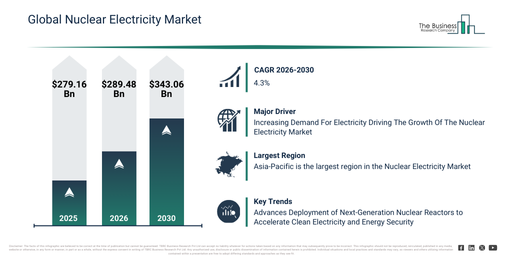
The nuclear electricity market size has demonstrated steady expansion in recent years. It is anticipated to grow from $279.16 billion in 2025 to $289.48 billion in 2026, achieving a compound annual growth rate (CAGR) of 3.7%. The market’s past growth is attributable to several factors, including the expansion of large-scale nuclear power capacity, sustained investment in baseload electricity generation, the advancement of generation II and III reactors, government-supported nuclear initiatives, and increasing electricity demand from industrial sectors.
The nuclear electricity market size is projected to experience consistent expansion in the upcoming period. Its valuation is anticipated to reach $343.06 billion by 2030, demonstrating a compound annual growth rate (CAGR) of 4.3%. This projected growth during the forecast timeframe is primarily driven by factors such as the broader development of Generation IV reactors, the increasing implementation of small modular reactors, more ambitious grid decarbonization objectives, escalating investments in nuclear safety advancements, and the expanding need for reliable low-carbon power. Key trends observed within this period encompass the greater adoption of advanced reactor architectures, a heightened emphasis on extending the operational lifespan of nuclear facilities, the wider integration of safety and monitoring enhancements, the scaling up of small modular reactor initiatives, and an amplified focus on providing low-carbon baseload electricity.
Get A Free Sample Report With In-Depth Market Insights:
Nuclear Electricity Market Expansion Drivers: What’s Shaping Future Growth?
The escalating requirement for electricity is anticipated to be a primary catalyst for the nuclear power generation market during the projected timeframe. This surge is linked to expanding economies and increasing populations, particularly in emerging nations like China, India, Brazil, And Some African Countries. As an illustration, the U.S. Energy Information Administration (EIA), a U.S.-based government body, forecasted in December 2025 that the total electricity consumption in the U.S. would climb to 4,199 billion kilowatt-hours (kWh) in 2025 from 4,110 billion kWh in 2024, representing a 2.1% growth largely due to heightened residential, commercial, and industrial power usage. Consequently, this persistent demand for electricity is propelling the expansion of the nuclear electricity market moving ahead.
Nuclear Electricity Market Driver: Increasing Need For Microgrids For Power Generation
The expanding implementation of microgrids is projected to stimulate the nuclear electricity market’s future growth. A microgrid represents a localized energy system capable of functioning autonomously or linked to the main power grid. These systems are crucial for integrating and refining AI technology within the energy domain, facilitating smart energy management, grid efficiency improvements, and the incorporation of renewable power sources. They contribute significantly to managing demand response, balancing loads, and embedding renewable energy. For example, a report from September 2024 by the Department of Energy security & net zero, a UK-based government body, indicated that net imports increased by 21% compared to Q2 2023, reaching 9.2 TWh, which constituted 13% of the UK’s electricity demand in Q2 2024. Hence, the rising utilization of microgrids is anticipated to propel the expansion of the nuclear electricity market going forward.
Nuclear Electricity Market Segment Analysis Spotlighting Growth Areas
The nuclear electricity market covered in this report is segmented –
1) By Reactor Type: Pressurized Water Reactors (PWR), Fast Breeder Reactor (FBR), Pressurized Heavy-Water Reactor (PHWR), Boiling Water Reactor (BWR), Light Water Graphite Reactor (LWGR), Gas-Cooled Reactor (GCR)
2) By Technology: Generation I, Generation II, Generation III, And Generation IV
3) By End-User: Residential, Commercial, Industrial
Subsegments:
1) By Pressurized Water Reactors (PWR): Small Modular PWRs, Conventional Large PWRs
2) By Fast Breeder Reactor (FBR): Sodium-Cooled FBR, Lead-Cooled FBR, Gas-Cooled FBR
3) By Pressurized Heavy-Water Reactor (PHWR): Advanced PHWRs, Conventional PHWRs
4) By Boiling Water Reactor (BWR): Advanced BWR (ABWR), Economic Simplified BWR (ESBWR)
5) By Light Water Graphite Reactor (LWGR): RBMK (Reaktor Bolshoy Moshchnosti Kanalny), EGP (Experimental Graphite Reactors)
6) By Gas-Cooled Reactor (GCR): Magnox Reactors, Advanced Gas-Cooled Reactors (AGR)
Nuclear Electricity Market Strategic Trends: What Defines The Next Growth Phase?
Leading firms within the nuclear electricity market are concentrating their efforts on developing future-generation nuclear reactor innovations, including small modular and advanced reactors, with the aim of speeding up clean and dependable electricity production, improving energy stability, and contributing to decarbonization objectives. These advanced reactors incorporate novel designs and safety mechanisms to maximize operational efficiency, minimize byproduct waste, and facilitate adaptable power distribution. As an illustration, in August 2025, the U.S. Department of Energy (DOE), a US-based government agency, initiated its Nuclear Reactor Pilot Program, working in partnership with 11 selected advanced reactor projects, involving organizations like Oklo Inc. and Terrestrial Energy Inc., to build, run, and reach the critical operational state of experimental reactors. The objective of this undertaking is to expedite commercial permits, attract private capital, and hasten the implementation of secure, effective, and carbon-free nuclear electricity offerings.
Nuclear Electricity Market Key Players Shaping Industry Direction
Major companies operating in the nuclear electricity market are Électricité de France S.A., Exelon Corporation, Duke Energy Corporation, Enel SpA, NextEra Energy Inc., State Atomic Energy Corporation Rosatom, Korea Electric Power Corporation, Constellation Energy Group Inc., China General Nuclear Power Corporation, General Electric Company, Hitachi Ltd., Mitsubishi Electric Corporation, Toshiba Corporation, Westinghouse Electric Company LLC, Areva SA, China National Nuclear Corporation, China National Nuclear Power Co. Ltd., Dominion Energy Inc., Southern Company, Bruce Power LP, Korea Hydro & Nuclear Power Co. Ltd., Rosenergoatom Concern JSC
View The Full Nuclear Electricity Market Report:
Nuclear Electricity Market Regional Analysis: Which Region Leads By Revenue?
Asia-Pacific was the largest region in the nuclear electricity market in 2025. Western Europe was the second-largest region in the nuclear electricity market. The regions covered in the nuclear electricity market report are Asia-Pacific, South East Asia, Western Europe, Eastern Europe, North America, South America, Middle East, Africa.
Reach Out To Our Team:
The Business Research Company: https://www.thebusinessresearchcompany.com/
Americas: +1 310-496-7795
Asia: +44 7882 955267 & +91 8897263534
Europe: +44 7882 955267
Email us at: marketing@tbrc.info
Follow us on:
LinkedIn: https://in.linkedin.com/company/the-business-research-company
YouTube: https://www.youtube.com/channel/UC24_fI0rV8cR5DxlCpgmyFQ
Global Market Model: https://www.thebusinessresearchcompany.com/global-market-model

Wasay has over a decade of experience in market research, data modelling, and analytics, with prior experience at GlobalData and Decision Tree Consulting Services. At The Business Research Company , he leads research operations across syndicated studies, customized consulting engagements, and the Global Market Model platform. His professional experience includes supporting organizations such as Boston Consulting Group, KPMG, and Ernst & Young. Wasay holds a degree in Electronics and Communications Engineering, postgraduate management qualifications from International Management Institute Belgium and Indian School of Business and Entrepreneurship, and completed the Integrated Program in Business Analytics from Indian Institute of Management Indore.