Built to provide research that’s more actionable and strategically valuable, The Business Research Company’s 2026 market reports include market attractiveness analysis, total addressable market sizing, company benchmarking matrices, interactive Excel dashboards, broader supply chain intelligence, emerging startup tracking, and in-depth product insights.
Offshore Platform Electrification Market Growth From $7.51 Billion In 2026 To $11.67 Billion By 2030 At A CAGR Of 11.7%
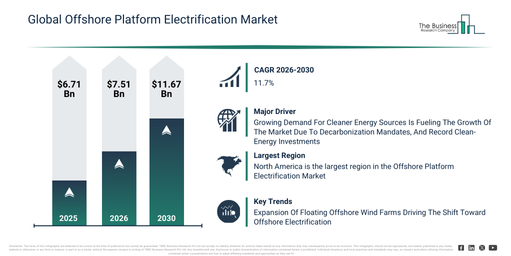
The offshore platform electrification market has experienced substantial growth in recent years. It is projected to expand from $6.71 billion in 2025 to $7.51 billion in 2026, at a compound annual growth rate (CAGR) of 11.8%. This historical expansion can be attributed to factors such as increasing offshore oil and gas development, reliance on gas turbine-based offshore power, the expansion of subsea infrastructure, rising fuel consumption on platforms, and the availability of high-voltage transmission technology.
The offshore platform electrification market is projected to experience substantial expansion in the coming years, with its size forecast to reach $11.67 billion by 2030, exhibiting a compound annual growth rate (CAGR) of 11.7%. This expected growth during the forecast period is driven by factors such as increasing decarbonization mandates for offshore operations, rising investments in offshore wind integration, the expansion of fully electric platforms, the growing deployment of digital twins for energy systems, and an increased focus on enhancing operational efficiency offshore. Major trends for the forecast period include the increasing electrification of offshore oil and gas platforms, the rising integration of subsea power transmission systems, the growing adoption of hybrid and renewable power sources, the expansion of digital energy management for offshore assets, and an enhanced focus on emission reduction and safety.
Get A Free Sample Report With In-Depth Market Insights:
Offshore Platform Electrification Market Growth Factors Behind Sustained Expansion
The expanding need for cleaner energy sources is anticipated to drive the advancement of the offshore platform electrification market in the coming years. These cleaner energy options are characterized by their minimal to non-existent emissions of greenhouse gases or pollutants, encompassing sources such as solar, wind, hydro, geothermal, and nuclear power. The surge in their demand stems from commitments to environmental sustainability, as they contribute to lowering greenhouse gas emissions and mitigating climate change impacts. Offshore platform electrification plays a crucial role in addressing this demand by replacing traditional fossil fuel-based power generation with renewable electricity, consequently reducing carbon emissions and fostering sustainable offshore operations. A notable instance occurred in May 2023, when the International Energy Agency, a France-based intergovernmental organization, reported that global energy investment reached approximately $2.8 trillion in 2023. Of this substantial amount, over $1.7 trillion was dedicated to clean energy initiatives, specifically including renewable power, nuclear energy, grid expansion, energy storage, low-emission fuels, efficiency improvements, and end-use electrification. Consequently, the rising demand for cleaner energy sources is a key factor propelling the growth of the offshore platform electrification market.
Offshore Platform Electrification Market Segment Landscape: Which Areas Lead Development?
The offshore platform electrification market covered in this report is segmented –
1) By Component: Power Generation, Transmission And Distribution, Equipment And Services
2) By Platform Type: Fixed Platforms, Floating Platforms, Subsea Platforms
3) By Power Source: Renewable Energy, Fossil Fuels, Hybrid Systems, Battery Storage
4) By Electrification Technology: Small-Scale Platforms, Medium-Scale Platforms, Large-Scale Platforms
5) By End-User: Oil And Gas, Renewable Energy, Other End-Users
Subsegments:
1) By Power Generation: Shore Power Supply Systems, Floating Offshore Wind Auxiliary Packages, Platform Solar Photovoltaic Arrays, Fuel Cell Power Systems, Battery Energy Storage Systems
2) By Transmission And Distribution: High Voltage Direct Current Converter Stations, High Voltage Direct Current Export Cables, High Voltage Alternating Current Export Cables, Medium Voltage Direct Current Subsea Hubs, Subsea Switchgear And Protection Assemblies, Subsea Power Distribution Modules
3) By Equipment And Services: Electric Actuated Subsea Valves And Chokes, Electric Submersible Pump Power And Control Packages, Subsea Variable Speed Drive Units, Engineering Procurement Construction And Installation Services, Cable Pull In Termination And Testing Services, Condition Monitoring And Digital Twin Services, Cybersecurity Integration And Compliance Services
Offshore Platform Electrification Market Industry Trends Fueling Future Revenue Growth
Major companies operating in the offshore platform electrification market are increasingly concentrating on the development of large-scale renewable energy projects, such as floating offshore wind farms, to provide power for offshore oil and gas platforms and reduce carbon emissions. Floating offshore wind farms offer the capability to generate clean energy in deep-water areas where fixed structures are not viable, thereby aiding the decarbonization of offshore operations through direct power-from-shore or offshore-to-offshore power transfer. As an example, in August 2023, Equinor, a Norway-based energy company, inaugurated Hywind Tampen, a floating offshore wind farm located in the Norwegian North Sea. This project consists of 11 wind turbines with a total capacity of 88 MW, designed to supply renewable power to the Snorre and Gullfaks oil and gas fields, which are operated by Equinor. By providing approximately 35% of the fields’ annual electricity demand, the Hywind Tampen project is expected to reduce annual carbon dioxide emissions by around 200,000 tonnes. This advancement highlights how substantial floating offshore wind farms can be instrumental in accelerating offshore platform electrification by enabling the integration of renewable power sources directly into oil and gas field operations, thus lowering emissions and fostering more sustainable offshore energy production.
Offshore Platform Electrification Market Top Companies Driving Competitive Growth
Major companies operating in the offshore platform electrification market are Siemens Energy AG, ABB Ltd, General Electric Company, Hitachi Energy Ltd, Schneider Electric SE, Prysmian Group, Nexans SA, TechnipFMC plc, Aker Solutions ASA, Kongsberg Gruppen ASA, Petrofac Limited, Worley Limited, McDermott International Inc, Baker Hughes Company, Emerson Electric Co, Rockwell Automation Inc, Eaton Corporation plc, Wärtsilä Oyj Abp, DNV AS, Jacobs Solutions Inc
View The Full Offshore Platform Electrification Market Report:
Offshore Platform Electrification Market Global Footprint: Which Region Leads The Market?
North America was the largest region in the offshore platform electrification market in 2025. Asia-Pacific is expected to be the fastest-growing region in the forecast period. The regions covered in the offshore platform electrification market report are Asia-Pacific, South East Asia, Western Europe, Eastern Europe, North America, South America, Middle East, Africa.
Reach Out To Our Team:
The Business Research Company: https://www.thebusinessresearchcompany.com/
Americas: +1 310-496-7795
Asia: +44 7882 955267 & +91 8897263534
Europe: +44 7882 955267
Email us at: marketing@tbrc.info
Follow us on:
LinkedIn: https://in.linkedin.com/company/the-business-research-company
YouTube: https://www.youtube.com/channel/UC24_fI0rV8cR5DxlCpgmyFQ
Global Market Model: https://www.thebusinessresearchcompany.com/global-market-model

Wasay has over a decade of experience in market research, data modelling, and analytics, with prior experience at GlobalData and Decision Tree Consulting Services. At The Business Research Company , he leads research operations across syndicated studies, customized consulting engagements, and the Global Market Model platform. His professional experience includes supporting organizations such as Boston Consulting Group, KPMG, and Ernst & Young. Wasay holds a degree in Electronics and Communications Engineering, postgraduate management qualifications from International Management Institute Belgium and Indian School of Business and Entrepreneurship, and completed the Integrated Program in Business Analytics from Indian Institute of Management Indore.