Delivering more actionable and strategically valuable research, The Business Research Company’s 2026 market reports feature market attractiveness analysis, total addressable market evaluation, company benchmarking matrices, interactive Excel dashboards, expanded supply chain intelligence, emerging startup coverage, and detailed product insights.
Power Generation Carbon Capture and Storage Market Size, Value And Growth Trends Through 2030
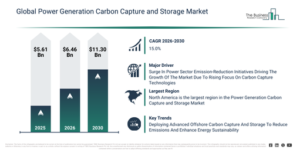
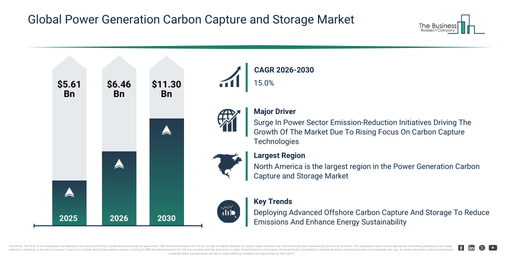
The market for carbon capture and storage in power generation has experienced rapid expansion over recent years. This market is projected to expand from $5.61 billion in 2025 to $6.46 billion in 2026, demonstrating a compound annual growth rate (CAGR) of 15.3%. Historically, this growth can be attributed to several factors: the rise in government climate mandates aimed at emission reduction, the increasing dependency on fossil fuel power plants necessitating decarbonization, a surge in investments into initial carbon capture demonstration projects, the broadening of regulatory structures that support carbon storage, and the greater implementation of post-combustion capture technologies.
The power generation carbon capture and storage market is anticipated to experience substantial growth over the next few years. It is projected to reach $11.30 billion by 2030, demonstrating a compound annual growth rate (CAGR) of 15.0%. This growth during the forecast period is primarily driven by increasing incentives and financial schemes for carbon capture adoption, the rising need to decarbonize existing coal and gas power fleets, the expansion of regional carbon transport and storage infrastructure, the growing integration of biomass power with carbon capture, and an increasing demand for negative emission technologies. Significant trends expected in this period include advancements in post-combustion capture solvent technologies, innovations in direct air capture systems, developments in oxy-fuel combustion research, research and development efforts in low energy penalty capture processes, and progress in digital monitoring and reservoir analytics.
Download A Free Sample Report For Comprehensive Market Insights:
Power Generation Carbon Capture and Storage Market Development Factors: Which Trends Are Supporting Demand?
The growing focus on decreasing power sector emissions is anticipated to drive the expansion of the power generation carbon capture and storage market moving forward. This reduction in power sector emissions involves governmental and regulatory actions aimed at lowering carbon dioxide (CO2) and other greenhouse gas outputs from electricity generation, particularly from fossil fuel facilities. This heightened attention to curbing power sector emissions stems from worries about climate change and global obligations demanding considerable cuts in greenhouse gas levels. The power generation carbon capture and storage market contributes to lessening power sector emissions by capturing CO2 before atmospheric release, allowing power plants to operate with a notably smaller carbon footprint. A relevant example is from March 2024, where the UK Department for Energy Security and Net Zero, a UK-based government entity, reported that greenhouse gas emissions from the country’s electricity supply decreased by 19.6% (10.8 MtCO2e) in 2023 compared to 2022, largely due to power-sector decarbonisation initiatives. Consequently, the heightened focus on cutting power sector emissions is fueling the growth of the power generation carbon capture and storage market.
Power Generation Carbon Capture and Storage Market Segmentation Trends And Revenue Drivers
The power generation carbon capture and storage market covered in this report is segmented –
1) By Technology: Post Combustion Capture, Pre Combustion Capture, Oxy Fuel Combustion, Direct Air Capture
2) By Capture Methodology: Absorption, Adsorption, Membrane Separation, Cryogenic Distillation
3) By Storage Method: Geological Storage, Ocean Storage, Mineral Carbonation, Utilization in Products
4) By Project Stage: Capture Technology And Engineering, Transportation (Pipeline And Shipping), Storage Site Characterization And Operation, Monitoring, Verification, And Reporting
5) By End User: Utility Sector, Industrial Sector, Government and Regulatory Bodies
Subsgments:
1) By Post Combustion Capture: Chemical Absorption, Physical Absorption, Solid Sorbent Adsorption, Membrane Based Separation
2) By Pre Combustion Capture: Gasification Based Capture, Steam Reforming Based Capture, Carbon Monoxide Shift Conversion, Physical Solvent Separation
3) By Oxy Fuel Combustion: Oxygen Production Systems, Flue Gas Recirculation Systems, Integrated Combustion Units, High Purity Carbon Dioxide Separation Systems
4) By Direct Air Capture: Liquid Solvent Based Capture, Solid Sorbent Based Capture, Temperature Swing Adsorption, Pressure Swing Adsorption
Power Generation Carbon Capture and Storage Market Transformation Trends: Which Innovations Are Driving Change?
Major companies within the power generation carbon capture and storage market are concentrating on implementing advanced offshore solutions, such as CO₂ compression and storage systems, to minimize emissions and boost sustainability in energy production. A CO₂ compression and storage system refers to the technological processes involved in capturing, purifying, and injecting carbon dioxide streams from energy facilities into secure geological formations, thereby contributing to the mitigation of climate impact. For instance, in September 2025, China National Offshore Oil Corporation (CNOOC), an energy company from China, launched its initial offshore CCS project at the Enping 15‑1 platform, which is capable of capturing and storing over 100,000 metric tons of CO₂ annually. This project supports nearby energy supply chains and power generation feedstocks while advancing the practical deployment of CCS.
#Power Generation Carbon Capture and Storage Market Industry Leaders: Which Organizations Are Driving Competition?
Major companies operating in the power generation carbon capture and storage market are Exxon Mobil Corporation, Shell plc, TotalEnergies SE, Chevron Corporation, General Electric Co., Schlumberger Limited, Linde AG, Mitsubishi Heavy Industries Ltd., Air Liquide, Occidental Petroleum Corporation, Baker Hughes Company, Fluor Corporation, Woodside Energy Group Ltd., Doosan Enerbility Co. Ltd., Saipem S.p.A., Worley Limited, Technip Energies, Chart Industries Inc., Hatch Ltd., Calix Limited, Aker Carbon Capture ASA, Carbon Clean Solutions Ltd., DNV AS
Access The Complete Power Generation Carbon Capture and Storage Market Report:
Power Generation Carbon Capture and Storage Market Regional Analysis: Which Region Leads By Revenue?
North America was the largest region in the power generation carbon capture and storage market in 2025. Asia-Pacific is expected to be the fastest-growing region in the forecast period. The regions covered in the power generation carbon capture and storage market report are Asia-Pacific, South East Asia, Western Europe, Eastern Europe, North America, South America, Middle East, Africa.
Get in touch with us:
The Business Research Company: https://www.thebusinessresearchcompany.com/
Americas: +1 310-496-7795
Asia: +44 7882 955267 & +91 8897263534
Europe: +44 7882 955267
Email us at: marketing@tbrc.info
Follow us on:
LinkedIn: https://in.linkedin.com/company/the-business-research-company
YouTube: https://www.youtube.com/channel/UC24_fI0rV8cR5DxlCpgmyFQ
Global Market Model: https://www.thebusinessresearchcompany.com/global-market-model

Wasay has over a decade of experience in market research, data modelling, and analytics, with prior experience at GlobalData and Decision Tree Consulting Services. At The Business Research Company , he leads research operations across syndicated studies, customized consulting engagements, and the Global Market Model platform. His professional experience includes supporting organizations such as Boston Consulting Group, KPMG, and Ernst & Young. Wasay holds a degree in Electronics and Communications Engineering, postgraduate management qualifications from International Management Institute Belgium and Indian School of Business and Entrepreneurship, and completed the Integrated Program in Business Analytics from Indian Institute of Management Indore.