Enhanced with market attractiveness analysis, total addressable market evaluation, company benchmarking matrices, interactive Excel dashboards, expanded supply chain intelligence, emerging startup coverage, and detailed product insights, The Business Research Company’s 2026 market reports deliver more actionable and strategically valuable research.
Smart Water Grid Market Value Analysis: What Growth Is Expected Over The Forecast Period?
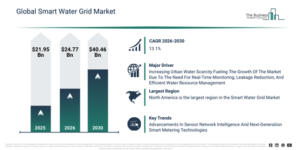
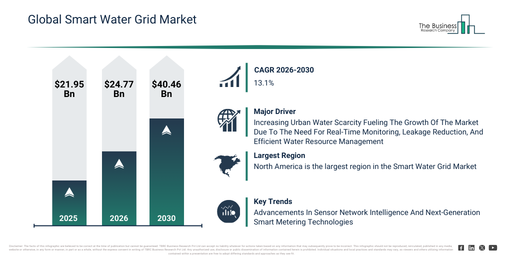
The smart water grid market has seen rapid expansion in recent years. It is forecast to rise from $21.95 billion in 2025 to $24.77 billion in 2026, achieving a compound annual growth rate (CAGR) of 12.8%. The growth observed in previous periods is attributable to factors including aging water distribution infrastructure, an increase in urban population, growing worries about water scarcity, governmental expenditures in utility modernization, and a heightened need for efficient resource management.
The smart water grid market is projected to experience substantial expansion over the upcoming years. By 2030, its size is anticipated to reach $40.46 billion, exhibiting a compound annual growth rate (CAGR) of 13.1%. This anticipated growth during the forecast timeframe is primarily driven by factors such as the rapid development of smart city infrastructure projects, the increasing acceptance of AI-based utility analytics, a heightened regulatory emphasis on water conservation, the broadening of digital utility management platforms, and the escalating requirements for industrial water monitoring. Key trends projected for this period encompass the wider implementation of smart water metering infrastructure, the growing uptake of real-time leak detection and pressure monitoring systems, the increasing incorporation of AI-driven water demand forecasting platforms, the spread of cloud-based water data management solutions, and the creation of sophisticated sensor-driven water quality monitoring networks.
Download A Free Sample Report For Comprehensive Market Insights:
Smart Water Grid Market Expansion Supported By Key Demand Factors
The expanding issue of urban water scarcity is anticipated to fuel the expansion of the smart water grid market in the future. This refers to an urban area lacking sufficient freshwater to satisfy the demands of its populace, industries, and public services, regarding either quantity, quality, or both aspects. The rise in urban water scarcity stems from rapid demographic expansion in cities, which boosts water usage and puts pressure on current supply infrastructure. The smart water grid assists in managing urban water scarcity through capabilities such as real-time tracking, minimizing leaks, optimizing demand, and effectively distributing finite water resources throughout city networks. As an illustration, the Dubai Electricity and Water Authority (DEWA), a government entity based in the UAE, announced in November 2024 that its overall desalinated water production saw a 4.64% year-on-year increase during the third quarter of 2024, achieving an unprecedented 40.5 billion imperial gallons. This growth highlights DEWA’s ongoing commitment to address escalating water requirements and facilitate Dubai’s swift urban development. Concurrently, peak demand for desalinated water hit 455 million imperial gallons per day (MIGD), marking a 4.92% rise when contrasted with the third quarter of 2023. Consequently, the growing issue of urban water scarcity is a key factor propelling the expansion of the smart water grid market.
Smart Water Grid Market Segment Analysis And Revenue Opportunities
The smart water grid market covered in this report is segmented –
1) By Component: Hardware, Software, Services
2) By Deployment Model And Ownership: Utility-Operated Smart Water Grids, Private Or Commercial Smart Water Grids, Public-Private Partnership (PPP) Smart Water Grids, Community-Operated Smart Water Grids
3) By Technology Type: Advanced Metering Infrastructure (AMI), Supervisory Control And Data Acquisition (SCADA), Geographic Information System (GIS), Internet of Things (IoT)-Enabled Sensors And Devices, Data Analytics And Artificial Intelligence (AI) Platforms
4) By Application: Water Distribution, Leak Detection, Water Quality Monitoring, Energy Management
5) By End-User: Municipalities Or Government, Agriculture, Commercial Enterprises, Residential Users, Public Or Private Utilities, Industrial Users
Subsegments:
1) By Hardware: Smart Meters, Sensors, Communication Devices
2) By Software: Meter Data Management Software, Grid Management Software, Analytics And Reporting Software
3) By Services: Installation Services, Maintenance Services, Consulting Services
Smart Water Grid Market Growth Trends Influencing Competitive Dynamics
Key players in the smart water grid market are prioritizing technological advancements in sensor networks to boost real-time water monitoring effectiveness, utilizing solutions like advanced smart metering infrastructure (AMI 2.0) to achieve superior data accuracy, enhanced network reliability, and practical operational insights throughout distribution systems. AMI 2.0 represents the subsequent stage of smart metering systems, integrating intelligent sensing capabilities, high-frequency data collection, and bidirectional digital communication. As an illustration, in September 2024, Metron, a cleantech firm from France, introduced its Ultrasonic Smart Water Meter. This groundbreaking meter offers exceptionally precise, non-invasive water flow measurement through the use of sound waves, removing mechanical parts, and thereby reducing wear and the need for upkeep. Its solid-state construction guarantees dependable operation even under difficult circumstances, including situations with low flow and water containing sediment. Furthermore, the device supports high-frequency, real-time data logging, aiding in early leak detection and detailed consumption analysis.
Smart Water Grid Market Leading Players Shaping Industry Direction
Major companies operating in the smart water grid market are Siemens AG, IBM Corporation, Oracle Corporation, Schneider Electric SE, Honeywell International Inc., Trimble Inc., Itron Inc., Mueller Water Products Inc., Badger Meter Inc., Arqiva Group Limited, Kamstrup A/S, Arad Group, Fluentgrid Limited, CIMCON Software India Pvt Ltd, Diehl Stiftung & Co. KG, Aquarius Spectrum Ltd., Omnitell Tech, Micronova Impex Pvt. Ltd., Ketos Water Solutions, BridgeThings IoT Pvt. Ltd., Ayyeka Technologies Ltd., Valarm LLC, ICT Co. Ltd., Xinapse Systems Ltd, and Kariot Solutions Pvt. Ltd.
Access The Complete Smart Water Grid Market Report:
Smart Water Grid Market Leading Geography: Which Region Generates The Most Revenue?
North America was the largest region in the smart water grid market in 2025. Asia-Pacific is expected to be the fastest-growing region in the forecast period. The regions covered in the smart water grid market report are Asia-Pacific, South East Asia, Western Europe, Eastern Europe, North America, South America, Middle East, Africa.
Get in touch with us:
The Business Research Company: https://www.thebusinessresearchcompany.com/
Americas: +1 310-496-7795
Asia: +44 7882 955267 & +91 8897263534
Europe: +44 7882 955267
Email us at: marketing@tbrc.info
Follow us on:
LinkedIn: https://in.linkedin.com/company/the-business-research-company
YouTube: https://www.youtube.com/channel/UC24_fI0rV8cR5DxlCpgmyFQ
Global Market Model: https://www.thebusinessresearchcompany.com/global-market-model

Wasay has over a decade of experience in market research, data modelling, and analytics, with prior experience at GlobalData and Decision Tree Consulting Services. At The Business Research Company , he leads research operations across syndicated studies, customized consulting engagements, and the Global Market Model platform. His professional experience includes supporting organizations such as Boston Consulting Group, KPMG, and Ernst & Young. Wasay holds a degree in Electronics and Communications Engineering, postgraduate management qualifications from International Management Institute Belgium and Indian School of Business and Entrepreneurship, and completed the Integrated Program in Business Analytics from Indian Institute of Management Indore.