Featuring market attractiveness scoring, total addressable market sizing, company benchmarking matrices, interactive Excel dashboards, deeper supply chain intelligence, emerging startup tracking, and granular product-level insights, The Business Research Company’s 2026 market reports are built to deliver research that is both more actionable and more strategically valuable.
Stack Damper Retrofit Market Growth Potential: How Will Market Size Shift Through 2030?
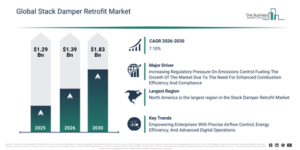
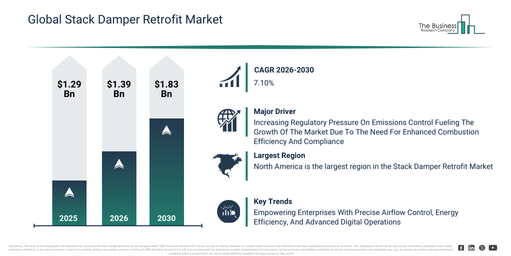
The stack damper retrofit market size has exhibited substantial expansion in recent years. The market is projected to expand from $1.29 billion in 2025 to $1.39 billion in 2026, at a compound annual growth rate (CAGR) of 7.4%. This historical growth can be ascribed to factors such as elevated industrial modernization initiatives, the increasing uptake of motorized damper systems, a heightened demand for energy-efficient exhaust management solutions, the broader execution of retrofit projects in older power plants, and intensified regulatory demands concerning emissions control.
The stack damper retrofit market is projected to experience robust expansion over the coming years. It is anticipated to reach a valuation of $1.83 billion in 2030, exhibiting a compound annual growth rate (CAGR) of 7.1%. This anticipated growth during the forecast period stems from several factors, including an escalating demand for automated and intelligent retrofit solutions, a greater emphasis on heat-loss reduction, increased implementation of actuator upgrade initiatives, the expansion of retrofitting activities in developing industrial nations, and a heightened commitment to ensuring operational safety and reliability. Key developments expected in this period encompass progress in IoT-enabled systems for damper monitoring, breakthroughs in high-temperature sealing materials, the evolution of automated actuator technologies, expanding research and development efforts in lightweight damper designs, and the growing use of digital twin simulations for planning retrofit projects.
Get A Free Sample Report With In-Depth Market Insights:
Stack Damper Retrofit Market Opportunity Drivers: What’s Unlocking New Revenue Potential?
The stack damper retrofit market is expected to experience accelerated growth due to escalating regulatory pressure concerning emissions control. These regulations mandate industrial facilities and power plants to curb pollutants and improve combustion performance to meet established environmental standards. The intensified focus on emissions control regulations is a direct response to mounting evidence of air pollution and greenhouse gases’ adverse impacts on public health, ecosystems, and climate stability, driving governmental intervention. Stack damper retrofits effectively support emissions control by enhancing draft management and heat utilization, enabling facilities to fine-tune combustion conditions and reduce stack losses within regulatory boundaries. For example, the International Energy Agency, a Paris-based intergovernmental energy policy organization, announced that from January 2025, emissions from light-duty vehicles must decline by about 6% annually through 2030. This target is crucial since nearly 80% of cars and vans on the road that year will still use internal combustion engines, making it imperative for all new car and van sales to be zero-emission by 2035. Therefore, the increasing regulatory pressure on emissions control is significantly encouraging industrial facilities to adopt stack damper retrofit solutions.
Stack Damper Retrofit Market Segmentation And Category Overview
The stack damper retrofit market covered in this report is segmented –
1) By Product Type: Manual Stack Dampers, Motorized Stack Dampers, Pneumatic Stack Dampers, Other Product Types
2) By Retrofit Type: Partial Retrofit, Full System Retrofit, Performance Optimization Retrofit
3) By Distribution Channel: Direct Sales, Distributors Or Wholesalers, System Integrators Or Engineering, Procurement, And Construction (EPC) Contractors, Online Retail And Procurement Platforms, Other Distribution Channels
4) By Application: Power Plants, Industrial Furnaces And Boilers, Refineries And Petrochemical Plants, Heating, Ventilation, And Air Conditioning (HVAC) And Building Exhaust Systems, Other Applications
5) By End-User: Industrial, Commercial, Residential, Other End-Users
Subsegments:
1) By Manual Stack Dampers: Single Blade Dampers, Multi Blade Dampers, Round Stack Dampers, Rectangular Stack Dampers
2) By Motorized Stack Dampers: Electric Actuated Dampers, Modulating Control Dampers, Automatic Control Dampers, Remote Operated Dampers
3) By Pneumatic Stack Dampers: Air Actuated Dampers, Spring Return Dampers, Pressure Controlled Dampers, Fail Safe Dampers
4) By Other Product Types: Gravity Operated Dampers, Counterweight Dampers, Custom Designed Dampers, High Temperature Dampers
Stack Damper Retrofit Market Innovation Trends Shaping Future Development
Leading companies within the stack damper retrofit market are concentrating on technological innovations, such as highly energy-efficient damper actuators featuring advanced digital controls, to improve airflow management, lower operational expenses, and streamline building automation for commercial and industrial settings. These energy-efficient damper actuators can provide accurate airflow regulation while consuming minimal power, allowing facility managers to uphold indoor environmental quality and reduce energy consumption as demand rises. For instance, in November 2025, Belimo Holding AG, a Switzerland-based provider of smart building solutions, introduced the 40 Newton Meter Non-Fail-Safe GM Damper Actuator, which is characterized by its high energy efficiency and sophisticated control capabilities. The actuator consumes only 2 watts during operation and 0.2 watts in standby mode, thereby decreasing energy usage by 75 percent compared to earlier models. Setup is made simple through Belimo Assistant 2, which facilitates quick adjustments to control signals, running times, and integrated auxiliary switches, while the M600 Microchip supports live trending and other advanced functions. This actuator ensures precise airflow regulation, making it optimally suited for retrofitting large air dampers in commercial and industrial applications.
Stack Damper Retrofit Market Key Players Shaping Industry Direction
Major companies operating in the stack damper retrofit market are Greenheck Fan Corporation, CECO Environmental, Ruskin Company, Cleaver-Brooks, Nooter Eriksen, Forney Corporation, GERB Schwingungsisolierungen GmbH & Co. KG, AeroDynamix Inc., Damper Technology Ltd, Enidine Corporation, Meca Enterprises, Steelcon Chimney and Stacks, Warren Environmental, Fox Equipment, TVS Acoustics, Flow Engineering B.V., Parth Valve and Hoses LLP, Effox-Flextor-Mader, Multitech Damper Solutions, EFM Equipment
View The Full Stack Damper Retrofit Market Report:
Stack Damper Retrofit Market Regional Analysis: Which Region Leads By Revenue?
North America was the largest region in the stack damper retrofit market in 2025. Asia-Pacific is expected to be the fastest-growing region in the forecast period. The regions covered in the stack damper retrofit market report are Asia-Pacific, South East Asia, Western Europe, Eastern Europe, North America, South America, Middle East, Africa.
Reach Out To Our Team:
The Business Research Company: https://www.thebusinessresearchcompany.com/
Americas: +1 310-496-7795
Asia: +44 7882 955267 & +91 8897263534
Europe: +44 7882 955267
Email us at: marketing@tbrc.info
Follow us on:
LinkedIn: https://in.linkedin.com/company/the-business-research-company
YouTube: https://www.youtube.com/channel/UC24_fI0rV8cR5DxlCpgmyFQ
Global Market Model: https://www.thebusinessresearchcompany.com/global-market-model

Wasay has over a decade of experience in market research, data modelling, and analytics, with prior experience at GlobalData and Decision Tree Consulting Services. At The Business Research Company , he leads research operations across syndicated studies, customized consulting engagements, and the Global Market Model platform. His professional experience includes supporting organizations such as Boston Consulting Group, KPMG, and Ernst & Young. Wasay holds a degree in Electronics and Communications Engineering, postgraduate management qualifications from International Management Institute Belgium and Indian School of Business and Entrepreneurship, and completed the Integrated Program in Business Analytics from Indian Institute of Management Indore.