
Featuring market attractiveness scoring, total addressable market sizing, company benchmarking matrices, interactive Excel dashboards, deeper supply chain intelligence, emerging startup tracking, and granular product-level insights, The Business Research Company’s 2026 market reports are built to deliver research that is both more actionable and more strategically valuable.
Stationary Fuel Cell Systems Market Expansion Outlook: What Revenue Opportunities Are Ahead?
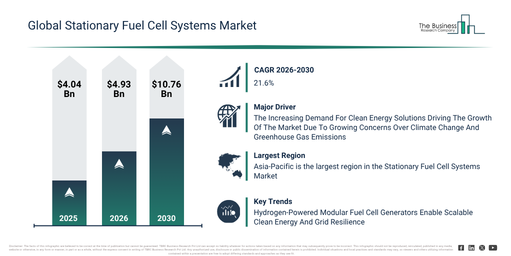
The market size for stationary fuel cell systems has expanded significantly in recent years. It will grow from $4.04 billion in 2025 to $4.93 billion in 2026 at a compound annual growth rate (CAGR) of 22.0%. This historical growth can be attributed to several factors, including the increasing demand for clean energy solutions, rising concerns over greenhouse gas emissions, the growing adoption of distributed power generation, expanding investments in hydrogen energy infrastructure, and an increasing need for reliable backup power systems.
The stationary fuel cell systems market size is projected to experience substantial expansion in the next few years. It is anticipated to grow to $10.76 billion by 2030, achieving a compound annual growth rate (CAGR) of 21.6%. This growth during the forecast period can be primarily attributed to the increasing deployment of hydrogen production and storage infrastructure, a rising demand for sustainable energy solutions in commercial facilities, the growing adoption of fuel cells for grid stabilization, the expanding utilization of stationary power systems in remote locations, and increasing investments in renewable energy integration. Additionally, significant trends identified for the forecast period encompass the increasing embrace of hydrogen-based clean energy generation systems, a growing requirement for reliable distributed power generation solutions, a rising preference for low-emission alternatives to conventional generators, the expanding integration of fuel cells within decentralized energy infrastructure, and an intensified focus on long-duration backup power solutions.
Get A Free Sample Report With In-Depth Market Insights:
Stationary Fuel Cell Systems Market Development Factors: What’s Supporting Demand?
The expanding need for clean energy technologies is anticipated to drive the progress of the stationary fuel cell system market in the future. These solutions encompass systems and technologies that produce, store, or manage energy from renewable or low-emission sources like solar, wind, hydrogen, and fuel cells, aiming to lessen environmental impact and greenhouse gas emissions. The rising call for clean energy stems from increasing worries about climate change and greenhouse gas emissions, prompting governments, businesses, and individuals to transition from fossil fuels to sustainable, low-carbon energy alternatives. Stationary fuel cell systems contribute to clean energy solutions by effectively transforming hydrogen into electricity without direct greenhouse gas emissions, thus aiding decarbonization and ensuring dependable low-carbon power. An example of this is the finding in March 2024 by the International Energy Agency (IEA), a France-based autonomous intergovernmental organization, that the growth of clean energy has helped curb the rise in global emissions, which saw an increase of merely 1.1% in 2023. Consequently, the escalating need for clean energy solutions is propelling the expansion of the stationary fuel cell system market.
Stationary Fuel Cell Systems Market Segment Breakdown: Which Categories Lead On Revenue?
The stationary fuel cell systems market covered in this report is segmented –
1) By Technology: Proton Exchange Membrane Fuel Cell, Solid Oxide Fuel Cell, Molten Carbonate Fuel Cell, Phosphoric Acid Fuel Cell
2) By Fuel Type: Hydrogen, Natural Gas, Biogas, Methanol
3) By Power Range: Less Than 1 Kilowatt, 5 Kilowatts To 250 Kilowatts, 250 Kilowatts To 1 Megawatt, More Than 1 Megawatt
4) By Application: Prime Power, Combined Heat And Power, Uninterruptible Power Supply, Backup Power
5) By End User: Residential, Commercial, Industrial, Utilities
Subsegments:
1) By Proton Exchange Membrane Fuel Cell: High Temperature Proton Exchange Membrane Fuel Cell, Low Temperature Proton Exchange Membrane Fuel Cell, Hydrogen Fueled Proton Exchange Membrane Fuel Cell, Methanol Fueled Proton Exchange Membrane Fuel Cell
2) By Solid Oxide Fuel Cell: Planar Solid Oxide Fuel Cell, Tubular Solid Oxide Fuel Cell, Intermediate Temperature Solid Oxide Fuel Cell, High Temperature Solid Oxide Fuel Cell
3) By Molten Carbonate Fuel Cell: Internal Reforming Molten Carbonate Fuel Cell, External Reforming Molten Carbonate Fuel Cell, Natural Gas Fueled Molten Carbonate Fuel Cell, Biogas Fueled Molten Carbonate Fuel Cell
4) By Phosphoric Acid Fuel Cell: Atmospheric Pressure Phosphoric Acid Fuel Cell, Pressurized Phosphoric Acid Fuel Cell, Natural Gas Fueled Phosphoric Acid Fuel Cell, Hydrogen Fueled Phosphoric Acid Fuel Cell
Stationary Fuel Cell Systems Market Transformation Trends: What Innovations Are Driving Change?
Leading companies within the stationary fuel cell systems market are concentrating on developing innovative solutions, such as hydrogen-fueled modular fuel cell generators, to boost clean energy generation, strengthen grid resilience, and facilitate the effective storage and use of renewable energy. These hydrogen-powered modular fuel cell generators represent sophisticated electrochemical systems that convert hydrogen into electricity through an electrochemical reaction, yielding only water and heat as by-products. They are designed in scalable containerized units for flexible deployment across industrial, commercial, and grid-support applications. For instance, in March 2023, Nuvera Fuel Cells LLC, a US-based clean energy technology company, introduced its G-Series Fuel Cell Power Generators in 360 kW and 470 kW configurations, tailored for commercial and industrial stationary applications. This system operates on hydrogen and delivers three-phase AC power in a containerized modular format, allowing versatile deployment for data centers, electric vehicle charging infrastructure, backup power systems, and microgrids. It is engineered to utilize hydrogen produced from surplus renewable energy, enabling efficient energy storage and reconversion to electricity during peak demand or grid outages, thereby improving energy reliability and contributing to the decarbonization of power systems.
Stationary Fuel Cell Systems Market Industry Leaders And Competitive Landscape
Major companies operating in the stationary fuel cell systems market are Panasonic Holdings Corporation, Denso Corporation, Cummins Inc., Mitsubishi Heavy Industries Ltd., L’Air Liquide S.A., Toshiba Energy Systems & Solutions Corporation, Fuji Electric Co. Ltd., Bloom Energy Corporation, Plug Power Inc., Doosan Fuel Cell Co. Ltd., FuelCell Energy Inc., SFC Energy AG, Ceres Power Holdings plc, Horizon Fuel Cell Technologies Pte Ltd, PowerCell Sweden AB, GenCell Ltd., Nedstack Fuel Cell Technology B.V., Advent Technologies Holdings Inc., AFC Energy plc, Ballard Power Systems Inc., Robert Bosch GmbH, Elcogen AS, SolidPower S.p.A.
View The Full Stationary Fuel Cell Systems Market Report:
Stationary Fuel Cell Systems Market Regional Analysis And Leading Geography
Asia-Pacific was the largest region in the stationary fuel cell systems market in 2025. Middle East is expected to be the fastest-growing region in the forecast period. The regions covered in the stationary fuel cell systems market report are Asia-Pacific, South East Asia, Western Europe, Eastern Europe, North America, South America, Middle East, Africa.
Reach Out To Our Team:
The Business Research Company: https://www.thebusinessresearchcompany.com/
Americas: +1 310-496-7795
Asia: +44 7882 955267 & +91 8897263534
Europe: +44 7882 955267
Email us at: marketing@tbrc.info
Follow us on:
LinkedIn: https://in.linkedin.com/company/the-business-research-company
YouTube: https://www.youtube.com/channel/UC24_fI0rV8cR5DxlCpgmyFQ
Global Market Model: https://www.thebusinessresearchcompany.com/global-market-model

Wasay has over a decade of experience in market research, data modelling, and analytics, with prior experience at GlobalData and Decision Tree Consulting Services. At The Business Research Company , he leads research operations across syndicated studies, customized consulting engagements, and the Global Market Model platform. His professional experience includes supporting organizations such as Boston Consulting Group, KPMG, and Ernst & Young. Wasay holds a degree in Electronics and Communications Engineering, postgraduate management qualifications from International Management Institute Belgium and Indian School of Business and Entrepreneurship, and completed the Integrated Program in Business Analytics from Indian Institute of Management Indore.