
Enhanced with market attractiveness analysis, total addressable market evaluation, company benchmarking matrices, interactive Excel dashboards, expanded supply chain intelligence, emerging startup coverage, and detailed product insights, The Business Research Company’s 2026 market reports deliver more actionable and strategically valuable research.
Thermal Energy Storage For Artificial Intelligence (AI) Data Centers Market Size Outlook: How Fast Will Revenue Grow Through 2030?
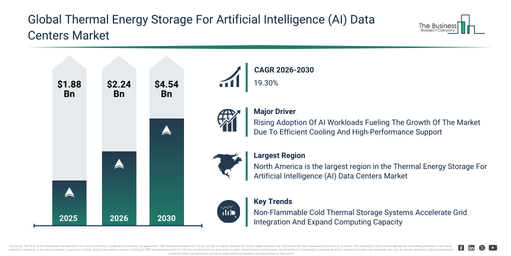
The thermal energy storage for artificial intelligence (AI) data centres market has experienced substantial growth in recent years. This market is anticipated to expand from $1.88 billion in 2025 to $2.24 billion in 2026, achieving a compound annual growth rate (CAGR) of 19.5%. The historical growth of this market can be attributed to several factors: the escalating requirement for effective data centre cooling, the increase in energy consumption due to AI workloads, the rising implementation of chilled water and ice storage systems, the expansion of hyperscale data centres, and an intensified focus on reducing operational cooling expenses.
The thermal energy storage for artificial intelligence (AI) data centres market is anticipated to experience substantial expansion over the coming years. This market is projected to reach $4.54 billion by 2030, exhibiting a compound annual growth rate (CAGR) of 19.3%. This expansion during the forecast period is primarily driven by the increasing implementation of phase change materials and thermal batteries, a growing need for environmentally friendly and carbon-neutral cooling methods, rising investments in AI-powered energy management platforms, the worldwide proliferation of edge and colocation data centres, and the increasing impetus to move cooling energy consumption to off-peak periods. Significant trends expected during this forecast timeframe encompass progress in intelligent thermal storage optimization software, breakthroughs in integrating high-density liquid and immersion cooling, the creation of modular and distributed thermal storage systems for edge locations, ongoing research and development into advanced storage media such as composite PCM, and technological improvements in automated load balancing between thermal storage and HVAC systems.
Download A Free Sample Report For Comprehensive Market Insights:
Thermal Energy Storage For Artificial Intelligence (AI) Data Centers Market Growth Drivers: What Factors Are Accelerating Expansion?
The anticipated expansion of the thermal energy storage for artificial intelligence (AI) data centers market is significantly influenced by the escalating integration of AI workloads. These workloads encompass demanding computational operations such as training models, conducting inference, and processing extensive data, which are executed on high-performance servers specifically designed for artificial intelligence and machine learning applications. The surge in AI workload adoption stems from numerous organizations, cloud providers, and hyperscalers actively expanding their AI-optimized infrastructure to support advanced applications like generative AI and large-model training. Thermal energy storage solutions for artificial intelligence (AI) data centers bolster the adoption of AI workloads by providing effective cooling mechanisms, lowering operational energy expenses, and facilitating robust high-performance computing environments. This technology guarantees consistent operation, supports intensive AI processing demands, and contributes to the overall sustainability of data centers. For instance, in April 2025, the International Energy Agency (IEA), a Paris-based intergovernmental organisation, projected that global data centre electricity consumption would more than double, escalating from approximately 415 TWh in 2024 to around 945 TWh by 2030, largely propelled by AI-optimised workloads. Consequently, the increasing embrace of AI workloads is a primary catalyst for the growth within the thermal energy storage for artificial intelligence (AI) data centers market. The expansion of the thermal energy storage for artificial intelligence (AI) data centers market is also being propelled by the increasing penetration of cloud computing. Cloud computing involves the provision of various computing assets, including servers, storage, databases, networking, software, and analytics, accessible via the internet to enable quicker innovation, flexible resource allocation, and benefits from economies of scale. The widespread use of cloud computing is primarily driven by its inherent scalability, which allows businesses to readily adapt their computing resources based on fluctuating demand while simultaneously reducing infrastructure expenditures. Thermal energy storage for artificial intelligence (AI) data centers facilitates cloud computing by ensuring efficient cooling, minimizing energy usage, and maintaining optimal operational conditions for server equipment. This contributes to enhanced reliability, superior performance, and greater scalability for cloud-based services. An example highlighting this trend is from December 2023, where Eurostat, a Luxembourg-based government organization, reported that 45.2% of enterprises across the European Union had acquired cloud computing services, with adoption rates reaching 77.6% among large enterprises, 59% for medium-sized enterprises, and 41.7% among small businesses. Therefore, the expanding adoption of cloud computing serves as a significant impetus for the growth of the thermal energy storage for artificial intelligence (AI) data centers market.
Thermal Energy Storage For Artificial Intelligence (AI) Data Centers Market Segment Outlook: Which Categories Are Expanding The Fastest?
The thermal energy storage for artificial intelligence (AI) data centers market covered in this report is segmented –
1) By Technology: Sensible Heat Storage, Latent Heat Storage, Thermochemical Storage
2) By Cooling Type: Liquid Cooling, Air Cooling
3) By Deployment: On-Premises Data Centers, Colocation Data Centers, Hyperscale Data Centers, Micro Data Centers
4) By Storage: Water, Phase Change Materials, Ice
5) By End-User: Cloud Service Providers, Enterprises And Corporate Data Centers, Artificial Intelligence (AI) Research And High-Performance Computing (HPC) Facilities, Government And Defense Data Centers, Banking, Financial Services, And Insurance (BFSI) Data Centers, Telecom And Information Technology (IT) Infrastructure Operators
Subsegments:
1) By Sensible Heat Storage: Water Based Storage, Molten Salt Storage, Concrete Storage, Brick Storage, Phase Change Material Based Storage
2) By Latent Heat Storage: Organic Phase Change Material Storage, Inorganic Phase Change Material Storage, Eutectic Salt Storage, Paraffin Wax Storage, Hydrated Salt Storage
3) By Thermochemical Storage: Adsorption Based Storage, Absorption Based Storage, Chemical Reaction Based Storage, Reversible Hydration Storage, Metal Hydride Storage
Thermal Energy Storage For Artificial Intelligence (AI) Data Centers Market Trends: What Is Shaping Future Industry Growth?
Leading companies in the thermal energy storage for artificial intelligence (AI) data centers market are concentrating on developing advanced products, such as non-flammable cold thermal energy storage (CTES) systems. This focus aims to accelerate grid connection, enhance computing capacity, and reduce both deployment time and associated risks. Non-flammable CTES systems are defined as energy storage solutions that employ water as a medium to store and release cooling energy, offering a secure alternative to chemical batteries. For instance, in November 2025, Nostromo Energy, a US-based energy storage company, introduced IceBrick360, a patented CTES system specifically engineered for high-demand data centers. This system is designed to shift a significant portion of cooling energy demand (10-30% of a data center’s peak electrical load) to off-peak hours by charging when power is inexpensive and discharging the stored cold energy during periods of high demand, enabling immediate load curtailment for the grid. It boasts a substantial 360TRh capacity per unit for major cooling loads, includes a 10-year warranty, offers over 20 years of daily use with practically zero degradation, and features automated integration with utility signals for demand-response markets.
Thermal Energy Storage For Artificial Intelligence (AI) Data Centers Market Key Companies And Competitive Benchmarking
Major companies operating in the thermal energy storage for artificial intelligence (AI) data centers market are Siemens Energy AG, Johnson Controls International plc, Carrier Global Corporation, Trane Technologies plc, Energy Vault Holdings Inc., Antora Energy Inc., PLUSS Advanced Technologies Pvt Ltd., Steffes Corporation, MGA Thermal Pty Ltd., Electrified Thermal Solutions Inc., Sunamp Ltd., Exowatt Inc., Rondo Energy Inc., Malta Inc., Knode Pty Ltd., Nostromo Energy Ltd., EnergyNest AS, Advanced Cooling Technologies Inc., Kraftblock GmbH, Fourth Power Inc.
Access The Complete Thermal Energy Storage For Artificial Intelligence (AI) Data Centers Market Report:
#Thermal Energy Storage For Artificial Intelligence (AI) Data Centers Market Largest Region: Which Geography Holds The Highest Market Share?
North America was the largest region in the thermal energy storage for AI data centers market in 2025. Asia–Pacific is expected to be the fastest-growing region in the forecast period. The regions covered in the thermal energy storage for artificial intelligence (AI) data centers market report are Asia-Pacific, South East Asia, Western Europe, Eastern Europe, North America, South America, Middle East, Africa.
Get in touch with us:
The Business Research Company: https://www.thebusinessresearchcompany.com/
Americas: +1 310-496-7795
Asia: +44 7882 955267 & +91 8897263534
Europe: +44 7882 955267
Email us at: marketing@tbrc.info
Follow us on:
LinkedIn: https://in.linkedin.com/company/the-business-research-company
YouTube: https://www.youtube.com/channel/UC24_fI0rV8cR5DxlCpgmyFQ
Global Market Model: https://www.thebusinessresearchcompany.com/global-market-model

Wasay has over a decade of experience in market research, data modelling, and analytics, with prior experience at GlobalData and Decision Tree Consulting Services. At The Business Research Company , he leads research operations across syndicated studies, customized consulting engagements, and the Global Market Model platform. His professional experience includes supporting organizations such as Boston Consulting Group, KPMG, and Ernst & Young. Wasay holds a degree in Electronics and Communications Engineering, postgraduate management qualifications from International Management Institute Belgium and Indian School of Business and Entrepreneurship, and completed the Integrated Program in Business Analytics from Indian Institute of Management Indore.