
Through market attractiveness analysis, total addressable market evaluation, company benchmarking matrices, interactive Excel dashboards, expanded supply chain intelligence, emerging startup coverage, and detailed product insights, The Business Research Company’s 2026 market reports provide more actionable and strategically valuable research.
Waste To Hydrogen Market Forecast: What Market Value Is Expected By 2030?
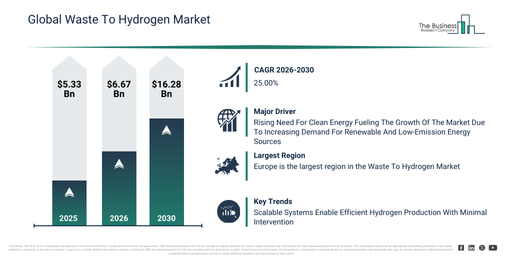
The waste to hydrogen market size has undergone significant expansion in recent years. This market is forecast to increase from $5.33 billion in 2025 to $6.67 billion in 2026, achieving a compound annual growth rate (CAGR) of 25.2%. The growth observed in the past can be ascribed to an elevated focus on waste-to-energy initiatives, an escalation in waste generation within urban areas, increased adoption of hydrogen in industrial applications, augmented government support for clean fuel projects, and mounting apprehension over landfill capacities.
The waste to hydrogen market size is anticipated to undergo significant expansion over the next few years. It is projected to achieve a valuation of $16.28 billion by 2030, growing at a compound annual growth rate (CAGR) of 25.0%. This projected growth can be attributed to several factors including increased investments in circular economy models, a growing demand for green hydrogen in the transportation sector, the rising integration of advanced conversion technologies, the expanding adoption of hydrogen in power and heating sectors, and escalating regulatory pressure for low-carbon energy solutions. Prominent trends expected during this forecast period encompass technological advancements in thermochemical conversion, innovations in hydrothermal liquefaction systems, improvements in catalyst efficiency for hydrogen production, ongoing research and development in biological hydrogen generation, and the technological integration of artificial intelligence (AI) for waste sorting and processing.
Download A Free Sample Report For Comprehensive Market Insights:
Waste To Hydrogen Market Growth Factors Supporting Long-Term Expansion
The expanding demand for clean energy is projected to drive the expansion of the waste to hydrogen market in the future. Clean energy is defined as power derived from renewable or low-emission sources, designed to lessen environmental harm and lower greenhouse gas emissions. The escalating need for clean energy stems from a heightened understanding of environmental sustainability, given its role in mitigating greenhouse gas emissions and tackling climate change. Waste to hydrogen contributes to clean energy ecosystems by converting municipal, industrial, and agricultural waste into renewable hydrogen, thereby presenting a sustainable alternative to fossil fuels. This process lowers greenhouse gas emissions through the valorization of waste streams, enhancing environmental sustainability and aiding decarbonization objectives. As an illustration, in June 2024, data from the International Energy Agency, an intergovernmental organization based in France, indicated that global investment in clean energy hit $80 billion in 2024, up from $67 billion in 2023. Consequently, the increasing requirement for clean energy is fueling the expansion of the waste to hydrogen market.
Waste To Hydrogen Market Segment Breakdown: Which Categories Generate The Most Revenue?
The waste to hydrogen market covered in this report is segmented –
1) By Feedstock Type: Municipal Solid Waste, Industrial Waste, Agricultural Waste, Wastewater, Food Waste
2) By Technology: Gasification, Pyrolysis, Anaerobic Digestion, Steam Reforming, Hydrothermal Liquefaction
3) By Application: Fuel Cells, Power Generation, Transportation, Chemical Production, Heating
4) By End Use Industry: Energy, Automotive, Chemical, Manufacturing, Residential
Subsegments:
1) By Municipal Solid Waste: Residential Waste, Commercial Waste, Institutional Waste, Construction Waste, Green Organic Waste
2) By Industrial Waste: Manufacturing Waste, Chemical Processing Waste, Metal Processing Waste, Textile Industry Waste, Pharmaceutical Industry Waste
3) By Agricultural Waste: Crop Residue, Livestock Manure, Harvest Waste, Food Crop Processing Waste, Forestry Residue
4) By Wastewater: Municipal Wastewater, Industrial Wastewater, Sewage Sludge, Slurry Wastewater, Organic Effluent Wastewater
5) By Food Waste: Household Food Waste, Retail Food Waste, Restaurant Food Waste, Food Processing Waste, Expired Packaged Food Waste
Waste To Hydrogen Market Industry Trends Shaping Future Revenue Growth
Major companies operating in the waste to hydrogen market are focusing on developing advanced waste-to-energy solutions, such as thermochemical conversion processes, to boost sustainability, enhance energy security, and reduce landfill waste and carbon emissions. Thermochemical conversion processes refer to advanced mechanisms that use high temperatures to break down non-recyclable waste materials into hydrogen and other valuable outputs. For instance, in August 2024, Manah Hydrogen, an Oman-based clean energy startup, launched its first waste-to-hydrogen pilot projects. The projects utilize a proprietary thermochemical conversion process designed to efficiently transform municipal and agricultural waste into clean hydrogen fuel. The system is engineered to be highly scalable and incorporates automated feedstock sorting and process optimization, enabling seamless hydrogen production from varying waste streams with minimal operator intervention. It also incorporates carbon capture technology and efficient resource management, aiming to maximize hydrogen yield while minimizing the environmental footprint for municipalities and industrial partners.
Waste To Hydrogen Market Key Players And Strategic Industry Positioning
Major companies operating in the waste to hydrogen market are Grandblue Environment Co. Ltd., BEEAH Group, Raven SR Inc., Enerkem Inc., Aether fuels, Klean Industries Inc., Compact Syngas Solutions Ltd., Ways2H Inc., Concord Blue Energy Inc., Mote Inc., Ossus Biorenewables Pvt. Ltd., Sierra Energy Crop., H2-Enterprises Group Inc., H2SITE, Plagazi AB, Boson Energy SA, GEMCO Energy, SGH2 Energy Global Corp., Shirke Energy Pvt. Ltd., Powerhouse Energy Group plc
Access The Complete Waste To Hydrogen Market Report:
Waste To Hydrogen Market Regional Outlook: Where Are The Largest Opportunities Located?
Europe was the largest region in the waste to hydrogen market in 2025. Asia-Pacific is expected to be the fastest-growing region in the forecast period. The regions covered in the waste to hydrogen market report are Asia-Pacific, South East Asia, Western Europe, Eastern Europe, North America, South America, Middle East, Africa.
Get in touch with us:
The Business Research Company: https://www.thebusinessresearchcompany.com/
Americas: +1 310-496-7795
Asia: +44 7882 955267 & +91 8897263534
Europe: +44 7882 955267
Email us at: marketing@tbrc.info
Follow us on:
LinkedIn: https://in.linkedin.com/company/the-business-research-company
YouTube: https://www.youtube.com/channel/UC24_fI0rV8cR5DxlCpgmyFQ
Global Market Model: https://www.thebusinessresearchcompany.com/global-market-model

Wasay has over a decade of experience in market research, data modelling, and analytics, with prior experience at GlobalData and Decision Tree Consulting Services. At The Business Research Company , he leads research operations across syndicated studies, customized consulting engagements, and the Global Market Model platform. His professional experience includes supporting organizations such as Boston Consulting Group, KPMG, and Ernst & Young. Wasay holds a degree in Electronics and Communications Engineering, postgraduate management qualifications from International Management Institute Belgium and Indian School of Business and Entrepreneurship, and completed the Integrated Program in Business Analytics from Indian Institute of Management Indore.