
Backed by market attractiveness analysis, total addressable market sizing, company benchmarking matrices, interactive Excel dashboards, wider supply chain intelligence, emerging startup coverage, and detailed product-level insights, The Business Research Company’s 2026 market reports are designed to offer research that is more actionable and strategically valuable than ever.
Veterinary Oral Liquid Stability Systems Market Value Growth And Long-Term Outlook
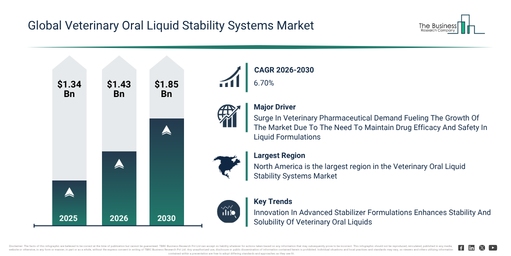
The veterinary oral liquid stability systems market has experienced robust growth in recent years. This market is projected to expand from $1.34 billion in 2025 to $1.43 billion in 2026, exhibiting a compound annual growth rate (CAGR) of 6.5%. Historically, this expansion has been driven by factors such as the limited stability duration of traditional veterinary oral formulations, a lack of advanced excipient technologies in animal drug manufacturing, high microbial contamination risks in liquid veterinary drugs, inconsistent formulation standards across veterinary pharmaceutical producers, and a dependence on manual formulation and storage practices.
The veterinary oral liquid stability systems market is projected to experience substantial expansion in the coming years. It is anticipated to reach $1. 85 billion by 2030, demonstrating a compound annual growth rate (CAGR) of 6. 7%. This projected growth throughout the forecast period stems from factors such as advancements in veterinary pharmaceutical formulation technologies, a heightened demand for veterinary medicines with extended shelf-lives, the increasing embrace of precision excipient engineering, a sharpened regulatory emphasis on drug stability and safety, and the broader implementation of automated formulation and quality control systems. Key trends anticipated during this period encompass sophisticated excipient engineering designed to bolster oral liquid stability in veterinary formulations, the wider incorporation of nanotechnology-based solubilization systems aimed at enhancing veterinary liquid drug uniformity, a surge in the utilization of smart packaging solutions for continuous stability monitoring of veterinary oral liquids, the increasing incorporation of predictive formulation modeling for optimizing stability in veterinary pharmaceuticals, and the spread of stabilization technologies for veterinary liquid medications that do not require a cold chain.
Get A Free Sample Report With In-Depth Market Insights:
Veterinary Oral Liquid Stability Systems Market Growth Momentum: What Factors Are Shaping Demand?
The expanding requirement for veterinary pharmaceuticals is projected to spur the growth of the veterinary oral liquid stability systems market moving forward. Veterinary pharmaceuticals encompass therapeutic products and medications developed to prevent, treat, or manage illnesses in animals, covering both livestock and companion species, thereby ensuring their health and productivity. The heightened need for these pharmaceuticals is a direct result of increasing livestock farming and a rise in pet ownership, both necessitating more medical interventions to maintain animal well-being. This surge in demand for veterinary pharmaceuticals consequently drives the need for veterinary oral liquid stability systems, as greater production of liquid formulations heightens the imperative to preserve drug efficacy and safety over time, ensuring active ingredients remain stable and effective through storage and administration. For instance, data from May 2025 by the Food and Drug Administration, a US-based government regulatory agency, indicated that US sales and distribution of medically important antimicrobial drugs approved for use in food-producing animals experienced a 16% increase between 2023 and 2024. This demonstrates how the escalating demand for veterinary pharmaceuticals is a key driver for the growth of the veterinary oral liquid stability systems market.
Veterinary Oral Liquid Stability Systems Market Segment Landscape And Growth Outlook
The veterinary oral liquid stability systems market covered in this report is segmented –
1) By Product Type: Preservative Systems, Buffering Agents, Flavoring Agents, Sweeteners, Other Product Types
2) By Animal Type: Companion Animals, Livestock, Other Animal Types
3) By Distribution Channel: Veterinary Hospitals, Retail Pharmacies, Online Pharmacies, Other Distribution Channels
4) By Application: Antibiotics, Nutritional Supplements, Anti-inflammatory Drugs, Other Applications
Subsegments:
1) By Preservative Systems: Natural Preservatives, Synthetic Preservatives, Antioxidants, Antimicrobial Agents
2) By Buffering Agents: Phosphate Buffers, Citrate Buffers, Acetate Buffers, Carbonate Buffers
3) By Flavoring Agents: Natural Flavors, Artificial Flavors, Sweet Flavors, Savory Flavors
4) By Sweeteners: Natural Sweeteners, Artificial Sweeteners, Sugar Alcohols, High Intensity Sweeteners
5) By Other Product Types: Emulsifiers, Stabilizers, Chelating Agents, Thickeners
Veterinary Oral Liquid Stability Systems Market Trends Redefining Industry Growth
Major companies operating in the veterinary oral liquid stability systems market are concentrating on developing advanced solutions, such as high-purity excipient systems, to enhance the chemical stability, solubility, and safety of veterinary oral liquid medications. High-purity excipient systems are specialized co-solvents, solubilizers, and stabilizers designed to maintain ingredient homogeneity, prevent degradation, reduce microbial load, and improve the bioavailability of sensitive active pharmaceutical ingredients in liquid formulations. For instance, in October 2024, Clariant AG, a Switzerland-based specialty chemicals company, launched its VitiPure LEX, VitiPure Superior, and VitiPure HCO excipient lines to support sensitive APIs and veterinary vaccines. These excipients feature ultra-low residual impurities, low endotoxin and microbial levels, and improved solubility for poorly water-soluble APIs, ensuring enhanced stability, colorless formulations, and consistent dosing in oral liquids.
Veterinary Oral Liquid Stability Systems Market Industry Leaders And Competitive Landscape
Major companies operating in the veterinary oral liquid stability systems market are Merck KGaA, Evonik Industries AG, DuPont de Nemours Inc., Ingredion Incorporated, Lonza Group AG, Wacker Chemie AG, Lubrizol Corporation, Clariant AG, IMCD N. V, Roquette Frères, Stepan Company, Croda International Plc, Ashland Global Holdings Inc., BASF SE, Colorcon Inc., Seppic SA, SPI Pharma Inc., Gattefossé SAS, Sigachi Industries Limited, ABITEC Corporation
View The Full Veterinary Oral Liquid Stability Systems Market Report:
Veterinary Oral Liquid Stability Systems Market Regional Analysis And Leading Geography
North America was the largest region in the veterinary oral liquid stability systems market in 2025. Asia-Pacific is expected to be the fastest-growing region in the forecast period. The regions covered in the veterinary oral liquid stability systems market report are Asia-Pacific, South East Asia, Western Europe, Eastern Europe, North America, South America, Middle East and Africa.
Reach Out To Our Team:
The Business Research Company: https://www.thebusinessresearchcompany.com/
Americas: +1 310-496-7795
Asia: +44 7882 955267 & +91 8897263534
Europe: +44 7882 955267
Email us at: marketing@tbrc.info
Follow us on:
LinkedIn: https://in.linkedin.com/company/the-business-research-company
YouTube: https://www.youtube.com/channel/UC24_fI0rV8cR5DxlCpgmyFQ
Global Market Model: https://www.thebusinessresearchcompany.com/global-market-model

Wasay has over a decade of experience in market research, data modelling, and analytics, with prior experience at GlobalData and Decision Tree Consulting Services. At The Business Research Company , he leads research operations across syndicated studies, customized consulting engagements, and the Global Market Model platform. His professional experience includes supporting organizations such as Boston Consulting Group, KPMG, and Ernst & Young. Wasay holds a degree in Electronics and Communications Engineering, postgraduate management qualifications from International Management Institute Belgium and Indian School of Business and Entrepreneurship, and completed the Integrated Program in Business Analytics from Indian Institute of Management Indore.