With a focus on actionable insights and strategic value, The Business Research Company’s 2026 market reports include market attractiveness scoring, total addressable market sizing, company benchmarking matrices, interactive Excel dashboards, deeper supply chain intelligence, emerging startup tracking, and granular product-level insights.
How Much Will The Carbon Dioxide (CO2) Mineralization Market Be Worth By 2030?
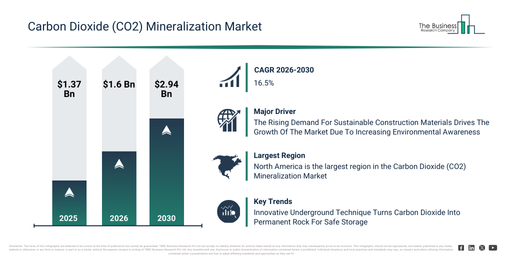
The carbon dioxide (CO2) mineralization market size has shown rapid expansion in recent years. It is projected to grow from $1.37 billion in 2025 to $1.6 billion in 2026, demonstrating a compound annual growth rate (CAGR) of 16.7%. Historically, this expansion has been driven by factors such as the increasing demand for carbon capture solutions, the growing use of mineralization in building materials, the adoption of magnesium-based cements, rising industrial emissions reduction initiatives, and regulatory support for CO2 management.
The carbon dioxide (CO2) mineralization market is anticipated to undergo significant expansion over the next few years. It is projected to reach $2.94 billion in 2030, growing at a compound annual growth rate (CAGR) of 16.5%. This growth in the forecast period is primarily driven by the increasing integration of advanced mineralization technologies, the expansion of ex-situ and in-situ mineralization projects, the development of scalable industrial applications, the rising adoption of enhanced weathering methods, and the growth in carbon credit and certification services. Prominent trends for the forecast period include the adoption of direct and indirect CO2 mineralization technologies, the expansion of enhanced weathering processes, the deployment of carbonate-based building materials, the integration of magnesium-based cements, and the implementation of monitoring and verification systems.
Get Access To A Free Carbon Dioxide (CO2) Mineralization Market Report Sample:
The Key Driver Behind The Carbon Dioxide (CO2) Mineralization Market’s 16.5% CAGR
The future expansion of the carbon dioxide (CO2) mineralization market is anticipated due to the increasing need for sustainable building materials. Sustainable construction materials are defined as building components that are ecologically sound, use resources efficiently, and are crafted to lessen environmental harm across their entire lifecycle, from creation and application to disposal or reuse. This heightened demand for sustainable construction materials stems from growing environmental consciousness among consumers, governments, and industries, recognizing the importance of lowering carbon footprints and fostering environmentally conscious building methods. Carbon dioxide (CO2) mineralization facilitates sustainable construction by transforming captured CO2 into stable carbonates suitable for use as environmentally friendly building components, thereby decreasing carbon emissions and advancing a circular economy in construction. An illustration of this trend is seen in July 2024, where the U.S. Green Building Council, a U.S.-based non-profit body, reported its involvement in over 46,000 residential projects certified under the LEED green building rating system in 2024. Furthermore, 2023 experienced nearly a 5% increase in new LEED residential project registrations. Consequently, the increasing need for sustainable construction materials is propelling the expansion of the carbon dioxide (CO2) mineralization market.
Carbon Dioxide (CO2) Mineralization Market Classification: Main Segments And Detailed Subsegments
The carbon dioxide (co2) mineralization market covered in this report is segmented –
1) By Technology: Direct Aqueous Mineralization, Indirect Mineralization, Enhanced Weathering, Other Technologies
2) By Feedstock: Natural Minerals, Industrial Waste, Other Feedstocks
3) By Application: Carbon Capture And Storage, Building Materials, Industrial Processes, Environmental Remediation, Other Applications
4) By End-User: Construction, Oil And Gas, Chemical, Power Generation, Other End-Users
Subsegments:
1) By Direct Aqueous Mineralization: In-Situ Mineralization, Ex-Situ Mineralization, Accelerated Carbonation, Brine-Based Mineralization
2) By Indirect Mineralization: Two-Step Carbonation, Acid Dissolution Process, Thermal Activation Process, Carbonation Of Industrial Residues
3) By Enhanced Weathering: Terrestrial Weathering, Marine Weathering, Olivine Weathering, Basalt Weathering
4) By Other Technologies: Electrochemical Mineralization, Biological Mineralization, Supercritical Carbon Dioxide Mineralization, Hybrid Mineralization Processes
Carbon Dioxide (CO2) Mineralization Market Strategic Shifts: What Leading Players Are Prioritizing
Leading companies within the carbon dioxide mineralization (CO2) market are concentrating on developing innovative solutions, such as in-situ mineralization, to transform CO2 into stable minerals for permanent and secure storage. In-situ mineralization is a technique where carbon dioxide (CO2) is directly injected into subterranean rock formations, reacting with naturally occurring minerals to form stable, solid carbonates, thereby achieving permanent CO2 storage within the Earth. For example, in April 2024, Deep Sky Corp., a Canada-based carbon removal technology and project development company, collaborated with Carbfix hf, an Iceland-based carbon capture and storage (CCS) firm, to launch Quebec’s first CO2 mineralization storage project, aiming to permanently sequester carbon by converting it into rock. These projects utilize a technology that injects CO2 into underground basaltic rock formations where it rapidly mineralizes into stable stone. This method ensures permanent and safe carbon sequestration within a few years, unlike conventional storage approaches. The project integrates Deep Sky’s carbon removal expertise with Carbfix’s proven mineralization technology to create scalable and commercially viable carbon storage solutions, supporting global net-zero goals.
Carbon Dioxide (CO2) Mineralization Market Company Analysis: Major Industry Participants
Major companies operating in the carbon dioxide (CO2) mineralization market are Heidelberg Materials AG, CEMEX S.A.B. de C.V., Lhoist Group S.A., Solidia Technologies Inc., Neustark AG, Calix Limited, Carbon Upcycling Technologies Inc., CarbiCrete Inc., Deep Sky Corp., Mineral Carbonation International Pty Ltd., CarbonBuilt LLC, Baie Minerals Inc., Green Minerals AS, Paebbl Inc., Blue Skies Minerals Inc., CO2 Lock Corporation, CarbonFree Chemicals Holdings LLC, Travertine Technologies Inc., Karbonetiq Inc, Carbfix hf.
Get Full Access To The Carbon Dioxide (CO2) Mineralization Market Report 2026:
Carbon Dioxide (CO2) Mineralization Market Global Regional Breakdown: Key Regions Analyzed
North America was the largest region in the carbon dioxide (CO2) mineralization market in 2025. Asia-Pacific is expected to be the fastest-growing region in the forecast period. The regions covered in the carbon dioxide (CO2) mineralization market report are Asia-Pacific, South East Asia, Western Europe, Eastern Europe, North America, South America, Middle East, Africa.
Reach Out To Our Team:
The Business Research Company: https://www.thebusinessresearchcompany.com/
Americas: +1 310-496-7795
Asia: +44 7882 955267 & +91 8897263534
Europe: +44 7882 955267
Email us at: marketing@tbrc.info
Follow us on:
LinkedIn: https://in.linkedin.com/company/the-business-research-company
YouTube: https://www.youtube.com/channel/UC24_fI0rV8cR5DxlCpgmyFQ
Global Market Model: https://www.thebusinessresearchcompany.com/global-market-model

Wasay has over a decade of experience in market research, data modelling, and analytics, with prior experience at GlobalData and Decision Tree Consulting Services. At The Business Research Company , he leads research operations across syndicated studies, customized consulting engagements, and the Global Market Model platform. His professional experience includes supporting organizations such as Boston Consulting Group, KPMG, and Ernst & Young. Wasay holds a degree in Electronics and Communications Engineering, postgraduate management qualifications from International Management Institute Belgium and Indian School of Business and Entrepreneurship, and completed the Integrated Program in Business Analytics from Indian Institute of Management Indore.