The Business Research Company’s 2026 market reports combine market attractiveness scoring, total addressable market sizing, company benchmarking matrices, interactive Excel dashboards, deeper supply chain intelligence, emerging startup tracking, and granular product-level insights to deliver research that is more actionable and strategically valuable.
Carbon Capture Low-Carbon Cement Additive Market Revenue Forecast: $1.63 Billion In 2026 Rising To $2.61 Billion In 2030
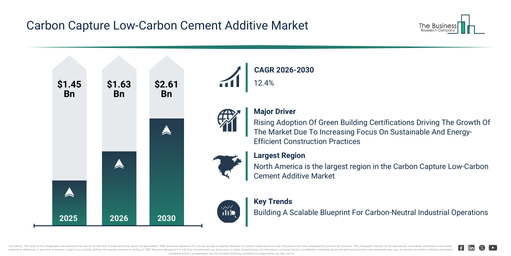
The carbon capture low-carbon cement additive market size has seen significant growth in recent years. It is anticipated to expand from $1.45 billion in 2025 to $1.63 billion in 2026, achieving a compound annual growth rate (CAGR) of 12.7%. Factors contributing to its historical growth include the increasing adoption of carbon-reducing cement additives, a rise in the use of mineralized CO2 aggregates, the expansion of low-carbon concrete projects, a reliance on supplementary cementitious materials, and the development of CO2-infused precast panels.
The carbon capture low-carbon cement additive market size is expected to witness significant growth in the upcoming years. It is projected to expand to $2.61 billion in 2030, achieving a compound annual growth rate (CAGR) of 12.4%. This anticipated growth during the forecast period is driven by factors such as the increasing manufacture of bio-based and chemical additives, the rising adoption of smart cement production, the broadening of carbon capture technologies, the development of high-performance low-carbon cement additives, and their growing use in residential, commercial, and infrastructure initiatives. Prominent trends for the forecast period include the integration of carbon capture cement additives, the deployment of CO2-infused precast concrete panels, the utilization of mineralized CO2 aggregates, the expansion of bio-based and chemical additives, and the implementation of smart cement production monitoring systems.
Free Sample Report: Carbon Capture Low-Carbon Cement Additive Market Size, Trends And Forecast To 2030:
Carbon Capture Low-Carbon Cement Additive Market Growth Catalyst: What Is Creating New Demand?
The increasing uptake of green building certifications is projected to stimulate the growth of the carbon capture low-carbon cement additive market. Green building certifications represent formal recognitions indicating that a structure complies with established benchmarks for environmental sustainability, energy efficiency, and occupant welfare. The expansion in green building certifications is primarily fueled by energy efficiency, as they lead to reduced resource consumption and lower operational expenditures. Carbon capture low-carbon cement additives play a role in achieving green building certifications by minimizing the carbon footprint of construction materials, thereby contributing to the creation of more sustainable and environmentally responsible buildings. For example, in February 2024, the US Green Building Council, a US-based non-profit organization that champions eco-friendly construction and developed the LEED certification system, reported that 2023 saw a 9% increase in LEED certifications compared to the previous year, along with 21 additional certifications specifically for single-family homes. New LEED project registrations also experienced a substantial jump of 51%. Therefore, the escalating adoption of green building certifications is driving the expansion of the carbon capture low-carbon cement additive market.
Carbon Capture Low-Carbon Cement Additive Market Segment Overview: Categories Covered In The 2026 Report
The carbon capture low-carbon cement additive market covered in this report is segmented –
1) By Product Type: Mineral-Based Additives, Chemical-Based Additives, Bio-Based Additives, Other Product Types
2) By Technology: Carbon Capture And Storage, Carbon Capture And Utilization, Direct Air Capture, Other Technologies
3) By Distribution Channel: Direct Sales, Distributors, Online Sales, Other Distribution Channels
4) By Application: Residential Construction, Commercial Construction, Infrastructure, Other Applications
5) By End-User: Construction Companies, Cement Manufacturers, Government And Municipalities, Other End-Users
Subsegments:
1) By Mineral-Based Additives: Fly Ash, Ground Granulated Blast Furnace Slag (GGBFS), Silica Fume, Limestone Powder, Natural Pozzolans, Calcined Clay
2) By Chemical-Based Additives: Carbonation Accelerators, Superplasticizers, Shrinkage-Reducing Agents, Corrosion Inhibitors, Air-Entraining Agents, Setting Retarders, Water-Reducing Agents
3) By Bio-Based Additives: Microalgae-Derived Additives, Lignin-Based Additives, Cellulose Nanomaterials, Biochar, Enzyme-Based Additives, Bacterial Carbonation Agents
4) By Other Product Types: Recycled Concrete Fines, Nano-Additives, Graphene-Based Additives, Geopolymer Additives, CO2-Infused Aggregates
How Are Leading Companies Shaping Carbon Capture Low-Carbon Cement Additive Market Trends?
Key businesses in the carbon capture low-carbon cement additive sector are prioritizing breakthroughs, specifically a complete value-chain strategy that combines CO2 capture, transportation, liquefaction, and long-term geological storage to minimize emissions throughout the cement manufacturing process. This full-value-chain method involves orchestrating every phase of carbon management, encompassing CO2 capture at facilities, its conveyance, processing, and eventual permanent storage or reuse, all within a unified system. For example, in March 2025, the Vicat group, a French producer of mineral-based construction materials like cement, ready-mixed concrete, and aggregates, initiated the Vicat Advanced Industrial Alliance (VAIA) project. This initiative intends to capture and utilize 1.2 million tonnes of CO2 each year, representing almost 100% of the plant’s emissions. The project strengthens Vicat’s wider decarbonization efforts, which involve lowering clinker content, substituting fossil fuels, and improving energy efficiency. Comparable to taking 75,000 combustion-engine vehicles off the road annually, the sequestered CO2 will be moved via a repurposed existing pipeline to Fos-sur-Mer, where it will be liquefied and then permanently placed in geological reservoirs.
Carbon Capture Low-Carbon Cement Additive Market Players: Key Companies Shaping Competition
Major companies operating in the carbon capture low-carbon cement additive market are Thyssenkrupp AG, CRH plc, Holcim Ltd, Heidelberg Materials AG, CEMEX S.A.B. de C.V., The Siam Cement Public Company Limited (SCG), Adani Group, Titan Cement International S.A., Calix Limited, Carbon Upcycling Technologies Inc., CarbonCure Technologies Inc., CarbiCrete Inc., Brimstone Energy Inc., Ecocem Materials Limited, CarbonBuilt Inc., Blue Planet Systems Corporation, Neocrete Limited, Alithic Limited, Terra CO2 Technologies Inc., Mineral Carbonation International Pty Ltd, Solid Carbon Inc.
Access Complete Carbon Capture Low-Carbon Cement Additive Market Data, Forecasts And Competitive Insights:
Carbon Capture Low-Carbon Cement Additive Market Regional Performance And Geographic Coverage
North America was the largest region in the carbon capture low-carbon cement additive market in 2025. The regions covered in the carbon capture low-carbon cement additive market report are Asia-Pacific, South East Asia, Western Europe, Eastern Europe, North America, South America, Middle East, Africa.
Reach Out To Our Team:
The Business Research Company: https://www.thebusinessresearchcompany.com/
Americas: +1 310-496-7795
Asia: +44 7882 955267 & +91 8897263534
Europe: +44 7882 955267
Email us at: marketing@tbrc.info
Follow us on:
LinkedIn: https://in.linkedin.com/company/the-business-research-company
YouTube: https://www.youtube.com/channel/UC24_fI0rV8cR5DxlCpgmyFQ
Global Market Model: https://www.thebusinessresearchcompany.com/global-market-model

Wasay has over a decade of experience in market research, data modelling, and analytics, with prior experience at GlobalData and Decision Tree Consulting Services. At The Business Research Company , he leads research operations across syndicated studies, customized consulting engagements, and the Global Market Model platform. His professional experience includes supporting organizations such as Boston Consulting Group, KPMG, and Ernst & Young. Wasay holds a degree in Electronics and Communications Engineering, postgraduate management qualifications from International Management Institute Belgium and Indian School of Business and Entrepreneurship, and completed the Integrated Program in Business Analytics from Indian Institute of Management Indore.