Backed by market attractiveness analysis, total addressable market sizing, company benchmarking matrices, interactive Excel dashboards, wider supply chain intelligence, emerging startup coverage, and detailed product-level insights, The Business Research Company’s 2026 market reports are designed to offer research that is more actionable and strategically valuable than ever.
Rocket Fluid Dynamics Market CAGR Outlook And Future Development
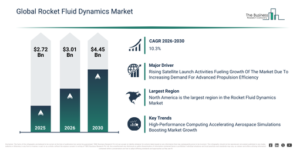
The rocket fluid dynamics market has experienced rapid expansion over recent years. Forecasts indicate it will escalate from $2.72 billion in 2025 to $3.01 billion in 2026, exhibiting a compound annual growth rate (CAGR) of 10.7%. Historically, this growth stemmed from several factors, including advancements in computational fluid dynamics improving engine and nozzle design accuracy, a rise in government and defense propulsion programs driving demand for fluid analysis services, the development of high-performance injectors and turbopumps requiring detailed flow modelling, the expansion of cryogenic propulsion systems necessitating specialized fluid-handling studies, and an increase in the utilization of test facilities such as wind tunnels supporting the validation of complex flow behaviors.
The market for rocket fluid dynamics is projected to expand significantly over the coming years. This sector is forecast to reach $4.45 billion by 2030, demonstrating a compound annual growth rate (CAGR) of 10.3%. This anticipated expansion stems from several factors, including the surge in commercial launch activities, which fuels the need for propulsion optimization consulting. Furthermore, progress in multi-physics simulation tools facilitates more accurate thermal–fluid modeling, while the proliferation of reusable rocket platforms necessitates advanced fluid dynamics analysis for their multiple flight cycles. The development of high-efficiency nozzle and combustion chamber designs also drives the requirement for sophisticated flow characterization. Additionally, increased funding for deep-space and high-energy missions boosts the demand for advanced cryogenic and high-pressure fluid systems analysis. Key developments expected during this period encompass high-fidelity multiphysics simulation, optimization of hypersonic propulsion, scaling up cryogenic fuel handling and testing, the adoption of hybrid simulation models combining on-premises and cloud deployments, and the application of model-based systems engineering in propulsion.
Get A Free Sample Report With In-Depth Market Insights:
Rocket Fluid Dynamics Market Growth Momentum: What Factors Are Shaping Demand?
Increased satellite launch endeavors are projected to fuel the expansion of the rocket fluid dynamics market in the future. These activities encompass the procedures for readying, moving, and deploying satellites into orbit utilizing rockets or alternative launch mechanisms. The rise in satellite launch operations stems from a surging requirement for global connectivity, propelled by an escalating need for high-speed internet. This necessitates resilient and adaptable satellite infrastructure to underpin contemporary communication networks, remote sensing uses, and strategic defense frameworks. Such launch efforts spur innovations in rocket fluid dynamics, fostering increased demand for propulsion systems that are both efficient and dependable. For example, in June 2024, according to a report from the Satellite Industry Association, a US-based organization, the commercial satellite industry in 2023 experienced unprecedented growth, deploying 2,781 satellites, marking a 20% increase from 2022. Furthermore, the space industry reached a significant milestone with a total of 190 launches, which stands as the highest figure ever documented. By the year’s conclusion, the count of active satellites reached 9,691, representing a 361% surge over the past five years. Consequently, the heightened volume of satellite launch activities is stimulating the expansion of the rocket fluid dynamics market.
Rocket Fluid Dynamics Market Segment Trends And Revenue Contributors
The rocket fluid dynamics market covered in this report is segmented –
1) By Component: Software, Hardware, Services
2) By Application: Aerospace, Defense, Research And Development, Commercial Space, Other Applications
3) By End-User: Government Agencies, Private Space Companies, Research Institutions, Other End-Users
Subsegments:
1) By Software: Computational Fluid Dynamics (CFD) Software, Propulsion Simulation Software, Thermal Analysis Software, Structural-Fluid Interaction Software, Multiphysics Simulation Platforms, Cloud-Based Simulation Tools
2) By Hardware: High-Performance Computing (HPC) Systems, Wind Tunnel Testing Equipment, Instrumentation And Sensors, Flow Visualization Systems, Thermal Imaging Devices, Data Acquisition Systems
3) By Services: Simulation And Modeling Services, Consulting And System Integration, Testing And Validation Services, Maintenance And Support Services, Custom Software Development, Training And Technical Support
Rocket Fluid Dynamics Market Trends Redefining Industry Growth
Leading companies in the rocket fluid dynamics market are concentrating on developing technologically advanced solutions, such as computational fluid dynamics (CFD) software, to improve propulsion system performance, optimize fuel efficiency, and shorten design cycle times for sophisticated rocket engines. Computational Fluid Dynamics (CFD) software serves as a simulation tool employed to model and analyze fluid flow, heat transfer, and combustion processes within rocket propulsion systems, aiming to boost both performance and design efficiency. For instance, in May 2024, the Indian Space Research Organisation (ISRO), an India-based space agency, created PraVaHa, an in-house Computational Fluid Dynamics (CFD) software specifically engineered for high-fidelity simulation of aerodynamic and aerothermal flows across various aerospace vehicles. This software, optimized for CPU and GPU-based high-performance computing, plays a critical role in the Gaganyaan mission by supporting the design and analysis of human-rated launch systems like HLVM3, the Crew Escape System, and the Crew Module.
Rocket Fluid Dynamics Market Competitive Landscape: Which Companies Lead The Industry?
Major companies operating in the rocket fluid dynamics market are Lockheed Martin Corporation, Northrop Grumman Corporation, Mitsubishi Heavy Industries Ltd., Safran S.A., Dassault Systèmes SE, Space Exploration Technologies Corp., Blue Origin LLC, ARIANESPACE SAS, Aerojet Rocketdyne Holdings Inc., ANSYS Inc., Virgin Galactic Holdings Inc., Sierra Nevada Corporation, United Launch Alliance LLC, IHI Corporation, Relativity Space Inc., Rocket Lab USA Inc., Firefly Aerospace Inc., Altair Engineering Inc., Ursa Major Technologies Inc., Avio S.p.A.
View The Full Rocket Fluid Dynamics Market Report:
Rocket Fluid Dynamics Market Top Region By Revenue And Market Share
North America was the largest region in the rocket fluid dynamics market in 2025. Asia-Pacific is expected to be the fastest-growing region in the forecast period. The regions covered in the rocket fluid dynamics market report are Asia-Pacific, South East Asia, Western Europe, Eastern Europe, North America, South America, Middle East, Africa.
Reach Out To Our Team:
The Business Research Company: https://www.thebusinessresearchcompany.com/
Americas: +1 310-496-7795
Asia: +44 7882 955267 & +91 8897263534
Europe: +44 7882 955267
Email us at: marketing@tbrc.info
Follow us on:
LinkedIn: https://in.linkedin.com/company/the-business-research-company
YouTube: https://www.youtube.com/channel/UC24_fI0rV8cR5DxlCpgmyFQ
Global Market Model: https://www.thebusinessresearchcompany.com/global-market-model

Wasay has over a decade of experience in market research, data modelling, and analytics, with prior experience at GlobalData and Decision Tree Consulting Services. At The Business Research Company , he leads research operations across syndicated studies, customized consulting engagements, and the Global Market Model platform. His professional experience includes supporting organizations such as Boston Consulting Group, KPMG, and Ernst & Young. Wasay holds a degree in Electronics and Communications Engineering, postgraduate management qualifications from International Management Institute Belgium and Indian School of Business and Entrepreneurship, and completed the Integrated Program in Business Analytics from Indian Institute of Management Indore.