Featuring market attractiveness scoring, total addressable market sizing, company benchmarking matrices, interactive Excel dashboards, deeper supply chain intelligence, emerging startup tracking, and granular product-level insights, The Business Research Company’s 2026 market reports are built to deliver research that is both more actionable and more strategically valuable.
Cylindrical Cell Battery Energy Storage System (BESS) Market Growth Analysis: How Will Revenue Trend Over The Forecast Period?
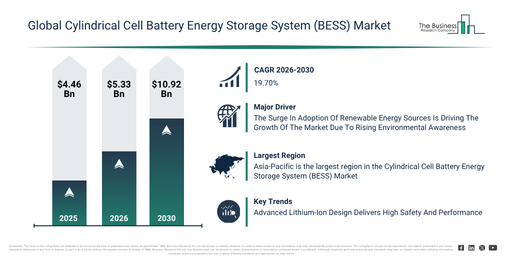
The market size for cylindrical cell battery energy storage systems (BESS) has shown rapid expansion in recent years. This market is set to increase from $4. 46 billion in 2025 to $5. 33 billion in 2026, achieving a compound annual growth rate (CAGR) of 19. 4%. The historical growth of this market can be attributed to several factors including the rising adoption of lithium-ion batteries, an increase in electric vehicle demand, growing integration of renewable energy, the decreasing cost of battery manufacturing, and progress in cell manufacturing technologies.
The cylindrical cell battery energy storage system (BESS) market size is projected to experience rapid growth in the coming years. It is anticipated to expand to $10.92 billion by 2030, achieving a compound annual growth rate (CAGR) of 19.7%. This growth during the forecast period is attributable to several factors, including increasing grid-scale energy storage deployments, a rising demand for long-duration storage systems, the ongoing expansion of smart grid infrastructure, advancements in battery recycling and second-life applications, and the general growth in decentralized energy systems. Key trends expected in the forecast period include advanced cylindrical cell energy density optimization, enhanced thermal runaway prevention in cylindrical battery architectures, modular battery pack scalability for grid-level storage, improvements in high cycle life and fast charge-discharge performance, and the standardization of cylindrical lithium-ion cell formats for BESS applications.
Get A Free Sample Report With In-Depth Market Insights:
Cylindrical Cell Battery Energy Storage System (BESS) Market Opportunity Drivers: What’s Unlocking New Revenue Potential?
The rising embrace of renewable energy sources is anticipated to drive the expansion of the cylindrical cell BESS market in the future. These sources, including solar, wind, and hydro, are eco-friendly power systems that substitute for or augment traditional fossil fuels, concurrently lowering greenhouse gas emissions. The growing uptake of renewable energy is increasing partly because of supportive government policies and incentives that stimulate capital infusion, lessen dependence on fossil fuels, and hasten the rollout of clean energy. Cylindrical cell BESS facilitates the integration of renewable energy by effectively holding surplus energy and delivering consistent power when generation is low or demand is high, thus guaranteeing grid equilibrium and uninterrupted power access. As an illustration, in June 2025, data from the Department of Climate Change, Energy, the Environment, and Water, an Australia-based government agency, revealed that renewable energy sources generated approximately 102,403 GWh, representing 36% of Australia’s total electricity production, marking an increase of one percentage point compared to 2023. Consequently, the expanding adoption of renewable energy sources is propelling the expansion of the cylindrical cell BESS market.
Cylindrical Cell Battery Energy Storage System (BESS) Market Segments: Where Is Growth Concentrated?
The cylindrical cell battery energy storage system (bess) market covered in this report is segmented –
1) By Battery Type: Lithium-ion, Nickel-cadmium, Nickel-metal hydride, Other Battery Types
2) By Installation Type: On-Grid Systems, Off-Grid Systems, Hybrid Systems
3) By Capacity: Below 2,500 mAh, 2,500–5,000 mAh, Above 5,000 mAh
4) By Distribution Channel: Original Equipment Manufacturers (OEMs), Aftermarket
5) By Application: Energy storage, Industrial, Automotive, Consumer electronics, Medical devices, Other Applications
Subsegments:
1) By Lithium-ion: Lithium Iron Phosphate Batteries, Lithium Nickel Manganese Cobalt Batteries, Lithium Nickel Cobalt Aluminum Batteries, Lithium Titanate Batteries, Lithium Cobalt Oxide Batteries
2) By Nickel-cadmium: Vented Nickel Cadmium Batteries, Sealed Nickel Cadmium Batteries, Industrial Grade Nickel Cadmium Batteries, High Temperature Nickel Cadmium Batteries, Low Maintenance Nickel Cadmium Batteries
3) By Nickel-metal Hydride: Standard Nickel Metal Hydride Batteries, High Capacity Nickel Metal Hydride Batteries, Low Self Discharge Nickel Metal Hydride Batteries, High Power Nickel Metal Hydride Batteries, Rechargeable Nickel Metal Hydride Batteries
4) By Other Battery Types: Solid State Batteries, Sodium Ion Batteries, Zinc Air Batteries, Lead Acid Batteries, Flow Batteries
Cylindrical Cell Battery Energy Storage System (BESS) Market Innovation Trends Shaping Future Development
Key companies operating within the cylindrical cell battery energy storage system (BESS) market are concentrating on developing advanced solutions, such as large-format cylindrical batteries, with the aim of improving energy density, enhancing safety performance, and enabling ultra-fast charging capabilities. Large cylindrical batteries are identified as next-generation lithium-ion cells featuring increased dimensions, like 46-series formats, specifically designed to offer higher energy output, improved thermal management, and scalable manufacturing efficiency for applications including electric vehicles and stationary energy storage systems. For example, in September 2025, EVE Energy Co., Ltd., a China-based battery manufacturer, introduced its new large cylindrical battery during IAA Mobility 2025. This particular solution is characterized by high energy density, a long cycle life, and fast-charging capability, positioning it as a crucial innovation for next-generation energy storage and electric mobility applications, while also addressing the growing demand for efficient and scalable BESS infrastructure.
Cylindrical Cell Battery Energy Storage System (BESS) Market Competitive Analysis Of Leading Industry Participants
Major companies operating in the cylindrical cell battery energy storage system (bess) market are Tesla Inc, Panasonic Energy Co Ltd, LG Energy Solution Ltd, Samsung SDI Co Ltd, Murata Manufacturing Co Ltd, EVE Energy Co Ltd, Gotion High-Tech Co Ltd, Energizer Holdings Inc, Northvolt AB, Saft Groupe SA, Duracell Inc, A123 Systems LLC, Shenzhen Redway Power Co Ltd, E-One Moli Energy Corp, Lithium Werks BV, Envision AESC Group Ltd, Farasis Energy Inc, Tianjin Lishen Battery Joint-Stock Co Ltd, BAK Battery Co Ltd, Tianjin BAK Power Battery Co Ltd
View The Full Cylindrical Cell Battery Energy Storage System (BESS) Market Report:
Cylindrical Cell Battery Energy Storage System (BESS) Market Geographic Spread And Regional Opportunities
Asia-Pacific was the largest region in the cylindrical cell battery energy storage system (BESS) market in 2025. North America is expected to be the fastest-growing region in the forecast period. The regions covered in the cylindrical cell battery energy storage system (BESS) market report are Asia-Pacific, South East Asia, Western Europe, Eastern Europe, North America, South America, Middle East and Africa.
Reach Out To Our Team:
The Business Research Company: https://www.thebusinessresearchcompany.com/
Americas: +1 310-496-7795
Asia: +44 7882 955267 & +91 8897263534
Europe: +44 7882 955267
Email us at: marketing@tbrc.info
Follow us on:
LinkedIn: https://in.linkedin.com/company/the-business-research-company
YouTube: https://www.youtube.com/channel/UC24_fI0rV8cR5DxlCpgmyFQ
Global Market Model: https://www.thebusinessresearchcompany.com/global-market-model

Wasay has over a decade of experience in market research, data modelling, and analytics, with prior experience at GlobalData and Decision Tree Consulting Services. At The Business Research Company , he leads research operations across syndicated studies, customized consulting engagements, and the Global Market Model platform. His professional experience includes supporting organizations such as Boston Consulting Group, KPMG, and Ernst & Young. Wasay holds a degree in Electronics and Communications Engineering, postgraduate management qualifications from International Management Institute Belgium and Indian School of Business and Entrepreneurship, and completed the Integrated Program in Business Analytics from Indian Institute of Management Indore.