The Business Research Company’s 2026 market reports are designed to deliver research that is more actionable and strategically valuable. Key offerings include market attractiveness scoring, total addressable market sizing, company benchmarking matrices, interactive Excel dashboards, deeper supply chain intelligence, emerging startup tracking, and granular product-level insights.
Turboshaft Engine Market Size Insights: Annual Growth Rate, Revenue Outlook And Forecast Drivers
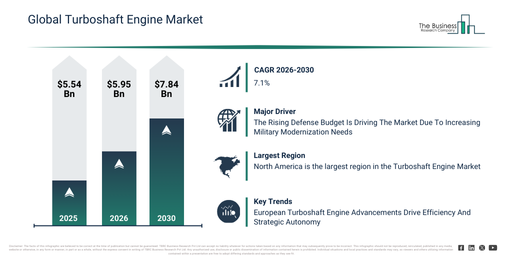
The turboshaft engine market has experienced substantial growth over recent years. It is anticipated to expand from $5.54 billion in 2025 to $5.95 billion in 2026, demonstrating a compound annual growth rate (CAGR) of 7.4%. This upward trend in the past can be attributed to several factors including an increase in military helicopter procurement, a rise in offshore oil and gas exploration, wider adoption in industrial power generation, continuous improvements in fuel efficiency, and breakthroughs in lightweight composite materials.
The turboshaft engine market is projected to experience robust expansion over the coming years. It is anticipated to reach $7.84 billion in 2030 at a compound annual growth rate (CAGR) of 7.1%. This projected growth stems from several factors, including increasing demand for urban air mobility and eVTOL applications, the expansion of defense rotorcraft initiatives, advancements in hybrid turboshaft engine technology, more stringent emission regulations pushing for engine optimization, and increased utilization in maritime propulsion systems. Key developments expected during this forecast period involve an escalating need for turboshaft engines within growing civil and parapublic helicopter fleets, a greater uptake of modular and upgradeable turboshaft engine designs, an enhanced emphasis on extending time-between-overhaul (tbo) and optimizing lifecycle costs, the broadening application of turboshafts in marine propulsion and industrial mechanical drive sectors, and increased consolidation along with strategic collaborations among engine OEMs and airframe manufacturers.
Request A Free Excerpt Of The Turboshaft Engine Global Market Report 2026:
What Will Drive Turboshaft Engine Market Growth Through 2030?
The expanding defense budget is anticipated to boost the turboshaft engine market. These budgets represent national government financial allocations specifically for the military’s planning, development, procurement, maintenance, and operational readiness, alongside related infrastructure. A key reason for their increase is the growing complexity of national security challenges, which necessitates greater government investment in advanced technologies, training, and capabilities to ensure strategic deterrence and a robust defense posture. Turboshaft engines enhance the performance, efficiency, and operational reliability of military helicopters and other rotary-wing aircraft, thereby supporting the objectives of these modernized and well-funded defense initiatives. For instance, in February 2025, the International Institute for Strategic Studies (IISS), a UK-based non-governmental think tank, reported that global defense spending surged to USD 2.46 trillion in 2024 from USD 2.24 trillion in 2023, with real-term growth accelerating to 7.4 percent compared to 6.5 percent in 2023 and 3.5 percent in 2022. This resulted in an average allocation of 1.9 percent of gross domestic product in 2024, up from 1.6 percent in 2022 and 1.8 percent in 2023. Consequently, the rising defense budget is a significant driver for the growth of the turboshaft engine market.
Turboshaft Engine Market Segment Analysis Covering All Major Categories
The turboshaft engine market covered in this report is segmented –
1) By Engine Type: Single-Spool Turboshaft Engines, Multi-Spool Turboshaft Engines, Turbocharged Turboshaft Engines
2) By Fuel Type: Aviation Turbine Fuel (ATF), Biofuels, Diesel, Jet Fuel
3) By Power Rating: Below 500 HP, 500–2000 HP, Above 2000 HP
4) By Application: Aerospace, Defense, Commercial Aviation, Industrial, Marine
5) By End-User: Commercial Operators, Military Or Government, Original Equipment Manufacturers (OEMs), Maintenance Repair And Overhaul (MRO) Providers
Subsegments:
1) By Single-Spool Turboshaft Engines: Light Duty Engines, Medium Duty Engines, Heavy Duty Engines
2) By Multi-Spool Turboshaft Engines: Twin Spool Engines, Triple Spool Engines, Variable Spool Engines
3) By Turbocharged Turboshaft Engines: Low Pressure Turbocharged Engines, Medium Pressure Turbocharged Engines, High Pressure Turbocharged Engines
Major Trends Shaping The Future Of The Turboshaft Engine Market
Leading companies within the turboshaft engine market are increasingly prioritizing strategic collaborations to advance free power turbine technology and develop high-efficiency engine components. This focus aims to boost overall performance, decrease fuel consumption, and meet the strict reliability and safety standards essential for contemporary military and civil helicopters. A free power turbine (FPT) is a specific component in a turboshaft engine that operates independently of the engine’s gas generator, extracting energy from exhaust gases to drive an output shaft, such as a helicopter rotor, without direct mechanical connection to the compressor or turbine responsible for the engine’s gas flow. For instance, in June 2025, Avio Aero, an Italy-based specialist in aviation propulsion systems, joined forces with Safran Helicopter Engines, a France-based helicopter engine manufacturer, and MTU Aero Engines, a Germany-based producer of commercial and military aircraft engines, to develop next-generation military helicopter engines. This partnership is expected to yield advanced turboshaft engines that will boast higher power-to-weight ratios, improved fuel efficiency, resilient free power turbines, modular designs, and integrated digital monitoring systems. These innovations are intended to simplify maintenance and enhance helicopter performance while supporting European strategic autonomy.
Turboshaft Engine Market Competitive Environment And Key Companies
Major companies operating in the turboshaft engine market are Honeywell Aerospace Inc., GE Aerospace, Pratt & Whitney, Rolls-Royce Plc, Aero Engine Corporation of China, Kawasaki Heavy Industries (KHI), IHI Corporation, AVIC Engine Corporation, MTU Aero Engines AG, Safran Group, ITP Aero S.A. (Bain Capital), Harbin Engine Group Co. Ltd., PBS GROUP, TUSAS Engine Industries Inc., Avio Aero S.p.A., Jakadofsky GmbH, Klimov JSC, Konner S.r.l., Motor Sich JSC, Astro Mechanica
Access Expert Turboshaft Engine Market Analysis In The Full Report:
Which Regions Are Covered In The Turboshaft Engine Market Report?
North America was the largest region in the turboshaft engine market in 2025. Asia-Pacific is expected to be the fastest-growing region in the forecast period. The regions covered in the turboshaft engine market report are Asia-Pacific, South East Asia, Western Europe, Eastern Europe, North America, South America, Middle East, Africa.
Reach Out To Our Team:
The Business Research Company: https://www.thebusinessresearchcompany.com/
Americas: +1 310-496-7795
Asia: +44 7882 955267 & +91 8897263534
Europe: +44 7882 955267
Email us at: marketing@tbrc.info
Follow us on:
LinkedIn: https://in.linkedin.com/company/the-business-research-company
YouTube: https://www.youtube.com/channel/UC24_fI0rV8cR5DxlCpgmyFQ
Global Market Model: https://www.thebusinessresearchcompany.com/global-market-model

Wasay has over a decade of experience in market research, data modelling, and analytics, with prior experience at GlobalData and Decision Tree Consulting Services. At The Business Research Company , he leads research operations across syndicated studies, customized consulting engagements, and the Global Market Model platform. His professional experience includes supporting organizations such as Boston Consulting Group, KPMG, and Ernst & Young. Wasay holds a degree in Electronics and Communications Engineering, postgraduate management qualifications from International Management Institute Belgium and Indian School of Business and Entrepreneurship, and completed the Integrated Program in Business Analytics from Indian Institute of Management Indore.