Market attractiveness scoring, total addressable market sizing, company benchmarking matrices, interactive Excel dashboards, deeper supply chain intelligence, emerging startup tracking, and granular product-level insights are among the key offerings featured in The Business Research Company’s 2026 market reports, designed to deliver more actionable and strategically valuable research.
Space Infrastructure Market Size Estimate For 2026 And Revenue Forecast Through 2030
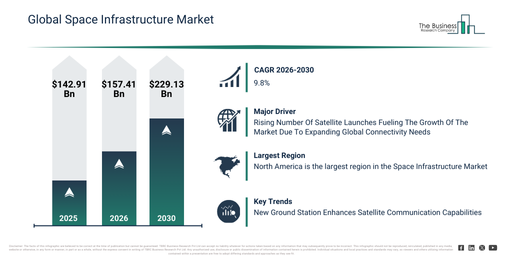
The space infrastructure market has experienced swift expansion recently. It is projected to grow from $142.91 billion in 2025 to $157.41 billion in 2026, at a compound annual growth rate (CAGR) of 10.1%. Historically, this expansion was driven by several key factors including the broadening of satellite networks, which increased the need for orbital support infrastructure; the creation of early space stations, enabling prolonged human presence in space; the rise in commercial launch activities, necessitating new spaceport facilities; the initial development and testing of space tug concepts for repositioning satellites and managing debris; and preliminary research along with prototypes for orbital refueling and servicing systems.
The space infrastructure market is anticipated to experience significant expansion over the coming years, with projections indicating it will reach $229.13 billion by 2030, demonstrating a compound annual growth rate (CAGR) of 9.8%. This projected growth is driven by several factors, including increased investment in advanced commercial space stations for research and industrial applications, the growing use of space tugs for extending satellite operational life and managing orbital logistics, rapid progress in developing orbital refueling centers for deep space missions, the expansion of global spaceport facilities to support more frequent launches, and enhanced partnerships between public and private entities to establish adaptable, multi-purpose space infrastructure. Key trends anticipated during this period involve the expansion of platforms for orbital refueling and servicing, the proliferation of commercial spaceports and launch sites, a rising need for reusable launch vehicles, improved integration of ground control systems, and the creation of modular and scalable space station designs.
Free Space Infrastructure Market Report Sample Available For Download:
Why Is Demand In The Space Infrastructure Market Expected To Keep Rising?
An increasing volume of satellite launches is anticipated to drive expansion in the space infrastructure market. Satellite launches refer to the process of sending artificial satellites into space using launch vehicles or rockets. The heightened demand for these launches stems from a growing global requirement for connectivity, as a greater number of regions seek dependable internet access through satellite broadband services. Space infrastructure supports satellite launches by supplying crucial ground-based and orbital systems, including launchpads, tracking stations, and command centers. This infrastructure guarantees mission success by facilitating pre-launch activities, real-time communications, and data management post-launch, thus allowing for efficient and dependable space operations. For instance, in January 2025, Space Foundation, a US-based nonprofit organization, reported that in 2024, 259 launches occurred, with an average rate of one every 34 hours, which was five hours faster than in 2023. Consequently, the increased volume of satellite launches is fueling the expansion of the space infrastructure market.
How Is The Space Infrastructure Market Divided Across Segments And Subsegments?
The space infrastructure market covered in this report is segmented –
1) By Component: Satellites, Ground Station, Launch Vehicles, Other Components
2) By Application: Earth Observation, Telecommunication, Research, Other Applications
3) By End-User: Commercial, Government, Private Agencies
Subsegments:
1) By Satellites: Communication Satellites, Earth Observation Satellites, Navigation Satellites, Scientific Satellites, Military And Intelligence Satellites, Technology Demonstration Satellites
2) By Ground Station: Antennas And Dishes, Radio Frequency (RF) Equipment, Telemetry, Tracking And Command (TT&C) Systems, Network Operations Centers (NOCs), Data Processing Units
3) By Launch Vehicles: Small-Lift Launch Vehicles, Medium-Lift Launch Vehicles, Heavy-Lift Launch Vehicles, Reusable Launch Vehicles, Sounding Rockets
4) By Other Components: Spaceports And Launch Pads, Integration And Testing Facilities, Propulsion Systems, Power Systems, Thermal Control Systems
Space Infrastructure Market Trends Reshaping Customer Demand And Business Strategies
Leading companies operating in the space infrastructure market are concentrating on strategic alliances to expand their global reach and expedite the deployment of advanced satellite and launch systems. Such collaborations involve partnerships between entities to utilize shared resources and expertise for mutual goals. These ventures foster innovation, decrease costs, and enhance competitive edge. For instance, in December 2024, the Space Science and Geospatial Institute (SSGI), an Ethiopia-based government agency, partnered with a Chinese firm to inaugurate a new 12-meter satellite ground station, a critical component of space infrastructure. This station boosts the country’s capability to independently communicate with and manage satellites, acquire high-resolution Earth observation data, and facilitate real-time monitoring. It also performs a vital role in essential sectors such as agriculture, disaster management, and environmental monitoring, thereby contributing to national development and resilience.
Space Infrastructure Market Major Players: Companies At The Forefront Of The Industry
Major companies operating in the space infrastructure market are The Boeing Company, Lockheed Martin Corporation, Airbus Group, China Aerospace Science and Technology Corporation, General Dynamics Corporation, Northrop Grumman Corporation, Honeywell International Inc., Mitsubishi Electric Corporation, Safran S.A., Thales Group, SpaceX, Blue Origin LLC, Hindustan Aeronautics Limited, Viasat Inc., Maxar Technologies Inc., OHB System AG, Sierra Nevada Corporation, Rocket Lab USA, Redwire Corporation, NanoAvionics, Astra Space Inc., Beijing Commsat Technology Development Co. Ltd
Read More About The Space Infrastructure Market In The Full Report:
Space Infrastructure Market Regional Share Analysis For 2025
North America was the largest region in the space infrastructure market in 2025. The regions covered in the space infrastructure market report are Asia-Pacific, South East Asia, Western Europe, Eastern Europe, North America, South America, Middle East, Africa.
Reach Out To Our Team:
The Business Research Company: https://www.thebusinessresearchcompany.com/
Americas: +1 310-496-7795
Asia: +44 7882 955267 & +91 8897263534
Europe: +44 7882 955267
Email us at: marketing@tbrc.info
Follow us on:
LinkedIn: https://in.linkedin.com/company/the-business-research-company
YouTube: https://www.youtube.com/channel/UC24_fI0rV8cR5DxlCpgmyFQ
Global Market Model: https://www.thebusinessresearchcompany.com/global-market-model

Wasay has over a decade of experience in market research, data modelling, and analytics, with prior experience at GlobalData and Decision Tree Consulting Services. At The Business Research Company , he leads research operations across syndicated studies, customized consulting engagements, and the Global Market Model platform. His professional experience includes supporting organizations such as Boston Consulting Group, KPMG, and Ernst & Young. Wasay holds a degree in Electronics and Communications Engineering, postgraduate management qualifications from International Management Institute Belgium and Indian School of Business and Entrepreneurship, and completed the Integrated Program in Business Analytics from Indian Institute of Management Indore.