Through market attractiveness analysis, total addressable market evaluation, company benchmarking matrices, interactive Excel dashboards, expanded supply chain intelligence, emerging startup coverage, and detailed product insights, The Business Research Company’s 2026 market reports provide more actionable and strategically valuable research.
Space Infrastructure Market Growth Analysis: How Will Revenue Expand During The Forecast Period?
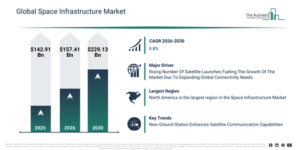
The space infrastructure market is projected to experience robust growth in the coming years, with its size expected to reach $229.13 billion by 2030, driven by a compound annual growth rate (CAGR) of 9.8%. This expansion is primarily attributed to several factors during the forecast period: increasing investment in next-generation commercial space stations for research and industrial uses, the growing deployment of space tugs for satellite life extension and orbital logistics, the accelerated development of orbital refueling hubs to support deep space missions, the expansion of global spaceport infrastructure to accommodate a higher frequency of launches, and enhanced collaboration between governments and private companies to construct scalable, multi-purpose space infrastructure. Significant trends expected in this period include the broadening of orbital refueling and servicing platforms, the growth of commercial spaceports and launch facilities, a rising demand for reusable launch vehicles, improved integration of ground control networks, and the continued development of modular and scalable space stations.
The increasing frequency of satellite launches is projected to stimulate the expansion of the space infrastructure market. Satellite launches involve deploying artificial satellites into orbit using launch vehicles or rockets. The growing need for these launches stems from the escalating global demand for connectivity, as more regions seek reliable internet access through satellite-based broadband services. Space infrastructure plays a crucial role in facilitating satellite launches by providing essential ground and orbital systems, such as launchpads, tracking stations, and command centers. These systems are vital for ensuring mission success by supporting pre-launch preparations, real-time communication during deployment, and post-launch data management, thereby enabling efficient and dependable space operations. For example, Space Foundation, a US-based nonprofit organization, reported in January 2025 that in 2024, 259 launches took place at an average rate of one every 34 hours, which was five hours faster than in 2023. Consequently, the rising volume of satellite launches is a primary driver for the growth of the space infrastructure market.
Download A Free Sample Report For Comprehensive Market Insights:
#Space Infrastructure Market Growth Factors: Which Forces Are Supporting Market Expansion?
Leading entities operating within the space infrastructure market are concentrating on strategic collaborations to broaden their global reach and accelerate the deployment of advanced satellite and launch systems. Such strategic alliances involve organizations coming together to leverage shared resources and expertise for common objectives. These partnerships foster innovation, reduce expenses, and enhance competitive advantage. For instance, in December 2024, the Space Science and Geospatial Institute (SSGI), an Ethiopia-based government agency, joined forces with a Chinese firm to launch a new 12-meter satellite ground station, which is a critical component of space infrastructure. This station improves the country’s capability to independently communicate with and control satellites, receive high-resolution Earth observation data, and support real-time monitoring. It also performs a vital function in crucial areas like agriculture, disaster management, and environmental monitoring, thereby contributing to national development and resilience.
Space Infrastructure Market Segment Analysis: What Are The Major Market Categories?
The space infrastructure market covered in this report is segmented –
1) By Component: Satellites, Ground Station, Launch Vehicles, Other Components
2) By Application: Earth Observation, Telecommunication, Research, Other Applications
3) By End-User: Commercial, Government, Private Agencies
Subsegments:
1) By Satellites: Communication Satellites, Earth Observation Satellites, Navigation Satellites, Scientific Satellites, Military And Intelligence Satellites, Technology Demonstration Satellites
2) By Ground Station: Antennas And Dishes, Radio Frequency (RF) Equipment, Telemetry, Tracking And Command (TT&C) Systems, Network Operations Centers (NOCs), Data Processing Units
3) By Launch Vehicles: Small-Lift Launch Vehicles, Medium-Lift Launch Vehicles, Heavy-Lift Launch Vehicles, Reusable Launch Vehicles, Sounding Rockets
4) By Other Components: Spaceports And Launch Pads, Integration And Testing Facilities, Propulsion Systems, Power Systems, Thermal Control Systems
#Space Infrastructure Market Growth Trends: What Is Influencing The Future Outlook?
Leading entities operating within the space infrastructure market are concentrating on strategic collaborations to broaden their global reach and accelerate the deployment of advanced satellite and launch systems. Such strategic alliances involve organizations coming together to leverage shared resources and expertise for common objectives. These partnerships foster innovation, reduce expenses, and enhance competitive advantage. For instance, in December 2024, the Space Science and Geospatial Institute (SSGI), an Ethiopia-based government agency, joined forces with a Chinese firm to launch a new 12-meter satellite ground station, which is a critical component of space infrastructure. This station improves the country’s capability to independently communicate with and control satellites, receive high-resolution Earth observation data, and support real-time monitoring. It also performs a vital function in crucial areas like agriculture, disaster management, and environmental monitoring, thereby contributing to national development and resilience.
Space Infrastructure Market Leading Companies: Who Holds Significant Market Presence?
Major companies operating in the space infrastructure market are The Boeing Company, Lockheed Martin Corporation, Airbus Group, China Aerospace Science and Technology Corporation, General Dynamics Corporation, Northrop Grumman Corporation, Honeywell International Inc., Mitsubishi Electric Corporation, Safran S.A., Thales Group, SpaceX, Blue Origin LLC, Hindustan Aeronautics Limited, Viasat Inc., Maxar Technologies Inc., OHB System AG, Sierra Nevada Corporation, Rocket Lab USA, Redwire Corporation, NanoAvionics, Astra Space Inc., Beijing Commsat Technology Development Co. Ltd
Access The Complete Space Infrastructure Market Report:
Space Infrastructure Market Geographic Landscape: Which Region Dominates Industry Growth?
North America was the largest region in the space infrastructure market in 2025. The regions covered in the space infrastructure market report are Asia-Pacific, South East Asia, Western Europe, Eastern Europe, North America, South America, Middle East, Africa.
Access a Customized Space Infrastructure Market Report for Deeper Competitive Insights
https://www.thebusinessresearchcompany.com/customise?id=25595&type=smp
The Business Research Company: https://www.thebusinessresearchcompany.com/
Americas: +1 310-496-7795
Asia: +44 7882 955267 & +91 8897263534
Europe: +44 7882 955267
Email us at: marketing@tbrc.info
Follow us on:
LinkedIn: https://in.linkedin.com/company/the-business-research-company
YouTube: https://www.youtube.com/channel/UC24_fI0rV8cR5DxlCpgmyFQ
Global Market Model: https://www.thebusinessresearchcompany.com/global-market-model

Wasay has over a decade of experience in market research, data modelling, and analytics, with prior experience at GlobalData and Decision Tree Consulting Services. At The Business Research Company , he leads research operations across syndicated studies, customized consulting engagements, and the Global Market Model platform. His professional experience includes supporting organizations such as Boston Consulting Group, KPMG, and Ernst & Young. Wasay holds a degree in Electronics and Communications Engineering, postgraduate management qualifications from International Management Institute Belgium and Indian School of Business and Entrepreneurship, and completed the Integrated Program in Business Analytics from Indian Institute of Management Indore.