Built to provide research that’s more actionable and strategically valuable, The Business Research Company’s 2026 market reports include market attractiveness analysis, total addressable market sizing, company benchmarking matrices, interactive Excel dashboards, broader supply chain intelligence, emerging startup tracking, and in-depth product insights.
Non-Chemical Space Propulsion System Market Growth Analysis: How Will Revenue Trend Over The Forecast Period?
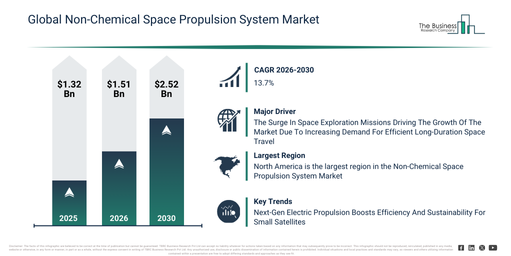
The non-chemical space propulsion system market has experienced significant expansion recently. This market is projected to expand from $1.32 billion in 2025 to $1.51 billion in 2026, achieving a compound annual growth rate (CAGR) of 14.0%. Historically, this expansion has been driven by several factors, including the greater uptake of electric propulsion systems for satellite station-keeping and orbit raising, enhancements in power processing units leading to better efficiency and thrust control, an increase in deep-space missions necessitating long-duration propulsion, the surge in small satellite launches boosting demand for compact non-chemical thrusters, and continued research into ion and hall-effect propulsion technologies.
The non-chemical space propulsion system market size is projected for swift expansion in the coming years. It is anticipated to reach $2.52 billion by 2030, exhibiting a compound annual growth rate (CAGR) of 13.7%. This anticipated growth during the forecast period stems from factors such as increasing investments in powerful electric propulsion for missions to the moon and other planets, a rising need for adaptable propulsion systems for extensive satellite constellations, the ongoing development of nuclear and plasma propulsion ideas for future exploration, the growth of commercial space operations that require effective in-space movement systems, and advancements in thermal management and propellant delivery technologies to boost propulsion efficiency. Key developments expected in this period encompass the miniaturization and modular design of non-chemical propulsion units for smaller satellites and vast constellations, the convergence of power and propulsion subsystems (PPS) to achieve greater system efficiency and reduce mass, an increasing embrace of high-specific-impulse propulsion for distant space and extended interplanetary journeys, the establishment of common non-chemical propulsion interfaces for rideshare operations and orbital transfer vehicles, and a growing requirement for propulsion solutions for tasks like in-orbit servicing, clearing space debris, and extending mission lifespans.
Get A Free Sample Report With In-Depth Market Insights:
Non-Chemical Space Propulsion System Market Development Factors: What’s Supporting Demand?
An increase in space exploration missions is anticipated to fuel the expansion of the non-chemical space propulsion system market in the future. These missions represent structured endeavors undertaken by humans or robotic probes to study and collect data from the cosmos beyond Earth’s atmosphere. This uptick in space exploration endeavors stems from a scientific drive to comprehend the universe, technological progress enabling deep-space journeys, and an ambition to locate novel resources and possible living environments beyond our planet. Such a rise in space exploration activities underpins current and prospective space initiatives by stimulating technological innovation, encouraging global partnership, and broadening scientific comprehension. For example, data from May 2024, provided by the National Space Operations Centre (NSpOC), a UK-based government body, indicated that active satellites in orbit totaled over 9,000 as of April 2024, with certain projections suggesting this figure could exceed 60,000 active satellites in space by 2030. Consequently, the escalating number of space exploration missions is accelerating the expansion of the non-chemical space propulsion system market.
Non-Chemical Space Propulsion System Market Segment Outlook: Which Categories Are Growing Fastest?
The non-chemical space propulsion system market covered in this report is segmented –
1) By Type: Nuclear Propulsion, Laser Propulsion
2) By Application: Commercial, Satellite Operators And Owners, Space Launch Service Providers, Government And Defense, Departments Of Defense, National Space Agencies, Other Applications
3) By End User: Civil And Earth Observation, Government And Military, Commercial
Subsegments:
1) By Nuclear Propulsion: Nuclear Thermal Propulsion, Nuclear Electric Propulsion, Radioisotope Thermoelectric Propulsion, Fission Fragment Propulsion, Fusion-Based Propulsion
2) By Laser Propulsion: Photon Pressure Propulsion, Laser Ablation Propulsion, Beamed Energy Propulsion, Laser Thermal Propulsion, Direct Energy Transfer Systems
Non-Chemical Space Propulsion System Market Transformation Trends: What Innovations Are Driving Change?
Leading companies active in the non-chemical space propulsion system market are concentrating on developing advanced technologies, such as electric propulsion systems, to boost efficiency and sustainability. Electric propulsion systems employ electrical energy to create thrust, allowing for quieter, more efficient, and cleaner locomotion of vehicles or spacecraft without relying on conventional chemical fuels. As an example, in May 2025, Enpulsion GmbH, an Austria-based aerospace and defense entity, introduced Nexus, a sophisticated propulsion system. Developed for spacecraft weighing up to 500 kilograms, Nexus provides considerably higher thrust and improved orbit-raising capacities to satisfy the rising requirement for responsive, high-performance electric propulsion in small satellite missions. The system incorporates a compact, modular design that supplies up to 7.1 mN of thrust and a specific impulse of 4,500 seconds, using a secure, non-toxic indium propellant. With its plug-and-play integration, absence of pressurized tanks, and scalable architecture, Nexus guarantees exceptional performance, safety, and adaptability across diverse satellite applications.
Non-Chemical Space Propulsion System Market Leading Companies And Competitive Benchmarking
Major companies operating in the non-chemical space propulsion system market are Airbus SE, Northrop Grumman Corporation, Safran SA, Thales Group, L3Harris Technologies Inc., IHI Corporation, Space Exploration Technologies Corp., Hanwha Aerospace Co. Ltd., Moog Inc., ArianeGroup, Sierra Space Corp., Benchmark Space Systems, Dawn Aerospace, Bradford Space, Busek Co. Inc., Comat Aerospace Corp., CU Aerospace LLC, Ad Astra Rocket Company, Enpulsion GmbH, LIA Aerospace Ltd., ThrustMe.
View The Full Non-Chemical Space Propulsion System Market Report:
Non-Chemical Space Propulsion System Market Geographic Distribution And Regional Opportunities
North America was the largest region in the non-chemical space propulsion system market in 2025. Asia-Pacific is expected to be the fastest-growing region in the forecast period. The regions covered in the non-chemical space propulsion system market report are Asia-Pacific, South East Asia, Western Europe, Eastern Europe, North America, South America, Middle East, Africa.
Reach Out To Our Team:
The Business Research Company: https://www.thebusinessresearchcompany.com/
Americas: +1 310-496-7795
Asia: +44 7882 955267 & +91 8897263534
Europe: +44 7882 955267
Email us at: marketing@tbrc.info
Follow us on:
LinkedIn: https://in.linkedin.com/company/the-business-research-company
YouTube: https://www.youtube.com/channel/UC24_fI0rV8cR5DxlCpgmyFQ
Global Market Model: https://www.thebusinessresearchcompany.com/global-market-model

Wasay has over a decade of experience in market research, data modelling, and analytics, with prior experience at GlobalData and Decision Tree Consulting Services. At The Business Research Company , he leads research operations across syndicated studies, customized consulting engagements, and the Global Market Model platform. His professional experience includes supporting organizations such as Boston Consulting Group, KPMG, and Ernst & Young. Wasay holds a degree in Electronics and Communications Engineering, postgraduate management qualifications from International Management Institute Belgium and Indian School of Business and Entrepreneurship, and completed the Integrated Program in Business Analytics from Indian Institute of Management Indore.