Delivering more actionable and strategically valuable research, The Business Research Company’s 2026 market reports feature market attractiveness analysis, total addressable market evaluation, company benchmarking matrices, interactive Excel dashboards, expanded supply chain intelligence, emerging startup coverage, and detailed product insights.
Space Robotics Market Forecast: What Market Value Is Expected By 2030?
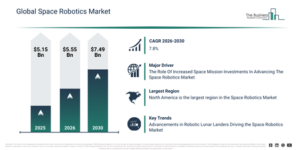
The space robotics market is projected to experience substantial expansion in the coming years. Its valuation is set to reach $7.49 billion by 2030, demonstrating a compound annual growth rate (CAGR) of 7.8%. This anticipated growth during the forecast period stems from several factors, including the increasing scope of lunar and Mars exploration missions necessitating sophisticated autonomous robots, the growing application of robotics for tasks such as in-orbit servicing, assembly, and debris removal, the surge in commercial space operations boosting the need for versatile robotic platforms, the incorporation of artificial intelligence to improve autonomous decision-making capabilities in space robots, and the ongoing creation of lightweight, energy-efficient robotic systems tailored for extended missions. Key trends expected over this period encompass a rise in autonomous robotic satellite servicing, the expanded deployment of humanoid and floating robots for intricate operations, a heightened demand for accurate robotic arms for tasks outside spacecraft, the broader implementation of robotic systems designed for extreme high-temperature and vacuum conditions, and ongoing improvements in specialized robotic mobility platforms.
The increasing financial commitments to space missions are projected to boost the expansion of the space robotics market. This growth in space mission investments refers to the rising expenditure on cosmic exploration and development. Such increased funding for space missions is expected to channel more resources into space robotics, thereby fostering significant technological advancements. For example, in August 2025, the UK Space Agency reported that UK space organizations allocated an estimated $1.25 billion USD to research and development in the fiscal year 2022/23. This sum constituted 5.7% of the industry’s total revenue, marking an increase from 5.1% in 2021/22. Consequently, the rising investments in space missions are a key factor propelling the space robotics market forward.
Download A Free Sample Report For Comprehensive Market Insights:
Space Robotics Market Industry Drivers: What Is Driving Revenue Growth?
Major companies operating within the space robotics market are prioritizing the development of advanced products, such as robotic lunar landers, to bolster exploration capabilities, streamline payload delivery to the moon, and support a growing range of commercial and scientific missions in the expanding space economy. Robotic lunar landers are automated spacecraft engineered to deliver payloads to the moon’s surface, facilitating scientific exploration, technology demonstration, and commercial activities without human presence. For instance, in January 2024, Astrobotic, a US-based space robotics company, successfully launched the Peregrine Lunar Lander. This lander incorporated sophisticated autonomous landing technologies for precise lunar touchdown, a robust propulsion system for reliable orbital maneuvering, and a versatile payload integration platform capable of supporting a wide array of scientific instruments and technology demonstrations. The launch significantly contributed to the space robotics market by enhancing payload delivery options and enabling various experiments in lunar exploration.
Space Robotics Market Segment Analysis: What Are The Major Market Categories?
The space robotics market covered in this report is segmented –
1) By Solution: Remotely Operated Vehicles, Remote Manipulator System, Software, Services
2) By Application: Deep Space, Near Space, Ground
3) By End-User: Commercial, Government
Subsegments:
1) By Remotely Operated Vehicles: Rovers, Landers
2) By Remote Manipulator System: Robotic Arms, Grippers, End-Effectors
3) By Software: Autonomous Navigation Software, Communication Software, Control System Software
4) By Services: Mission Support Services, Maintenance And Repair Services, Data Analytics Services
Space Robotics Market Transformation Trends: Which Innovations Are Driving Change?
Major companies operating within the space robotics market are prioritizing the development of advanced products, such as robotic lunar landers, to bolster exploration capabilities, streamline payload delivery to the moon, and support a growing range of commercial and scientific missions in the expanding space economy. Robotic lunar landers are automated spacecraft engineered to deliver payloads to the moon’s surface, facilitating scientific exploration, technology demonstration, and commercial activities without human presence. For instance, in January 2024, Astrobotic, a US-based space robotics company, successfully launched the Peregrine Lunar Lander. This lander incorporated sophisticated autonomous landing technologies for precise lunar touchdown, a robust propulsion system for reliable orbital maneuvering, and a versatile payload integration platform capable of supporting a wide array of scientific instruments and technology demonstrations. The launch significantly contributed to the space robotics market by enhancing payload delivery options and enabling various experiments in lunar exploration.
Space Robotics Market Leading Companies: Who Holds Significant Market Presence?
Major companies operating in the space robotics market are Northrop Grumman Corporation, Altius Space Machines Inc., Astrobotic Technology Inc., Honeybee Robotics Ltd., Maxar Technologies Inc., Motiv Space Systems Inc., Oceaneering International Inc., Olis Robotics, Intuitive Machines LLC, Effective Space Solutions Ltd., Stinger Ghaffarian Technologies Inc. (SGT), GITAI Inc., Ispace Inc., Lockheed Martin Corporation, ABB Ltd., NVIDIA Corporation, Blue Origin LLC, Boeing Company, Space Exploration Technologies Corp. (SpaceX), IHI Corporation
Access The Complete Space Robotics Market Report:
Space Robotics Market Leading Geography: Which Region Generates The Most Revenue?
North America was the largest region in the space robotics market in 2025. Asia-Pacific is expected to be the fastest-growing region in the global space robotics market during the forecast period. The regions covered in the space robotics market report are Asia-Pacific, South East Asia, Western Europe, Eastern Europe, North America, South America, Middle East, Africa.
Access a Customized Space Robotics Market Report for Deeper Competitive Insights
https://www.thebusinessresearchcompany.com/customise?id=10458&type=smp
The Business Research Company: https://www.thebusinessresearchcompany.com/
Americas: +1 310-496-7795
Asia: +44 7882 955267 & +91 8897263534
Europe: +44 7882 955267
Email us at: marketing@tbrc.info
Follow us on:
LinkedIn: https://in.linkedin.com/company/the-business-research-company
YouTube: https://www.youtube.com/channel/UC24_fI0rV8cR5DxlCpgmyFQ
Global Market Model: https://www.thebusinessresearchcompany.com/global-market-model

Wasay has over a decade of experience in market research, data modelling, and analytics, with prior experience at GlobalData and Decision Tree Consulting Services. At The Business Research Company , he leads research operations across syndicated studies, customized consulting engagements, and the Global Market Model platform. His professional experience includes supporting organizations such as Boston Consulting Group, KPMG, and Ernst & Young. Wasay holds a degree in Electronics and Communications Engineering, postgraduate management qualifications from International Management Institute Belgium and Indian School of Business and Entrepreneurship, and completed the Integrated Program in Business Analytics from Indian Institute of Management Indore.