Backed by market attractiveness analysis, total addressable market sizing, company benchmarking matrices, interactive Excel dashboards, wider supply chain intelligence, emerging startup coverage, and detailed product-level insights, The Business Research Company’s 2026 market reports are designed to offer research that is more actionable and strategically valuable than ever.
#Aerospace Robotics Market Size Forecast: How Big Could The Market Get By 2030?#_x000D_
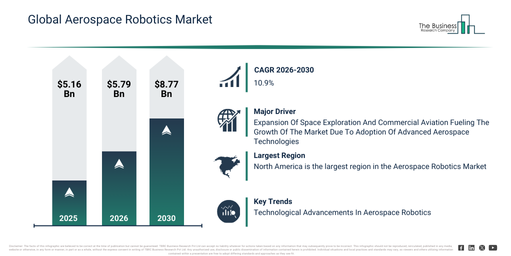
The aerospace robotics market has seen rapid expansion in recent years. It is projected to increase from $5.16 billion in 2025 to $5.79 billion in 2026, exhibiting a compound annual growth rate (CAGR) of 12.3%. The historical growth trajectory is attributable to the increasing embrace of robotics for automating repetitive aerospace manufacturing operations like drilling and fastening, the escalating requirement for precision and consistency in aircraft engine and airframe production, the expansion of aerospace manufacturing capacity fostering the uptake of industrial robots, the increasing deployment of robotic inspection systems to elevate quality assurance, and the early integration of robotic painting and surface treatment solutions to improve productivity._x000D_
_x000D_
The aerospace robotics market is projected to experience significant expansion in the coming years, reaching $8.77 billion by 2030, propelled by a compound annual growth rate (CAGR) of 10.9%. This growth in the forecast period is anticipated due to several factors, including the expected rise in next-generation automated production lines for aircraft and engine manufacturing, the increasing utilization of advanced robotics to address labor shortages and boost operational efficiency, the growing adoption of artificial intelligence-enabled robots for adaptive inspection and complex assembly tasks, the expansion of collaborative robot applications to enhance flexibility in aerospace operations, and technological advancements enabling higher payload and multi-axis robotic systems tailored for aerospace manufacturing. Key trends during this period will encompass the rising adoption of aerospace-specific robotic drilling and fastening systems, increased use of robotic inspection for non-destructive testing (NDT), the expansion of robotic painting and coating applications for airframes, growing integration of multi-functional end effectors for complex assembly tasks, and the development of aerospace robots capable of high-precision engine component handling._x000D_
_x000D_
#Get A Free Sample Report With In-Depth Market Insights:#_x000D_
_x000D_
#Aerospace Robotics Market Growth Momentum: What Factors Are Shaping Demand?#_x000D_
The future expansion of space exploration and commercial aviation is projected to drive the growth of the aerospace robotics market. Space exploration encompasses the scientific investigation of outer space through the use of spacecraft, satellites, telescopes, and other technologies to understand celestial bodies, space environments, and phenomena beyond Earth. Commercial aviation, conversely, involves the operation of aircraft by airlines and other commercial carriers to transport passengers, cargo, or mail along scheduled or chartered routes for profit. Both space exploration and commercial aviation are experiencing an increase, fueled by growing global investments and a heightened interest in advanced aerospace technologies. Aerospace robotics enhances these fields by enabling precise satellite deployment, automating spacecraft operations, and ensuring efficient aircraft maintenance, thereby improving safety and performance. For instance, according to Space Capital Corp., a US-based space-focused venture capital firm, global investments in space startups surged to $17.9 billion in 2023, marking a 31% increase from previous years, as reported in December 2024. Thus, the ongoing expansion in space exploration and commercial aviation is a significant factor propelling the aerospace robotics market’s growth._x000D_
_x000D_
#Aerospace Robotics Market Segmentation And Category Overview#_x000D_
The aerospace robotics market covered in this report is segmented – _x000D_
_x000D_
1) By Type: Articulated, Cartesian, Other Types_x000D_
2) By Technology: Conventional, Collaborative_x000D_
3) By Component: Controller, Sensors, Drive, Arm Processor, End Effector_x000D_
4) By Payload: Small-Medium Payloads Robots, Large Payloads Robots, Extra Large Payloads Robots_x000D_
5) By Application: Drilling, Welding, Painting, Inspection, Other Applications_x000D_
_x000D_
Subsegments:_x000D_
1) By Articulated Robots: 6-Axis Articulated Robots, 7-Axis Articulated Robots, Collaborative Articulated Robots _x000D_
2) By Cartesian Robots: Gantry Robots, Linear Robots, Delta Robots _x000D_
3) By Other Types: SCARA Robots (Selective Compliance Assembly Robot Arm), Cylindrical Robots, Parallel Robots, Mobile Robots, Humanoid Robots _x000D_
_x000D_
#Aerospace Robotics Market Trends Redefining Industry Growth#_x000D_
Leading companies in the aerospace robotics industry are developing novel solutions, such as worm-like robots, to improve maintenance and inspection operations. These worm-inspired robots are typically soft-bodied, highly flexible robotic systems capable of navigating through constricted or confined areas. For example, in September 2023, GE Aerospace, a US-based aerospace firm, introduced Sensiworm. Sensiworm is a worm-mimicking robot engineered for on-wing inspections of jet engines. This robot, which resembles an inchworm, employs untethered soft robotics technology to explore the complex internal parts of jet engines, identifying imperfections and assessing the thickness of thermal barrier coatings. It is equipped to transmit real-time video and data back to operators, thereby enhancing the inspection procedure by offering immediate insights into engine conditions. Sensiworm can maneuver through narrow spaces and intricate geometries within various engine components._x000D_
_x000D_
#Aerospace Robotics Market Competitive Analysis Of Leading Industry Participants#_x000D_
Major companies operating in the aerospace robotics market are KUKA Aktiengesellschaft, ABB Group, FANUC Corporation, Yaskawa Electric Corporation, Kawasaki Heavy Industries Ltd., Apex Automation and Robotics, Nachi-Fujikoshi Corp., Stäubli International AG, Omron Adept Technologies Inc., Mitsubishi Electric Corporation, JH Robotics Inc., M Torres Olvega Industrial S.A., Comau S.p.A., MTM Robotics LLC, Güdel Group AG, Electroimpact Inc., Honeybee Robotics Ltd., Oliver Crispin Robotics Ltd., Northrop Grumman Corporation, Aethon _x000D_
_x000D_
#View The Full Aerospace Robotics Market Report:#_x000D_
_x000D_
#Aerospace Robotics Market Regional Split: Which Areas Are Fueling Growth?#_x000D_
North America was the largest region in the aerospace robotics market in 2025. Asia-Pacific is expected to be the fastest-growing region in the aerospace robotics market share during the forecast period. The regions covered in the aerospace robotics market report are Asia-Pacific, South East Asia, Western Europe, Eastern Europe, North America, South America, Middle East, Africa._x000D_
_x000D_
#Reach Out To Our Team:#_x000D_
_x000D_
The Business Research Company: https://www.thebusinessresearchcompany.com/_x000D_
Americas: +1 310-496-7795_x000D_
Asia: +44 7882 955267 & +91 8897263534_x000D_
Europe: +44 7882 955267_x000D_
Email us at: marketing@tbrc.info_x000D_
_x000D_
#Follow us on:#_x000D_
_x000D_
LinkedIn: https://in.linkedin.com/company/the-business-research-company_x000D_
YouTube: https://www.youtube.com/channel/UC24_fI0rV8cR5DxlCpgmyFQ_x000D_
Global Market Model: https://www.thebusinessresearchcompany.com/global-market-model

Wasay has over a decade of experience in market research, data modelling, and analytics, with prior experience at GlobalData and Decision Tree Consulting Services. At The Business Research Company , he leads research operations across syndicated studies, customized consulting engagements, and the Global Market Model platform. His professional experience includes supporting organizations such as Boston Consulting Group, KPMG, and Ernst & Young. Wasay holds a degree in Electronics and Communications Engineering, postgraduate management qualifications from International Management Institute Belgium and Indian School of Business and Entrepreneurship, and completed the Integrated Program in Business Analytics from Indian Institute of Management Indore.