
Delivering more actionable and strategically valuable research, The Business Research Company’s 2026 market reports feature market attractiveness analysis, total addressable market evaluation, company benchmarking matrices, interactive Excel dashboards, expanded supply chain intelligence, emerging startup coverage, and detailed product insights.
Airborne Swarm Coordination System Market Expected To Reach $4.77 Billion By 2030 At 20.96% CAGR
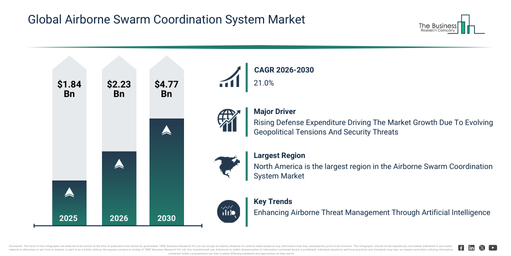
The airborne swarm coordination system market size has undergone substantial expansion in recent years. It is anticipated to grow from $1.84 billion in 2025 to $2.23 billion in 2026, exhibiting a compound annual growth rate (CAGR) of 21.2%. The historical increase can be ascribed to a number of factors, including the growing deployment of autonomous drone fleets, breakthroughs in real-time communication protocols, increasing defense modernization expenditures, improvements in multi-agent coordination algorithms, and the demand for resilient mission-critical operations.
The airborne swarm coordination system market is anticipated to undergo significant expansion in the coming years. Its valuation is projected to reach $4.77 billion by 2030, growing at a compound annual growth rate (CAGR) of 21.0%. This growth throughout the forecast period stems from the integration of AI-driven decision making, the expansion of commercial applications beyond defense, enhanced cybersecurity for swarm networks, the development of interoperable hardware modules, and the adoption of cloud-based swarm management platforms. Noteworthy trends during this period are expected to encompass swarm-based mission optimization, real-time data communication, multi-uav coordination algorithms, fleet-level autonomous navigation, and simulation-driven system validation.
Download A Free Sample Report For Comprehensive Market Insights:
Airborne Swarm Coordination System Market Growth Drivers: What Factors Are Accelerating Expansion?
Future expansion of the airborne swarm coordination system market is anticipated to be fueled by increasing defense spending. Defense expenditure encompasses government funds directed towards military forces, defense ministries, and associated security infrastructure, covering aspects like personnel, operational activities, acquisition of goods, and research and development efforts. This rise in defense outlays primarily stems from evolving geopolitical challenges and security concerns, compelling countries to prioritize modernizing their military and acquiring advanced defense capabilities to ensure strategic deterrence and combat readiness amidst a more intricate global security landscape. Elevated defense budgets stimulate the demand for airborne swarm coordination systems, as military organizations are increasingly seeking advanced autonomous technologies to improve battlefield efficacy and enable synchronized operations across numerous unmanned platforms. As an illustration, the UK Parliament’s House of Commons Library, a UK-based government administration, projected in May 2025 that UK defense spending would climb to approximately $70.5 billion(£56.9 billion) in the 2024-25 financial year, subsequently increasing to about $73.9 billion(£59.8 billion) in 2025-26. Consequently, increasing defense expenditure is a key factor propelling the expansion of the airborne swarm coordination system market.
Airborne Swarm Coordination System Market Segment Analysis Highlighting Growth Areas
The airborne swarm coordination system market covered in this report is segmented –
1) By Component: Hardware, Software, Services
2) By Technology: Artificial Intelligence, Machine Learning, Communication Systems, Sensor Integration, Other Technologies
3) By Platform: Unmanned Aerial Vehicles, Manned Aircraft, Hybrid Systems
4) By End-User: Government, Defense, Commercial, Other End-Users
Subsegments:
1) By Hardware: Sensors, Communication Devices, Navigation Systems, Control Units, Power Supply Systems
2) By Software: Mission Planning Software, Flight Control Software, Data Analytics Software, Simulation Software, Communication Management Software
3) By Services: System Integration, Maintenance And Support, Training And Consultation, Testing And Certification, Deployment Services
Airborne Swarm Coordination System Market Trends: What Is Shaping Future Industry Growth?
Leading companies in the airborne swarm coordination system market are actively adopting advanced technologies, such as artificial intelligence (AI)-powered detection, to improve the efficiency of real-time threat identification, tracking, and response. AI-enabled detection leverages AI algorithms to automatically pinpoint and follow objects or threats like drones by analyzing sensor data in real time, thereby enhancing the speed, accuracy, and overall effectiveness in detecting, classifying, and reacting to airborne threats. As an illustration, in February 2025, Lockheed Martin Corporation, a U.S.-based aerospace and defense company, unveiled a scalable Counter-Unmanned Aerial System (C-UAS) solution. This system integrates AI-driven detection, sophisticated command and control (C2) capabilities, and adaptable effectors to detect, track, identify, and mitigate both individual drones and entire drone swarms. The solution demonstrates rapid, networked coordination between sensors and mitigation systems, underscoring Lockheed Martin’s commitment to utilizing AI and open-architecture designs to bolster real-time threat response and maintain operational superiority against evolving airborne threats. The modular nature of the system’s design allows for the incorporation of a wide variety of sensors and effectors, which facilitates tailored responses to various threat scenarios and ensures its adaptability as drone technology continues to advance.
Airborne Swarm Coordination System Market Leading Players Shaping Industry Direction
Major companies operating in the airborne swarm coordination system market are The Boeing Company, Lockheed Martin Corporation, Northrop Grumman Corporation, Bae Systems Plc, Thales S.A., Leonardo S.P.A., Elbit Systems Ltd., Teledyne Technologies Incorporated, Saab AB, General Atomics Aeronautical Systems, Inc., Kratos Defense & Security Solutions, Inc., Telespazio S.P.A., AeroVironment, Inc., Havelsan A.S., Aevex Aerospace, Quantum Systems GmbH, Charles River Analytics, Inc., UAV Navigation S.L., Sky-Drones Technologies Ltd., Swarmer
Access The Complete Airborne Swarm Coordination System Market Report:
Airborne Swarm Coordination System Market Geographic Landscape: Which Region Dominates Industry Growth?
North America was the largest region in the airborne swarm coordination system market in 2025. Asia-Pacific is expected to be the fastest-growing region in the forecast period. The regions covered in the airborne swarm coordination system market report are Asia-Pacific, South East Asia, Western Europe, Eastern Europe, North America, South America, Middle East, Africa.
Access a Customized Airborne Swarm Coordination System Market Report for Deeper Competitive Insights
https://www.thebusinessresearchcompany.com/customise?id=8462&type=smp
Get in touch with us:
The Business Research Company: https://www.thebusinessresearchcompany.com/
Americas: +1 310-496-7795
Asia: +44 7882 955267 & +91 8897263534
Europe: +44 7882 955267
Email us at: marketing@tbrc.info
Follow us on:
LinkedIn: https://in.linkedin.com/company/the-business-research-company
YouTube: https://www.youtube.com/channel/UC24_fI0rV8cR5DxlCpgmyFQ
Global Market Model: https://www.thebusinessresearchcompany.com/global-market-model

Wasay has over a decade of experience in market research, data modelling, and analytics, with prior experience at GlobalData and Decision Tree Consulting Services. At The Business Research Company , he leads research operations across syndicated studies, customized consulting engagements, and the Global Market Model platform. His professional experience includes supporting organizations such as Boston Consulting Group, KPMG, and Ernst & Young. Wasay holds a degree in Electronics and Communications Engineering, postgraduate management qualifications from International Management Institute Belgium and Indian School of Business and Entrepreneurship, and completed the Integrated Program in Business Analytics from Indian Institute of Management Indore.
