
Through market attractiveness analysis, total addressable market evaluation, company benchmarking matrices, interactive Excel dashboards, expanded supply chain intelligence, emerging startup coverage, and detailed product insights, The Business Research Company’s 2026 market reports provide more actionable and strategically valuable research.
Airborne Target Acquisition Systems Market Value Expansion And Long-Term Growth Outlook
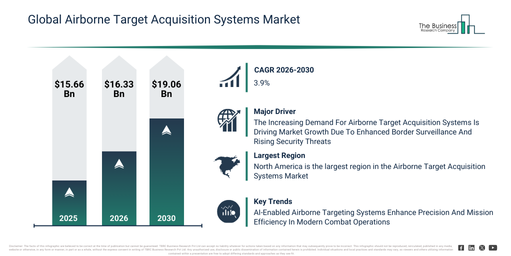
The airborne target acquisition systems market has shown consistent growth in recent years. This sector is projected to expand from $15.66 billion in 2025 to $16.33 billion in 2026, demonstrating a compound annual growth rate (CAGR) of 4.3%. Historically, this growth can be attributed to the increasing adoption of airborne sensors for target detection and tracking, the integration of precision targeting solutions in military aircraft, a rising demand for real-time surveillance and situational awareness, the deployment of advanced sensor payloads for reconnaissance missions, and the development of communication and fire control systems for coordinated targeting.
The market size for airborne target acquisition systems is anticipated to experience steady expansion over the next few years. It is projected to reach $19.06 billion by 2030, exhibiting a compound annual growth rate (CAGR) of 3.9%. This increase during the forecast period can be attributed to several factors, including rising investment in AI-driven target acquisition and automated threat detection, the expansion of airborne systems for unmanned aerial vehicles (UAVs), a concentrated effort on multi-sensor integration to enhance accuracy, growing demand for networked and interoperable targeting solutions, and increased procurement for next-generation combat aircraft and defense platforms. Significant trends expected in this period involve the greater deployment of multi-sensor fusion, an increase in high-resolution electro-optical/infrared (EO/IR) targeting capabilities, the broadening of UAV-based target acquisition, the integration of fire-control and communication systems, and a sustained demand for advanced threat detection systems.
Download A Free Sample Report For Comprehensive Market Insights:
Airborne Target Acquisition Systems Market Demand Drivers: What Is Fueling Industry Growth?
The increasing need for border surveillance is anticipated to drive the expansion of the airborne target acquisition systems market moving forward. Border surveillance utilizes advanced technologies to monitor border regions in real-time, focusing on detecting, deterring, and addressing illegal crossings or potential threats. Heightened security threats are intensifying the need for border surveillance, resulting in greater adoption of sophisticated systems to track risks and unlawful entries. Airborne target acquisition systems assist border surveillance by providing real-time aerial detection, tracking, and threat identification. Their advanced sensors and wide-area coverage allow for rapid responses in remote or difficult-to-monitor border zones. For instance, in October 2025, KXAN Austin, a US-based television station, reported that in September, U.S. Border Patrol agents apprehended 10,203 individuals, marking a 26% month-over-month increase. Consequently, the rising demand for border surveillance is propelling the growth of the airborne target acquisition systems market.
Airborne Target Acquisition Systems Market Segmentation Trends And Revenue Drivers
The airborne target acquisition systems market covered in this report is segmented –
1) By Platform: Fixed-Wing Aircraft, Helicopters, Unmanned Aerial Vehicles (UAVs)
2) By Technology: Radar, Electro-Optical Or Infrared (EO Or IR) Systems, Electronic Support Measures (ESM)
3) By Range: Short Range (0-8 Kilometers (Km)), Medium Range (8-250 Kilometers (Km)), Long Range (Above 250 Kilometers (Km))
4) By Applications: Air-To-Air Combat, Air-To-Ground Surveillance, Maritime Surveillance, Electronic Warfare
5) By End-User: Military, Homeland Security
Subsegments:
1) By Fixed-Wing Aircraft: Fighter Aircraft, Transport Aircraft, Maritime Patrol Aircraft, Surveillance Aircraft, Reconnaissance Aircraft
2) By Helicopters: Attack Helicopters, Reconnaissance Helicopters, Transport Helicopters, Maritime Helicopters
3) By Unmanned Aerial Vehicles (UAVs): Tactical Unmanned Aerial Vehicles (UAVs), Strategic Unmanned Aerial Vehicles (UAVs), Combat Unmanned Aerial Vehicles (UAVs), Mini Or Micro Unmanned Aerial Vehicles (UAVs), Medium Altitude Long Endurance Unmanned Aerial Vehicles (UAVs), High Altitude Long Endurance (HALE) Unmanned Aerial Vehicles (UAVs)
Airborne Target Acquisition Systems Market Innovation Trends: Which Developments Are Transforming The Industry?
Key players within the airborne target acquisition systems market are prioritizing the development of sophisticated solutions, such as AI-enabled airborne targeting systems, to enhance operational effectiveness in complex combat scenarios. An AI-enabled airborne targeting system functions as an advanced aerial mechanism that leverages artificial intelligence to automatically detect, classify, and track targets with heightened speed and precision. This system substantially improves situational awareness, threat assessment capabilities, and targeting efficiency across dynamic combat and surveillance operations. For example, in September 2024, Hensoldt, a defense electronics company based in Germany, launched the ARGOS-15 at the Africa Aerospace and Defense Expo 2024. This 15-inch gimbal system integrates AI-powered functionalities for object detection, classification, and tracking, which contributes to better real-time decision-making and mission productivity. The ARGOS-15 is engineered for deployment on both manned and unmanned airborne platforms, providing superior performance for intelligence, surveillance, target acquisition, and reconnaissance (ISTAR) operations.
Airborne Target Acquisition Systems Market Company Landscape And Strategic Competition
Major companies operating in the airborne target acquisition systems market are Raytheon Technologies Corporation, The Boeing Company, Lockhee Martin Corporation, Airbus, General Dynamics Corporation, Northrop Grumman Corporation, BAE Systems plc, Safran SA, Thales Group, L3Harris Technologies Inc., Leidos Holdings Inc., Rheinmetall AG, Saab AB, Hensoldt AG, Aselsan A.S., Kratos Defense & Security Solutions Inc., Teledyne FLIR, Kearfott Corporation, Thermoteknix Systems Ltd., Blighter Surveillance Systems Limited
Access The Complete Airborne Target Acquisition Systems Market Report:
Airborne Target Acquisition Systems Market Regional Outlook: Where Are The Largest Opportunities Located?
North America was the largest region in the airborne target acquisition systems market in 2025. Asia-Pacific is expected to be the fastest-growing region in the forecast period. The regions covered in the airborne target acquisition systems market report are Asia-Pacific, South East Asia, Western Europe, Eastern Europe, North America, South America, Middle East, Africa.
Access a Customized Airborne Target Acquisition Systems Market Report for Deeper Competitive Insights
https://www.thebusinessresearchcompany.com/customise?id=28491&type=smp
Get in touch with us:
The Business Research Company: https://www.thebusinessresearchcompany.com/
Americas: +1 310-496-7795
Asia: +44 7882 955267 & +91 8897263534
Europe: +44 7882 955267
Email us at: marketing@tbrc.info
Follow us on:
LinkedIn: https://in.linkedin.com/company/the-business-research-company
YouTube: https://www.youtube.com/channel/UC24_fI0rV8cR5DxlCpgmyFQ
Global Market Model: https://www.thebusinessresearchcompany.com/global-market-model

Wasay has over a decade of experience in market research, data modelling, and analytics, with prior experience at GlobalData and Decision Tree Consulting Services. At The Business Research Company , he leads research operations across syndicated studies, customized consulting engagements, and the Global Market Model platform. His professional experience includes supporting organizations such as Boston Consulting Group, KPMG, and Ernst & Young. Wasay holds a degree in Electronics and Communications Engineering, postgraduate management qualifications from International Management Institute Belgium and Indian School of Business and Entrepreneurship, and completed the Integrated Program in Business Analytics from Indian Institute of Management Indore.
