Built to provide research that’s more actionable and strategically valuable, The Business Research Company’s 2026 market reports include market attractiveness analysis, total addressable market sizing, company benchmarking matrices, interactive Excel dashboards, broader supply chain intelligence, emerging startup tracking, and in-depth product insights.
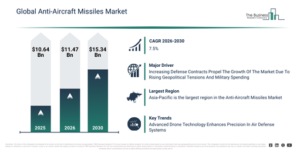
Anti-Aircraft Missiles Market Growth From $11.47 Billion In 2026 To $15.34 Billion By 2030 At A CAGR Of 7.5%
The anti-aircraft missiles market has seen considerable growth in its size over recent years. Projections indicate it will expand from $10.64 billion in 2025 to $11.47 billion in 2026, demonstrating a compound annual growth rate (CAGR) of 7.8%. This historical expansion can be attributed to the extensive adoption of man-portable air-defense systems (MANPADS) for tactical defense, the advancement of interceptor missiles for countering high-speed aerial threats, the implementation of missile guidance systems to boost targeting accuracy, the increasing utilization of naval air defense missiles for maritime protection, and the establishment of air defense services for threat deterrence and surveillance.
The anti-aircraft missiles market is poised for robust expansion in the coming years. This sector is projected to reach $15.34 billion by 2030, demonstrating a compound annual growth rate (CAGR) of 7.5%. The anticipated growth during this forecast period is primarily fueled by increasing investment in next-generation guided anti-aircraft missiles, the expansion of integrated air defense networks featuring rapid response capabilities, the rising adoption of multi-sensor and AI-enhanced targeting systems, a growing procurement of modular and mobile missile launch platforms, and a strong focus on advanced interceptor technologies designed for high-altitude and hypersonic threats. Significant trends for this period include a heightened demand for next-generation integrated air defense, the proliferation of multi-layered missile interception systems, the expansion of long-range and high-precision interceptor programs, an increase in the acquisition of man-portable air-defense systems (manpads), and a notable shift towards enhancing survivability and all-weather missile capabilities.
Get A Free Sample Report With In-Depth Market Insights:
Anti-Aircraft Missiles Market Development Factors: What’s Supporting Demand?
The expansion of the anti-aircraft missiles market in the future is anticipated to be fueled by a rise in defense contracts. These contracts are defined as legally binding agreements between governments and private companies or organizations for the provision of military goods, services, or technology. The surge in defense contracts is primarily driven by escalating geopolitical tensions and conflicts, which prompt nations to boost military spending for enhanced security and preparedness. Anti-aircraft missiles strengthen defense contracts by offering essential capabilities for national security, fostering technological innovation, and sustaining long-term military procurement and development partnerships. For instance, in June 2025, according to the Single Source Regulations Office (SSRO), a UK-based independent public body overseeing the regulation of non-competitive defense procurement, the number of reported sub-contracts linked to Qualifying Defence Contracts (QDCs) and Qualifying Sub-Contracts (QSCs) rose significantly to 243 in 2024/25, up from 82 in 2023/24. Consequently, the increasing defense contracts are stimulating the growth of the anti-aircraft missile market.
Anti-Aircraft Missiles Market Breakdown By Product Type And Application
The anti-aircraft missiles market covered in this report is segmented –
1) By Missile Type: Air To Air, Anti Ballistic, Surface To Air
2) By Propulsion System: Hybrid Propellant, Liquid Propellant, Solid Propellant
3) By Warhead Type: Fragmentation, High Explosive, Nuclear
4) By End User: Air Force, Army, Coast Guard, Navy
Subsegments:
1) By Air To Air: Short Range Air-To-Air Missiles (SRAAM), Medium Range Air-To-Air Missiles (MRAAM), Long Range Air-To-Air Missiles (LRAAM)
2) By Anti Ballistic: Exo-Atmospheric Ballistic Missile Interceptors, Endo-Atmospheric Ballistic Missile Interceptors
3) By Surface To Air: Short Range Surface-To-Air Missiles (SHORAD), Medium Range Surface-To-Air Missiles (MRSAM), Long Range Surface-To-Air Missiles (LRSAM)
Anti-Aircraft Missiles Market Transformation Trends: What Innovations Are Driving Change?
Major companies within the anti-aircraft missiles market are concentrating on developing innovations like missile-slinging drones to improve precision and defensive capabilities. Missile-slinging drones are unmanned aerial vehicles designed to launch missiles for specific air defense and attack missions. For example, in March 2025, Airbus SE, a France-based aerospace company, introduced a missile-armed drone concept called LOAD (Low-Cost Air Defense). This drone is specifically engineered to counter the escalating threat posed by enemy drones and loitering munitions. The LOAD system functions as an economical, reusable air defense solution built on the Do-DT25 platform, able to carry up to three guided missiles to intercept hostile drones. It offers a range of 100 kilometers, is launched using a catapult, and recovers via parachute for reuse. Operated from a ground control station, LOAD can independently search for and identify threats, engaging them only after receiving human authorization.
Anti-Aircraft Missiles Market Company Landscape And Competitive Strategy
Major companies operating in the anti-aircraft missiles market are Raytheon Technologies Corporation, Lockheed Martin Corporation, Airbus Defense And Space, General Dynamics, Northrop Grumman Corporation, BAE Systems PLC, Thales SA, L3 Harris, Leonardo S.P.A., Hanwha Corporation, Elbit Systems, Israel Aerospace Industries Ltd., Diehl Defence GmbH And Co. KG, Saab AB, Kongsberg Gruppen, MBDA SAS, Aselsan A.S., Rafael Advanced Defense Systems Ltd., Almaz-Antey Air and Space Defense Corporation, Denel SOC Ltd.
View The Full Anti-Aircraft Missiles Market Report:
Anti-Aircraft Missiles Market Largest Region: Which Geography Holds The Highest Market Share?
Asia-Pacific was the largest region in the anti-aircraft missiles market in 2025. Asia-Pacific is expected to be the fastest-growing region in the forecast period. The regions covered in the anti-aircraft missiles market report are Asia-Pacific, South East Asia, Western Europe, Eastern Europe, North America, South America, Middle East, Africa.
Reach Out To Our Team:
The Business Research Company: https://www.thebusinessresearchcompany.com/
Americas: +1 310-496-7795
Asia: +44 7882 955267 & +91 8897263534
Europe: +44 7882 955267
Email us at: marketing@tbrc.info
Follow us on:
LinkedIn: https://in.linkedin.com/company/the-business-research-company
YouTube: https://www.youtube.com/channel/UC24_fI0rV8cR5DxlCpgmyFQ
Global Market Model: https://www.thebusinessresearchcompany.com/global-market-model

Wasay has over a decade of experience in market research, data modelling, and analytics, with prior experience at GlobalData and Decision Tree Consulting Services. At The Business Research Company , he leads research operations across syndicated studies, customized consulting engagements, and the Global Market Model platform. His professional experience includes supporting organizations such as Boston Consulting Group, KPMG, and Ernst & Young. Wasay holds a degree in Electronics and Communications Engineering, postgraduate management qualifications from International Management Institute Belgium and Indian School of Business and Entrepreneurship, and completed the Integrated Program in Business Analytics from Indian Institute of Management Indore.