Featuring market attractiveness scoring, total addressable market sizing, company benchmarking matrices, interactive Excel dashboards, deeper supply chain intelligence, emerging startup tracking, and granular product-level insights, The Business Research Company’s 2026 market reports are built to deliver research that is both more actionable and more strategically valuable.
Anti-Aircraft Warfare Market Size And Revenue Outlook Through 2030
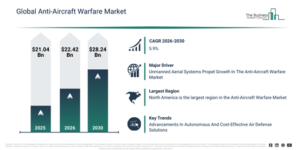
The anti-aircraft warfare market has observed significant expansion in recent years. It is projected to grow from $21.04 billion in 2025 to $22.42 billion in 2026, exhibiting a compound annual growth rate (CAGR) of 6.6%. This historical growth can be attributed to advancements in radar and detection technologies, an increase in global military conflicts and air threats, the proliferation of unmanned aerial vehicles (UAVs), expansions in government defense budgets, and the legacy integration of surface-to-air missile systems.
The anti-aircraft warfare market size is projected to experience robust expansion over the coming years. This market is predicted to reach $28.24 billion by 2030, exhibiting a compound annual growth rate (CAGR) of 5.9%. Several factors contribute to this growth during the forecast period, including an increasing need for integrated air defense systems, the integration of artificial intelligence and machine learning into targeting systems, upgrades to naval and ground defense infrastructure, advancements in electronic warfare and counter-drone capabilities, and strategic alliances and defense cooperation among nations. Key trends anticipated within this period encompass the incorporation of sophisticated radar and sensor technologies, the creation of hypersonic missile defense solutions, an increase in electronic warfare (EW) capabilities, the implementation of simulation and training platforms for air defense, and the rollout of integrated multi-layer air defense systems.
Get A Free Sample Report With In-Depth Market Insights:
Anti-Aircraft Warfare Market Expansion Drivers: What’s Shaping Future Growth?
The rising danger posed by unmanned aerial systems is anticipated to drive the expansion of the anti-aircraft warfare market moving forward. Unmanned aerial systems are defined as aircraft that operate without a human pilot present, being either remotely controlled or functioning autonomously. These systems serve diverse functions, such as reconnaissance, surveillance, and, with growing frequency, combat operations. The proliferation of unmanned aerial threat systems stems from technological progress that facilitates more affordable, readily available, and potent reconnaissance and assault capabilities. Anti-aircraft warfare counters the risks posed by unmanned aerial systems by deploying systems engineered to detect, track, and neutralize drones prior to them reaching their intended targets. For example, in August 2024, the National Counter Terrorism Security Office, a UK-based government office, reported that in 2023, police documented over 6,000 drone-related incidents, with approximately 11% of these instances categorized as offences. Consequently, the escalating menace from unmanned aerial systems is propelling the expansion of the anti-aircraft warfare market.
Anti-Aircraft Warfare Market Segment Landscape And Growth Outlook
The anti-aircraft warfare market covered in this report is segmented –
1) By Technology: Fire Control System, Weapon System, Countermeasure System, Command And Control System
2) By Range: Short Range, Medium Range, Long Range
3) By Threat Type: Subsonic Missiles, Supersonic Missiles, Hypersonic Missiles
4) By Domain: Ground, Air, Marine, Space
Subsegments:
1) By Fire Control System: Radar Systems, Target Tracking Systems, Guidance and Control Systems
2) By Weapon System: Anti-Aircraft Guns, Surface-to-Air Missiles (SAMs), Anti-Aircraft Artillery
3) By Countermeasure System: Electronic Warfare (EW) Systems, Decoy Systems, Jamming Systems
4) By Command and Control System: Integrated Air Defense Systems (IADS), Surveillance and Reconnaissance Systems, Tactical Communication Systems
Anti-Aircraft Warfare Market Strategic Trends: What Defines The Next Growth Phase?
Leading firms within the anti-aircraft warfare market are prioritizing technological innovations, such as counter-unmanned aerial systems (C-UAS), to bolster their capacity for identifying, tracking, and neutralizing adversarial drones and other low-altitude airborne dangers. A Counter-Unmanned Aerial System (C-UAS) constitutes a holistic defense solution, utilizing components like sensors, radar, electronic warfare, along with kinetic or non-kinetic strategies, to safeguard vital assets from drone-based risks. For example, in March 2025, Airbus Defence and Space, an aeronautics company based in Germany, unveiled LOAD (low-cost air defence), an economical unmanned air defense system engineered to autonomously combat kamikaze drone threats. This system offers a cost-effective and scalable approach to neutralize extensive drone swarms, enhancing current air defense infrastructures and bridging gaps in radar coverage. Its objective is to strengthen contemporary air defense by delivering an affordable, autonomous counter-drone capability, unhindered by U.S. export restrictions, thereby facilitating adaptable and effective protection against developing aerial threats.
Anti-Aircraft Warfare Market Competitive Landscape: Who Leads The Industry?
Major companies operating in the anti-aircraft warfare market are Raytheon Technologies Corporation, The Boeing Company, Lockheed Martin Corporation, Hanwha Land Systems Co. Ltd., General Dynamics Corporation, Northrop Grumman Corporation, China Aerospace Science and Technology Corporation, BAE Systems plc, Thales Group, Leonardo S.p.A, Rheinmetall AG, Saab AB, Indra Sistemas S.A, Kongsberg Gruppen ASA, Rafael Advanced Defense Systems Ltd., Aselsan A.S., Airbus Defence and Space, Rosoboronexport State Corporation, Defense Research and Development Organisation (DRDO), Almaz-Antey Corp.
View The Full Anti-Aircraft Warfare Market Report:
Anti-Aircraft Warfare Market Geographic Landscape: Which Region Dominates Industry Growth?
North America was the largest region in the anti-aircraft warfare market in 2025. The regions covered in the anti-aircraft warfare market report are Asia-Pacific, South East Asia, Western Europe, Eastern Europe, North America, South America, Middle East, Africa.
Reach Out To Our Team:
The Business Research Company: https://www.thebusinessresearchcompany.com/
Americas: +1 310-496-7795
Asia: +44 7882 955267 & +91 8897263534
Europe: +44 7882 955267
Email us at: marketing@tbrc.info
Follow us on:
LinkedIn: https://in.linkedin.com/company/the-business-research-company
YouTube: https://www.youtube.com/channel/UC24_fI0rV8cR5DxlCpgmyFQ
Global Market Model: https://www.thebusinessresearchcompany.com/global-market-model

Wasay has over a decade of experience in market research, data modelling, and analytics, with prior experience at GlobalData and Decision Tree Consulting Services. At The Business Research Company , he leads research operations across syndicated studies, customized consulting engagements, and the Global Market Model platform. His professional experience includes supporting organizations such as Boston Consulting Group, KPMG, and Ernst & Young. Wasay holds a degree in Electronics and Communications Engineering, postgraduate management qualifications from International Management Institute Belgium and Indian School of Business and Entrepreneurship, and completed the Integrated Program in Business Analytics from Indian Institute of Management Indore.