Through market attractiveness analysis, total addressable market evaluation, company benchmarking matrices, interactive Excel dashboards, expanded supply chain intelligence, emerging startup coverage, and detailed product insights, The Business Research Company’s 2026 market reports provide more actionable and strategically valuable research.
Artificial Satellite Market Revenue Outlook: What CAGR Is Expected Through 2030?
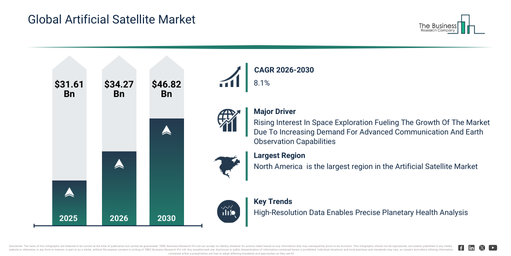
The artificial satellite market size has experienced substantial growth recently. It is projected to expand from $31.61 billion in 2025 to $34.27 billion in 2026, achieving a compound annual growth rate (CAGR) of 8.4%. This historical expansion can be attributed to factors such as an enhanced worldwide requirement for communication and navigation solutions, technological progress in satellite bus and payload systems, increased capital allocation for earth observation and scientific research satellites, partnerships formed between aerospace firms and space organizations, and the initial acceptance and deployment of compact and mid-sized satellite platforms.
The artificial satellite market is anticipated to experience robust expansion over the coming years. This market is projected to reach $46.82 billion by 2030, exhibiting a compound annual growth rate (CAGR) of 8.1%. The drivers for this growth during the forecast timeframe include the proliferation of low-earth-orbit (LEO) and mega-constellation satellite networks, the incorporation of AI and autonomous systems into satellite operations, an increasing need for high-throughput and advanced communication satellites, the creation of economical and modular satellite components, and a focus on lifecycle assistance, upkeep, and in-orbit maintenance solutions. Key trends expected during this period involve a growing requirement for smaller satellite components, the broadening of commercial satellite constellations, an increase in the integration of multifunctional payloads, greater uptake of standardized satellite buses, and improvements in onboard power and thermal management systems.
Download A Free Sample Report For Comprehensive Market Insights:
#Artificial Satellite Market Growth Drivers And Industry Catalysts
The increasing fascination with venturing into space is set to drive the expansion of the artificial satellite market in the future. Space exploration involves exploring and examining outer space using spacecraft, satellites, and sophisticated technology. This heightened interest stems from a growing need for sophisticated communication and Earth observation satellites, which facilitate worldwide connections, environmental oversight, and improved safety. Artificial satellites play a crucial role in space exploration by delivering vital information on cosmic entities, trajectories, and celestial events, thereby allowing for more accurate mission planning. They contribute to scientific understanding and support investigations in fields such as astronomy, planetary studies, and observation of deep space, deepening human comprehension of the cosmos. As an illustration, Novaspace, a France-based space governance provider, reported in September 2023 that government expenditures on space exploration reached $27 billion in 2024 and are projected to rise to nearly $31 billion by 2034. Consequently, the escalating enthusiasm for space exploration is propelling the expansion of the artificial satellite market.
Artificial Satellite Market Segment Analysis And Revenue Opportunities
The artificial satellite market covered in this report is segmented –
1) By Satellite Type: Communication Satellites, Earth Observation Satellites, Navigational Satellites, Scientific Research Satellites, Military Satellites
2) By Orbit Type: Low Earth Orbit (LEO), Medium Earth Orbit (MEO), Geostationary Orbit (GEO), Highly Elliptical Orbit (HEO)
3) By Ownership: Government-Owned, Commercial Entities, Non-Profit Organizations, Educational Institutions
4) By Application: Space Exploration, Telecommunications, Weather Forecasting, Scientific Research
5) By End User: Telecommunications Companies, Government Agencies, Aerospace And Defense Contractors, Research Organizations, Media And Broadcasting Firms
Subsegments:
1) By Communication Satellites: Geostationary, Low Earth Orbit, Medium Earth Orbit
2) By Earth Observation Satellites: Optical Imaging, Radar Imaging, Hyperspectral Imaging
3) By Navigational Satellites: Global Positioning, Regional Navigation, Augmentation Systems
4) By Scientific Research Satellites: Space Telescopes, Atmospheric Monitoring, Microgravity Experiments
5) By Military Satellites: Reconnaissance, Surveillance, Communication
Artificial Satellite Market Trends: What Is Shaping Future Industry Growth?
Leading companies within the artificial satellite market are concentrating on creating sophisticated solutions, such as hyperspectral satellite constellations, to deliver high-resolution environmental data, enhance monitoring precision, and bolster global climate action initiatives. These hyperspectral satellite constellations represent space platforms equipped with sensors that capture data across numerous narrow spectral bands, enabling detailed analysis of Earth’s surface, including chemical compositions, vegetation health, and atmospheric changes. For instance, in January 2025, Pixxel Space Technologies Inc., a US-based space technology company, launched the first three satellites of its Firefly constellation aboard a SpaceX Transporter-12 rideshare mission. This particular hyperspectral satellite features 5-meter spatial resolution, over 150 spectral bands, a 40-kilometer swath width, and daily revisit capability, allowing for near-real-time, detailed monitoring of planetary health. The integration of high spatial resolution and rich spectral data facilitates targeted environmental analysis, predictive modeling, and the detection of subtle changes in chemical compositions, water quality, vegetation health, and atmospheric conditions, thereby providing critical insights for climate action and sustainable resource management.
Artificial Satellite Market Leading Players Shaping Industry Direction
Major companies operating in the artificial satellite market are The Boeing Company, Airbus Group SE, Raytheon Technologies Corporation, Lockheed Martin Corporation, Northrop Grumman Corporation, Mitsubishi Electric Corporation, L3Harris Technologies Inc., Space Exploration Technologies Corp. (SpaceX), Blue Origin LLC, QinetiQ Group plc, Maxar Technologies Inc., OHB SE, Sierra Nevada Corporation, Iridium Communications Inc., OneWeb Satellites Limited, Planet Labs PBC, GomSpace Group AB, Dhruva Space Private Limited, NPO Lavochkin Association, Berlin Space Technologies GmbH, Indian Space Research Organisation, RKK Energiya
Access The Complete Artificial Satellite Market Report:
Artificial Satellite Market Largest Region By Revenue And Market Share
North America was the largest region in the artificial satellite market in 2025. The regions covered in the artificial satellite market report are Asia-Pacific, South East Asia, Western Europe, Eastern Europe, North America, South America, Middle East, Africa.
Access a Customized Artificial Satellite Market Report for Deeper Competitive Insights
https://www.thebusinessresearchcompany.com/customise?id=27589&type=smp
Get in touch with us:
The Business Research Company: https://www.thebusinessresearchcompany.com/
Americas: +1 310-496-7795
Asia: +44 7882 955267 & +91 8897263534
Europe: +44 7882 955267
Email us at: marketing@tbrc.info
Follow us on:
LinkedIn: https://in.linkedin.com/company/the-business-research-company
YouTube: https://www.youtube.com/channel/UC24_fI0rV8cR5DxlCpgmyFQ
Global Market Model: https://www.thebusinessresearchcompany.com/global-market-model

Wasay has over a decade of experience in market research, data modelling, and analytics, with prior experience at GlobalData and Decision Tree Consulting Services. At The Business Research Company , he leads research operations across syndicated studies, customized consulting engagements, and the Global Market Model platform. His professional experience includes supporting organizations such as Boston Consulting Group, KPMG, and Ernst & Young. Wasay holds a degree in Electronics and Communications Engineering, postgraduate management qualifications from International Management Institute Belgium and Indian School of Business and Entrepreneurship, and completed the Integrated Program in Business Analytics from Indian Institute of Management Indore.