Enhanced with market attractiveness analysis, total addressable market evaluation, company benchmarking matrices, interactive Excel dashboards, expanded supply chain intelligence, emerging startup coverage, and detailed product insights, The Business Research Company’s 2026 market reports deliver more actionable and strategically valuable research.
Artillery Ammunition Market Size Forecast: How Large Could The Market Become By 2030?
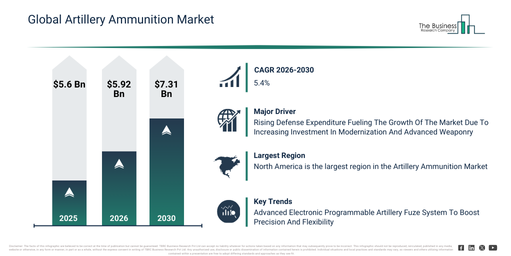
The artillery ammunition market has demonstrated strong growth in recent years. It is projected to expand from $5.6 billion in 2025 to $5.92 billion in 2026, achieving a compound annual growth rate (CAGR) of 5.7%. The historical increase in this market can be attributed to the widespread deployment of large-caliber artillery shells in land-based military operations, the adoption of training shells to enhance crew proficiency and safety, the use of cluster ammunition for suppressing area targets, the development of incendiary and gas shells for specialized battlefield effects, and the rising requirement for artillery ammunition to support conventional warfare strategies.
The artillery ammunition market size is anticipated to undergo significant growth in the upcoming years. It is projected to expand to $7.31 billion by 2030, achieving a compound annual growth rate (CAGR) of 5.4%. This projected expansion during the forecast period is attributed to increased investment in precision-guided and smart artillery munitions, the development of high-performance incendiary and multi-purpose shells, a growing preference for environmentally compliant and low-collateral-damage ammunition, a focus on extended-range and high-velocity artillery rounds, and rising procurement for modernizing artillery arsenals and supporting advanced combat operations. Noteworthy trends for the forecast period include an escalating demand for long-range precision artillery, the increased adoption of multi-purpose and modular ammunition, a growing requirement for advanced training ammunition variants, an intensified focus on battlefield lethality and survivability, and the expansion of specialized munitions for diverse environments.
Download A Free Sample Report For Comprehensive Market Insights:
Artillery Ammunition Market Expansion Supported By Key Demand Factors
The growing defense expenditure is expected to drive the expansion of the artillery ammunition market in the future. Defense expenditure refers to government spending on military forces, encompassing costs for personnel, equipment, operations, and defense infrastructure to ensure national security. This spending is increasing as countries invest significantly in modernizing their armed forces with advanced technologies such as AI, autonomous weapons, and cyber defense systems to maintain a lead in modern warfare. Defense expenditure is vital for artillery ammunition as it provides the necessary funding for the research, development, production, and procurement of advanced artillery shells and fuze systems, thereby boosting the firepower, precision, and overall effectiveness of military forces. For instance, in May 2025, according to the House of Commons of the United Kingdom, a UK-based governing body, defense spending is projected to reach approximately $72.2 billion (£56.9 billion) in 2024/25 and further increase to around $75.9 billion (£59.8 billion) in 2025/26, indicating an average annual real-terms growth rate of 2.4% between 2023/24 and 2025/26. Therefore, the rising defense expenditure is propelling the growth of the artillery ammunition market.
Artillery Ammunition Market Categorization By Product Type And Application
The artillery ammunition market covered in this report is segmented –
1) By Ammunition Type: High Explosive Ammunition, Armor-Piercing Ammunition, Training Ammunition, Illumination Ammunition, Smoke Ammunition
2) By Component: Fuses, Primers, Propellants, Projectiles, Other Components
3) By Application: Land Forces, Naval Forces, Air Forces, Special Forces
4) By End-User: Military, Law Enforcement, Other End-Users
Subsegments:
1) By High Explosive Ammunition: High-Explosive (HE) Fragmentation Shells, High-Explosive Anti-Tank (HEAT) Shells, High-Explosive Squash Head (HESH) Shells
2) By Armor-Piercing Ammunition: Armor-Piercing Fin-Stabilized Discarding Sabot (APFSDS), Armor-Piercing Capped (APC), Armor-Piercing High-Explosive (APHE)
3) By Training Ammunition: Inert Practice Rounds, Reduced Range Practice Ammunition, Target Practice With Tracer (TP-T)
4) By Illumination Ammunition: White Light Illumination Rounds, Infrared (IR) Illumination Rounds, Multispectral Illumination Rounds
5) By Smoke Ammunition: White Phosphorus Smoke Rounds, Hexachloroethane (HC) Smoke Rounds, Colored Smoke Rounds
Artillery Ammunition Market Innovation Trends: Which Developments Are Transforming The Industry?
Leading companies active within the artillery ammunition market are concentrating on devising technologically advanced solutions, such as electronic programmable artillery fuzes, to elevate the precision, versatility, and efficacy of their firepower. Electronic programmable artillery fuzes represent sophisticated fuse mechanisms that can be electronically configured before discharge to govern the timing and method of detonation, thereby improving the accuracy and impact of artillery rounds. For instance, in June 2024, KMW+Nexter Defense Systems, a Netherlands-based defense industry enterprise, introduced an innovative programmable artillery fuze system, consisting of two electronic programmable fuzes and a compact, portable inductive fuze setter. This system enables artillery crews to swiftly and securely program fuzes just prior to firing, allowing for various detonation modes like airburst, point detonation, and delay, ensuring peak operational flexibility and safety. These fuzes are engineered for compatibility with diverse calibers of artillery ammunition and conform to NATO standards, thereby augmenting both the effectiveness and adaptability of modern artillery units.
Artillery Ammunition Market Company Landscape And Strategic Competition
Major companies operating in the artillery ammunition market are RTX Corporation, General Dynamics Corporation, Northrop Grumman Corporation, BAE Systems Public Limited Company, Thales S.A., Leonardo Società per Azioni, Textron Inc., Singapore Technologies Engineering Ltd, Rheinmetall AG, Elbit Systems Ltd., Hanwha Aerospace Co. Ltd., Saab Aktiebolag, Diehl Defence GmbH & Co. KG, Poongsan Corporation, Nammo AS, Denel SOC Ltd, Arsenal Joint Stock Company, Nexter Systems S.A., MESKO Spólka Akcyjna, Hirtenberger Defence Systems GmbH & Co KG.
Access The Complete Artillery Ammunition Market Report:
Artillery Ammunition Market Geographic Distribution And Regional Opportunities
North America was the largest region in the artillery ammunition market in 2025. Asia-Pacific is expected to be the fastest-growing region in the forecast period. The regions covered in the artillery ammunition market report are Asia-Pacific, South East Asia, Western Europe, Eastern Europe, North America, South America, Middle East, Africa.
Access a Customized Artillery Ammunition Market Report for Deeper Competitive Insights
https://www.thebusinessresearchcompany.com/customise?id=25228&type=smp
Get in touch with us:
The Business Research Company: https://www.thebusinessresearchcompany.com/
Americas: +1 310-496-7795
Asia: +44 7882 955267 & +91 8897263534
Europe: +44 7882 955267
Email us at: marketing@tbrc.info
Follow us on:
LinkedIn: https://in.linkedin.com/company/the-business-research-company
YouTube: https://www.youtube.com/channel/UC24_fI0rV8cR5DxlCpgmyFQ
Global Market Model: https://www.thebusinessresearchcompany.com/global-market-model

Wasay has over a decade of experience in market research, data modelling, and analytics, with prior experience at GlobalData and Decision Tree Consulting Services. At The Business Research Company , he leads research operations across syndicated studies, customized consulting engagements, and the Global Market Model platform. His professional experience includes supporting organizations such as Boston Consulting Group, KPMG, and Ernst & Young. Wasay holds a degree in Electronics and Communications Engineering, postgraduate management qualifications from International Management Institute Belgium and Indian School of Business and Entrepreneurship, and completed the Integrated Program in Business Analytics from Indian Institute of Management Indore.