The Business Research Company’s 2026 market reports combine market attractiveness scoring, total addressable market sizing, company benchmarking matrices, interactive Excel dashboards, deeper supply chain intelligence, emerging startup tracking, and granular product-level insights to deliver research that is more actionable and strategically valuable.
Autonomous Naval Vessel Market Size Review: What Shaped Past Growth And What Will Drive Future Expansion?
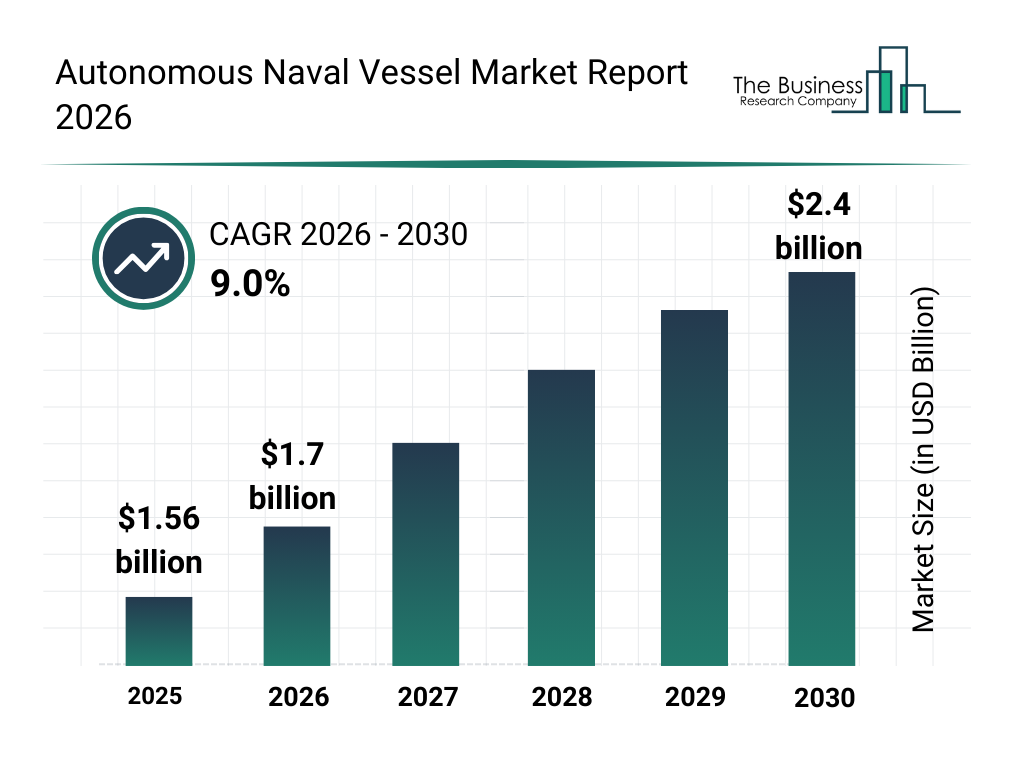
In recent years, the autonomous naval vessel market has shown strong expansion. It is anticipated to increase from $1.56 billion in 2025 to $1.7 billion in 2026, exhibiting a compound annual growth rate (CAGR) of 9.0%. Historically, this growth was driven by several factors, including the increasing adoption of unmanned surface vessels (USVs) for maritime surveillance and reconnaissance, the advancement of unmanned underwater vehicles (UUVs) for mine detection and countermeasures, the incorporation of autonomous navigation and propulsion systems into naval platforms, the utilization of sensor suites and payload modules for specific mission requirements, and the growing application of command and control systems for remote monitoring and coordination.
The autonomous naval vessel market size is anticipated to undergo significant expansion in the upcoming years, with projections indicating it will reach $2.4 billion in 2030, exhibiting a compound annual growth rate (CAGR) of 9.0%. This growth during the forecast period can be attributed to an escalating demand for AI-enhanced autonomous naval vessels crucial for anti-submarine warfare and maritime patrol, the proliferation of unmanned platforms employed for logistics, resupply, and border security operations, an increasing embrace of integrated sensor and communication systems essential for real-time situational awareness, a concentrated focus on developing modular and scalable payload and mission systems, and augmented procurement efforts for naval modernization and the expansion of unmanned fleets. Prominent trends throughout this period involve a heightened demand for unmanned maritime surveillance platforms, the extension of autonomous mine countermeasure operations, the integration of modular payload systems to facilitate multi-role naval missions, an elevated adoption of long-endurance surface and underwater vessels, and the escalating deployment of autonomous vessels for maritime border enforcement.
Access Free Sample Pages From The Autonomous Naval Vessel Market Report 2026:
Understanding The Main Driver Of The Autonomous Naval Vessel Market
The rising requirement for maritime security is projected to fuel the expansion of the autonomous naval vessel market in the future. Maritime security involves safeguarding ships, harbors, and shorelines against dangers like piracy, terrorism, and unlawful actions, thereby ensuring secure and safe maritime operations. The escalating demand for maritime security stems from the increase in illegal maritime activities, which pose threats to national sovereignty, interfere with trade routes, and jeopardize coastal safety. Autonomous naval vessels boost maritime security through their capacity for uninterrupted, uncrewed surveillance and swift threat identification across extensive oceanic regions. These vessels mitigate human risk by effectively executing high-risk missions, thereby bolstering coastal defense and readiness for operations. For example, in January 2024, the International Maritime Bureau (IMB) of the International Chamber of Commerce, a France-based business organization, reported 120 incidents of maritime piracy and armed robbery in 2023, an increase from 115 in 2022. Consequently, the growing requirement for maritime security is propelling the expansion of the autonomous naval vessel market.
Autonomous Naval Vessel Market Segment Mapping For 2026 And Beyond
The autonomous naval vessel market covered in this report is segmented –
1) By Type: Surface Vessel, Sub-Surface Vessels And Vehicles
2) By Autonomy: Fully Autonomous, Partially Autonomous
3) By Vessel Category: Newbuild, Retrofit
4) By Propulsion Type: Fully Electric, Conventional, Hybrid
5) By End User: Navies And Defense Forces, Commercial Shipping Operators, Research Institutions And Academia, Coast Guard And Homeland Security, Environmental Agencies
Subsegments:
1) By Surface Vessels: Unmanned Surface Vehicles (USVs), Autonomous Patrol Vessels, Mine Countermeasure Vessels, Surveillance And Reconnaissance Vessels, Logistic Support Vessels, Combat And Armed Surface Vessels
2) By Sub-Surface Vessels And Vehicles: Autonomous Underwater Vehicles (AUVs), Autonomous Submarines, Gliders, Towed Underwater Systems, Unmanned Combat Submersibles, Inspection And Survey Submersibles
What Key Trend Is Expected To Shape The Autonomous Naval Vessel Market Over The Forecast Period?
Leading companies in the autonomous naval vessel market are focused on developing advanced solutions, such as fully autonomous fleets, to boost operational efficiency, expand mission capabilities, and minimize human involvement in maritime activities. These fully autonomous fleets consist of a network of unmanned ships equipped with self-navigation, real-time decision-making, and adaptive mission execution, allowing for seamless deployment across various maritime applications. For instance, in February 2025, Zerousv, a UK-based autonomous maritime technology company, introduced the Oceanus12, an autonomous naval vessel built for multi-mission adaptability, advanced maritime surveillance, and extended operational endurance. The Oceanus12 is a versatile autonomous naval vessel featuring modular payloads and advanced endurance systems, engineered for efficient, low-carbon maritime missions such as surveillance, environmental monitoring, and defense, thereby enhancing situational awareness and operational flexibility.
Autonomous Naval Vessel Market Major Players And Industry Competition Overview
Major companies operating in the autonomous naval vessel market are RTX Corporation, Lockheed Martin Corporation, Northrop Grumman Corporation, BAE Systems plc, Thales Group, L3Harris Technologies Inc., Textron Systems Corporation, Elbit Systems Ltd., Saab AB, Kongsberg Maritime AS, Fugro N.V, EXAIL Technologies SA, Ocean Infinity, Saildrone Inc., Maritime Applied Physics Corporation, Ocius Technology Ltd., Sea Machines Robotics Inc., SeaRobotics Corporation, Ocean Aero Inc, Buffalo Automation Group Inc., Metron Inc., Deep Ocean Engineering Inc.
Full Autonomous Naval Vessel Market Report: Market Size, Trends, Segments And Key Players:
Autonomous Naval Vessel Market Geographic Segmentation: Regions Covered In The Report
North America was the largest region in the autonomous naval vessel market in 2025. Asia-Pacific is expected to be the fastest-growing region in the forecast period. The regions covered in the autonomous naval vessel market report are Asia-Pacific, South East Asia, Western Europe, Eastern Europe, North America, South America, Middle East, Africa.
Reach Out To Our Team:
The Business Research Company: https://www.thebusinessresearchcompany.com/
Americas: +1 310-496-7795
Asia: +44 7882 955267 & +91 8897263534
Europe: +44 7882 955267
Email us at: marketing@tbrc.info
Follow us on:
LinkedIn: https://in.linkedin.com/company/the-business-research-company
YouTube: https://www.youtube.com/channel/UC24_fI0rV8cR5DxlCpgmyFQ
Global Market Model: https://www.thebusinessresearchcompany.com/global-market-model

Wasay has over a decade of experience in market research, data modelling, and analytics, with prior experience at GlobalData and Decision Tree Consulting Services. At The Business Research Company , he leads research operations across syndicated studies, customized consulting engagements, and the Global Market Model platform. His professional experience includes supporting organizations such as Boston Consulting Group, KPMG, and Ernst & Young. Wasay holds a degree in Electronics and Communications Engineering, postgraduate management qualifications from International Management Institute Belgium and Indian School of Business and Entrepreneurship, and completed the Integrated Program in Business Analytics from Indian Institute of Management Indore.