With a focus on actionable insights and strategic value, The Business Research Company’s 2026 market reports include market attractiveness scoring, total addressable market sizing, company benchmarking matrices, interactive Excel dashboards, deeper supply chain intelligence, emerging startup tracking, and granular product-level insights.
How Large Could The Autonomous Rocket Flight Market Become By 2030 At A 10.4% CAGR?
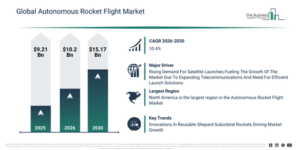
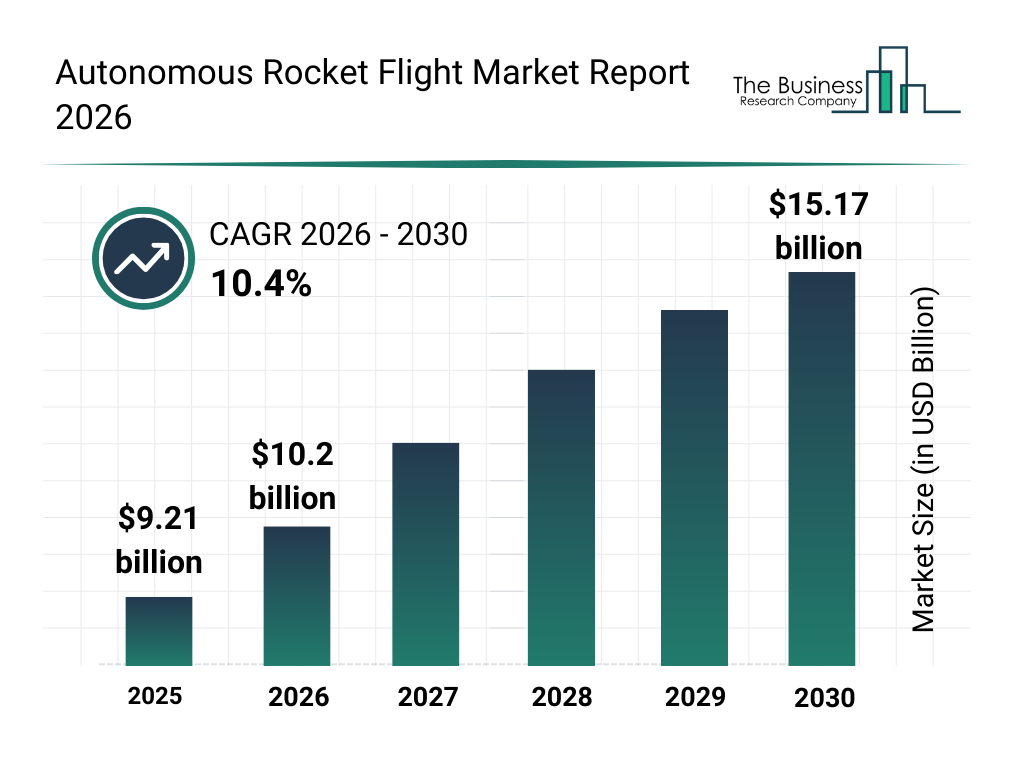
The autonomous rocket flight market size has experienced swift expansion recently. This market is projected to expand from $9.21 billion in 2025 to $10.2 billion in 2026, demonstrating a compound annual growth rate (CAGR) of 10.7%. Historically, this growth was driven by several factors, including the creation of initial autonomous navigation and guidance systems for rockets, the implementation of onboard control units to ensure flight stability, the rollout of automated launch operations aimed at minimizing human involvement, the incorporation of propulsion modules featuring autonomous control, and the increasing application of AI-powered flight software for adjusting trajectories and executing missions.
The autonomous rocket flight market is projected to experience substantial expansion over the upcoming years, reaching a valuation of $15.17 billion by 2030, demonstrating a robust compound annual growth rate (CAGR) of 10.4%. This anticipated growth is primarily fueled by factors such as the increasing need for fully autonomous rockets equipped with sophisticated in-flight decision-making capabilities, the broadening scope of autonomous landing and recovery systems, the rising integration of AI for payload deployment and mission optimization, a strategic emphasis on modular and scalable autonomous rocket designs, and an uptick in procurement for both commercial space and defense sector applications. Key developments expected during this period include the wider deployment of reusable autonomous launch vehicles, advancements in automated trajectory correction systems, greater adoption of precise autonomous landing techniques, improvements in autonomous in-flight decision-making processes, and a surging demand for autonomous payload deployment mechanisms.
Get A Free Autonomous Rocket Flight Market Sample With 2030 Forecast Insights:
Autonomous Rocket Flight Market Outlook: Key Driver Supporting Long-Term Growth
The increasing need for satellite deployments is anticipated to drive the expansion of the autonomous rocket flight market in the future. Satellite launches involve the method of dispatching artificial satellites into space via rockets, positioning them in specific orbits for applications such as communication, navigation, or scientific exploration. This rising demand for satellite launches stems from expanding uses in telecommunications, given that satellites provide extensive and worldwide communication capabilities, particularly in distant or neglected areas lacking sufficient terrestrial infrastructure. Autonomous rocket flight facilitates satellite launches by allowing accurate, streamlined, and economical placement of satellites into orbit, achieved through real-time path corrections and minimal human involvement. An example is Russia’s objective, as reported in July 2024 by the Foreign Policy Research Institute, a US-based non-profit think tank, to increase its satellite fleet from approximately 160 satellites in 2023 to 1,000 satellites by 2030. Consequently, the escalating need for satellite launches is fueling the expansion of the autonomous rocket flight market.
Segmentation Of The Autonomous Rocket Flight Market: Key Categories Explained
The autonomous rocket flight market covered in this report is segmented –
1) By Component: Hardware, Software, Services
2) By Application: Commercial, Military, Research And Development, Space Exploration, Other Applications
3) By End-User: Aerospace, Defense, Space Agencies, Other Users
Subsegments:
1) By Hardware: Navigation And Guidance Systems, Propulsion Systems, Sensors And Cameras, Communication Modules, Onboard Computers And Processors, Actuators And Control Systems
2) By Software: Flight Control Software, Autonomous Navigation Algorithms, Mission Planning Software, Data Processing And Analytics Software, Simulation And Testing Software
3) By Services: Launch And Flight Support Services, Maintenance And Repair Services, Software Update And Integration Services, Consulting And System Integration Services, Training And Technical Support Services
Autonomous Rocket Flight Market Evolving Trends: What Businesses Should Know
Companies operating in the autonomous rocket flight market are concentrating on developing technologically advanced solutions, such as reusable Shepard suborbital rockets, to reduce launch expenditures and increase the frequency of flights for commercial space missions. The reusable Shepard suborbital rocket is defined as a fully autonomous, vertically launching and landing vehicle designed and developed for multiple suborbital missions utilizing the same hardware, intended to cut costs and improve sustainability in spaceflight. For instance, in May 2025, Blue Origin Enterprises L.P., a US-based space technology company, sent six people into space aboard its New Shepard suborbital rocket for the NS-32 mission. This rocket system, powered by a BE-3PM engine that uses liquid hydrogen and oxygen, is built for minimal environmental footprint, emitting only water vapor as exhaust. The fully autonomous, single-stage reusable rocket carried six civilian passengers within the RSS First Step crew capsule, ascending to an altitude just beyond the Kármán Line (100 km), officially entering space. The booster then executed a precise vertical landing, while the capsule returned safely with parachutes and retro-thrust cushioning.
Who Competes In The Autonomous Rocket Flight Market? Major Companies Listed
Major companies operating in the autonomous rocket flight market are Space Exploration Technologies Corp., Blue Origin Enterprises L.P., Rocket Lab USA Inc., Relativity Space Inc., Firefly Aerospace Inc., Aevum Inc., Stoke Space Technologies Inc., Deep Blue Aerospace Co. Ltd., Virgin Orbit Inc., The Exploration Company GmbH, Isar Aerospace Technologies GmbH, Stratolaunch LLC, ABL Space Systems Inc., Astrobotic Technology Inc., Elecnor Deimos S.L.U., LandSpace Technology Corporation, iRocket Space Systems Inc., Exos Aerospace Systems & Technologies Inc., SpaceWalker Inc., Payload Aerospace S.L.
Read The Complete Autonomous Rocket Flight Market Forecast Report Through 2030:
Autonomous Rocket Flight Market Regional Ranking: Which Geography Comes First?
North America was the largest region in the autonomous rocket flight market in 2025. The regions covered in the autonomous rocket flight market report are Asia-Pacific, South East Asia, Western Europe, Eastern Europe, North America, South America, Middle East, Africa.
Reach Out To Our Team:
The Business Research Company: https://www.thebusinessresearchcompany.com/
Americas: +1 310-496-7795
Asia: +44 7882 955267 & +91 8897263534
Europe: +44 7882 955267
Email us at: marketing@tbrc.info
Follow us on:
LinkedIn: https://in.linkedin.com/company/the-business-research-company
YouTube: https://www.youtube.com/channel/UC24_fI0rV8cR5DxlCpgmyFQ
Global Market Model: https://www.thebusinessresearchcompany.com/global-market-model

Wasay has over a decade of experience in market research, data modelling, and analytics, with prior experience at GlobalData and Decision Tree Consulting Services. At The Business Research Company , he leads research operations across syndicated studies, customized consulting engagements, and the Global Market Model platform. His professional experience includes supporting organizations such as Boston Consulting Group, KPMG, and Ernst & Young. Wasay holds a degree in Electronics and Communications Engineering, postgraduate management qualifications from International Management Institute Belgium and Indian School of Business and Entrepreneurship, and completed the Integrated Program in Business Analytics from Indian Institute of Management Indore.