With a focus on actionable insights and strategic value, The Business Research Company’s 2026 market reports include market attractiveness scoring, total addressable market sizing, company benchmarking matrices, interactive Excel dashboards, deeper supply chain intelligence, emerging startup tracking, and granular product-level insights.
Commercial Radars Market Size Forecast Points To $8.9 Billion In Revenue By 2030
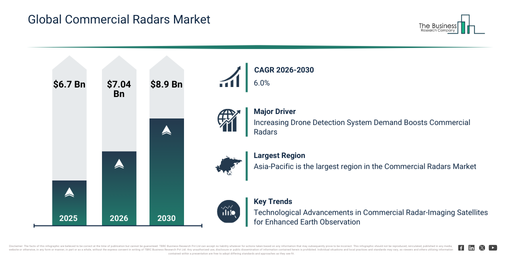
The commercial radars market size has shown significant growth in recent years. This market is expected to expand from $6.7 billion in 2025 to $7.04 billion in 2026, registering a compound annual growth rate (CAGR) of 5.1%. The expansion observed during the historical period can be attributed to several factors including the rise in commercial and civil aviation infrastructure, developments in radar detection and signal processing technologies, increased uptake of monostatic and bistatic radar systems, the broadening of radar maintenance and support services, and government regulations designed to improve air traffic safety and surveillance standards.
The commercial radars market is projected to experience substantial expansion in the forthcoming years. It will reach $8.9 billion in 2030 at a compound annual growth rate (CAGR) of 6.0%. This projected growth is fueled by several factors, such as the increasing demand for advanced multistate radar systems, the incorporation of AI and machine learning to enhance detection capabilities, the expansion of commercial air traffic necessitating greater radar infrastructure, the growing application of radar systems in maritime and industrial contexts, and breakthroughs in compact, high-resolution radar technologies. Furthermore, significant trends anticipated during this forecast period include the uptake of sophisticated weather and terrain detection systems, the integration of collision avoidance with air traffic control radars, the rising utilization of UAV-based radar systems for surveillance, a growing preference for multi-dimensional (2D/3D/4D) radar solutions, and a heightened focus on radar maintenance and lifecycle support services.
Get A Free Commercial Radars Market Sample Covering Drivers, Trends And Key Players:
Commercial Radars Market Driver Analysis: Key Factor Supporting Revenue Growth
The increasing prevalence of autonomous vehicles is anticipated to drive the expansion of the commercial radar market in the future. These self-driving cars and trucks utilize sophisticated sensors and software to operate independently of human intervention. Their adoption is increasing, spurred by ongoing progress in artificial intelligence and sensor technologies, which improve driving precision, safety, and operational efficiency. Additionally, increasing government backing for pilot programs and integration into public transport systems helps mitigate human error and alleviate traffic congestion. The proliferation of autonomous vehicles significantly fosters the development and progress of commercial radar technologies, given that these vehicles rely on advanced radar systems for precise sensing, object identification, and navigation, which are crucial for secure and dependable autonomous functionality. For example, the National Association of Insurance Commissioners (NAIC), a US-based entity, projected in December 2024 that approximately 4.5 million self-driving vehicles would be present on U.S. roads by 2030. The organization clarified, however, that these vehicles would possess self-driving features under particular conditions rather than being fully autonomous. Moreover, the Institute of Electrical and Electronics Engineers (IEEE) forecasts that 75% of all vehicles worldwide will be autonomous by 2040. Consequently, the expansion of autonomous vehicles is fueling the growth of the commercial radar market.
Commercial Radars Market Segmentation Framework: Major Segments At A Glance
The commercial radars market covered in this report is segmented –
1) By Type: Commercial Aircraft Radars, Commercial Helicopters Radars, Business Jets Radars, Uav Radars
2) By Technology: Quantum Radar, Conventional Radar, Software Defined Radar (Sdr)
3) By Dimension: 2D, 3D, 4D
4) By Application: Surveillance Radars, Surface Movement Radars, Precision Approach Radars, Weather Radars, Others
Subsegments:
1) By Commercial Aircraft Radars: Weather Radar Systems, Ground Proximity Warning Systems (GPWS), Air Traffic Control (ATC) Radar, Collision Avoidance Radar Systems, Other Commercial Aircraft Radars
2) By Commercial Helicopters Radars: Weather Radar Systems, Ground Collision Radar, Terrain Avoidance Radar, Synthetic Aperture Radar (SAR), Other Commercial Helicopter Radars
3) By Business Jets Radars: Weather Radar Systems, Collision Avoidance Radar Systems, Terrain Avoidance Radar, Ground Proximity Warning Systems (GPWS), Other Business Jets Radars
4) By UAV Radars: Synthetic Aperture Radar (SAR), Ground Moving Target Indicator (GMTI), Airborne Radar Systems, Radar for Navigation And Surveillance, Other UAV Radars
Latest Commercial Radars Market Developments And Emerging Trends
Key companies operating within the commercial radar market are prioritizing the development of technologically advanced solutions, such as commercial radar-imaging satellites, to bolster their capacities in high-resolution Earth observation and surveillance. Commercial radar-imaging satellites are defined as space-based systems that leverage radar technology, specifically synthetic aperture radar (SAR), to acquire high-resolution images of Earth’s surface. As an illustration, in March 2024, Rocket Lab USA, Inc., a US-based aerospace manufacturer and launch service provider, launched the StriX-4 satellite on behalf of the Japanese company Synspective from its Launch Complex 1 in New Zealand. This particular synthetic aperture radar (SAR) satellite, which represents the initial offering of Synspective’s third generation, was placed into a 543-kilometer orbit with an inclination of 43 degrees. The StriX-4 incorporates an upgraded SAR sensor that improves imaging resolution and facilitates high-frequency observations from multiple angles, concentrating on low- and mid-latitude regions.
Which Companies Are Shaping The Commercial Radars Market?
Major companies operating in the commercial radars market are Terma A/S, Hensoldt Inc., Detect Inc., Raytheon Technologies Corporation, NEC Corporation, Thales Group, Indra Sistemas SA, Easat Radar Systems Limited, Leonardo SpA, Honeywell International Inc., GEM elettronica, Blighter Surveillance Systems Ltd., Teledyne FLIR LLC, Airbus Defense and Space Inc., BAE Systems PLC, NXP Semiconductors N.V., Satellink Inc., Lockheed Martin Corporation, Saab AB, Northrop Grumman Corporation, Collins Aerospace, L3Harris Technologies Inc., Mitsubishi Electric Corporation, Israel Aerospace Industries Ltd., ASELSAN A.S., ELTA Systems Ltd., RADA Electronic Industries Ltd., SRC Inc., Telephonics Corporation, Selex ES Inc., Kongsberg Gruppen ASA, Thales Nederland B.V., Cobham plc, Rockwell Collins Inc., Harris Corporation.
Dive Deeper Into The Commercial Radars Market With The Full Report:
Commercial Radars Market Regional Distribution: Where Is Revenue Concentrated?
Asia-Pacific was the largest region in the commercial radars market in 2025. Asia-Pacific is expected to be the fastest-growing region in the commercial radars market during the forecast period. The regions covered in the commercial radars market report are Asia-Pacific, South East Asia, Western Europe, Eastern Europe, North America, South America, Middle East, Africa.
Reach Out To Our Team:
The Business Research Company: https://www.thebusinessresearchcompany.com/
Americas: +1 310-496-7795
Asia: +44 7882 955267 & +91 8897263534
Europe: +44 7882 955267
Email us at: marketing@tbrc.info
Follow us on:
LinkedIn: https://in.linkedin.com/company/the-business-research-company
YouTube: https://www.youtube.com/channel/UC24_fI0rV8cR5DxlCpgmyFQ
Global Market Model: https://www.thebusinessresearchcompany.com/global-market-model

Wasay has over a decade of experience in market research, data modelling, and analytics, with prior experience at GlobalData and Decision Tree Consulting Services. At The Business Research Company , he leads research operations across syndicated studies, customized consulting engagements, and the Global Market Model platform. His professional experience includes supporting organizations such as Boston Consulting Group, KPMG, and Ernst & Young. Wasay holds a degree in Electronics and Communications Engineering, postgraduate management qualifications from International Management Institute Belgium and Indian School of Business and Entrepreneurship, and completed the Integrated Program in Business Analytics from Indian Institute of Management Indore.