The Business Research Company’s 2026 market reports are designed to deliver research that is more actionable and strategically valuable. Key offerings include market attractiveness scoring, total addressable market sizing, company benchmarking matrices, interactive Excel dashboards, deeper supply chain intelligence, emerging startup tracking, and granular product-level insights.
Commercial Satellite Constellations Market Historical Growth Vs. Forecast Growth: How Do The Numbers Compare?
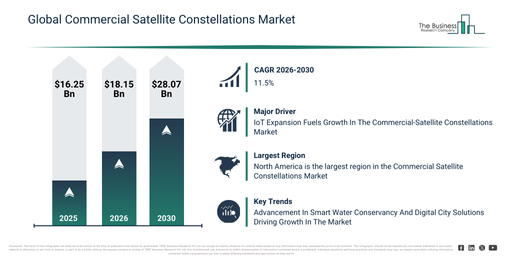
The market size for commercial satellite constellations has experienced significant expansion recently. This market is projected to expand from $16.25 billion in 2025 to $18.15 billion in 2026, demonstrating a compound annual growth rate (CAGR) of 11.7%. Historically, this growth was driven by factors such as initial commercial demand for global communication and widespread broadband access, a decrease in satellite manufacturing expenses that facilitated the deployment of extensive constellations, the expanded application of earth observation and remote-sensing data across various sectors, enhancements in RF signal processing and geolocation instruments that boost constellation efficiency, and the rise of microsatellites which support economical constellation expansion.
The commercial satellite constellations market is projected to experience swift expansion over the coming years. This market is predicted to reach $28.07 billion by 2030, exhibiting a compound annual growth rate (CAGR) of 11.5%. Key drivers for this growth include the increasing need for high-speed internet access in remote and underserved areas, the proliferation of IoT and M2M applications demanding constant low-latency connections, the expansion of commercial earth observation services utilized for analytics and monitoring, a surge in investments for LiDAR and advanced sensing satellites aimed at improving data precision, and the accelerated deployment of mega-constellations as part of commercial operators’ global coverage initiatives. Significant trends anticipated during this period encompass a growing interest in multi-orbit satellite architectures, the broadening of commercial earth observation platforms, an increased reliance on microsatellites and smallsat clusters, the rising uptake of RF geolocation and signal intelligence tools, and the swift commercialization of satellite-based IoT and M2M services.
Start With A Free Sample Of The Commercial Satellite Constellations Market Research Report:
The Leading Growth Driver In The Commercial Satellite Constellations Market Explained
The increasing adoption of the Internet of Things (IoT) is anticipated to fuel the expansion of the commercial satellite constellations market in the future. IoT represents a system of linked physical objects, such as devices, vehicles, and appliances, which are equipped with sensors, software, and connectivity, allowing them to gather and share data via the Internet. Satellite constellations play a crucial role in enabling global connectivity, providing internet access to IoT devices even in distant or hard-to-reach locations where conventional land-based networks might be inadequate. For example, data from IoT Analytics GmbH, a Germany-based non-governmental organization, released in September 2024, showed that by the end of 2023, the number of connected IoT devices reached 16.6 billion, marking a 15% rise from 2022. IoT Analytics forecasts an additional 13% increase, reaching 18.8 billion by the close of 2024. Furthermore, projections indicate that the count of connected IoT devices will hit 40 billion by 2030, which is a substantial leap compared to the market figures updated in 2023. Consequently, the expanding Internet of Things (IoT) sector is a key catalyst for the growth of the commercial satellite constellations market.
Key Segments Shaping The Commercial Satellite Constellations Market Landscape
The commercial satellite constellations market covered in this report is segmented –
1) By Type: Low Earth Orbit (LEO) Constellations, Medium Earth Orbit (MEO) Constellations, Geostationary Earth Orbit (GEO) Satellites
2) By Frequency: Ka-Band, Ku-Band, C-Band
3) By Application: Telecommunications And Connectivity, Earth Observation And Remote Sensing, Navigation And Positioning Services
Subsegments:
1) By Low Earth Orbit (LEO) Constellations: Broadband Communication Satellites, Earth Observation Satellites, Scientific And Research Satellites
2) By Medium Earth Orbit (MEO) Constellations: Navigation Satellites, Communication Satellites, Earth Observation Satellites
3) By Geostationary Earth Orbit (GEO) Satellites: Direct-To-Home (DTH) Broadcast Satellites, Communication Satellites, Weather Satellites
Commercial Satellite Constellations Market Trend Spotlight: Key Shifts Shaping Future Demand
Major companies operating in the commercial satellite constellations market are focusing on creating innovative products such as smart water conservancy and digital city solutions. These solutions aim to improve urban management, environmental monitoring, and resource optimization by leveraging real-time satellite data. Smart water conservancy and digital city concepts involve using satellite-based data and analytics to efficiently manage water resources and support intelligent urban planning, infrastructure monitoring, and sustainable city development. As an illustration, in April 2024, China Siwei Surveying and Mapping Technology Co. Ltd., a China-based satellite imaging company, successfully launched the SuperView Neo 3-01 satellite to enhance its high-resolution Earth observation and commercial imaging capabilities. The SuperView Neo 3-01 satellite features next-generation high-resolution optical imaging technology, allowing it to deliver clearer, more detailed Earth observation data for applications like urban planning, environmental monitoring, and disaster assessment. This launch represents a significant step in China Siwei’s strategy to expand its SuperView Neo constellation and strengthen its global imaging capabilities.
Commercial Satellite Constellations Market Competitive Analysis: Who Are The Main Competitors?
Major companies operating in the commercial satellite constellations market are Lockheed Martin Corporation, Northrop Grumman Corporation, Mitsubishi Electric Corporation, Honeywell International Inc, China Aerospace Science and Technology Corporation (CASC), Thales Alenia Space, Space Exploration Technologies Corp, Viasat Inc., Cobham plc, L3Harris Technologies Inc, Airbus Defence and Space SAS, OHB System AG, Iridium Communications Inc, Telesat Canada, Al Yah Satellite Communications Company (Yahsat), Skyloom Global Corp, Globalstar Inc., Planet Labs PBC, Spire Global Inc., Capella Space, Kepler Communications Inc., LeoLabs Inc., OneWeb Global Limited, LeoStella LLC, SatSure Ltd., Nuview, Lynk Global Inc.
Find The Complete Commercial Satellite Constellations Market Outlook In The Full Report:
Mapping The Commercial Satellite Constellations Market: Regional Leadership And Global Reach
North America was the largest region in the commercial satellite constellations market in 2025. Asia-Pacific is expected to be the fastest-growing region in the forecast period. The regions covered in the commercial satellite constellations market report are Asia-Pacific, South East Asia, Western Europe, Eastern Europe, North America, South America, Middle East, Africa.
Reach Out To Our Team:
The Business Research Company: https://www.thebusinessresearchcompany.com/
Americas: +1 310-496-7795
Asia: +44 7882 955267 & +91 8897263534
Europe: +44 7882 955267
Email us at: marketing@tbrc.info
Follow us on:
LinkedIn: https://in.linkedin.com/company/the-business-research-company
YouTube: https://www.youtube.com/channel/UC24_fI0rV8cR5DxlCpgmyFQ
Global Market Model: https://www.thebusinessresearchcompany.com/global-market-model

Wasay has over a decade of experience in market research, data modelling, and analytics, with prior experience at GlobalData and Decision Tree Consulting Services. At The Business Research Company , he leads research operations across syndicated studies, customized consulting engagements, and the Global Market Model platform. His professional experience includes supporting organizations such as Boston Consulting Group, KPMG, and Ernst & Young. Wasay holds a degree in Electronics and Communications Engineering, postgraduate management qualifications from International Management Institute Belgium and Indian School of Business and Entrepreneurship, and completed the Integrated Program in Business Analytics from Indian Institute of Management Indore.