The Business Research Company’s 2026 market reports combine market attractiveness scoring, total addressable market sizing, company benchmarking matrices, interactive Excel dashboards, deeper supply chain intelligence, emerging startup tracking, and granular product-level insights to deliver research that is more actionable and strategically valuable.
Composites In The Defense Market Size Review: What Shaped Past Growth And What Will Drive Future Expansion?
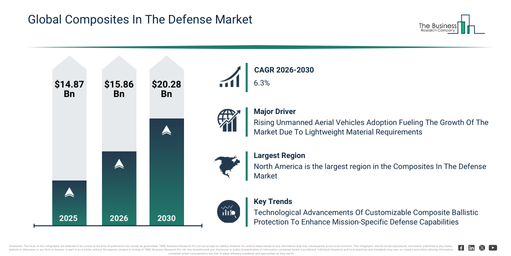
The composites in the defense market size has experienced significant growth recently. This market is projected to expand from $14.87 billion in 2025 to $15.86 billion in 2026, demonstrating a compound annual growth rate (CAGR) of 6.7%. Historically, this expansion can be ascribed to several factors, including the increased adoption of lightweight composite materials for military aircraft structures, a rise in the application of composites in ballistic protection equipment like helmets and panels, the expanding production of unmanned aerial vehicles necessitating composite airframes, the creation of composite-based missile casings to improve performance and durability, and the incorporation of composite materials in radar enclosures to meet stealth and signal transparency requirements.
The defense market for composites is projected to experience substantial expansion in the coming years. This market is forecast to reach $20.28 billion by 2030, exhibiting a compound annual growth rate (CAGR) of 6.3%. This expansion is driven by several factors, including the increasing need for sophisticated composites in next-generation stealth platforms, greater application of high-temperature and impact-resistant composites in missile and drone systems, ongoing defense modernization initiatives focusing on lightweight vehicle parts, technological progress in resin and fiber enhancing multifunctional composite structures, and wider integration of composites in autonomous defense and military space programs. Key trends anticipated during this period involve the rising adoption of lightweight composite components, a growing requirement for high-impact ballistic composites, increased utilization of stealth-grade composite materials, broader application of composites in missile casings and UAV airframes, and a stronger preference for corrosion-resistant composites in naval applications.
Access Free Sample Pages From The Composites In The Defense Market Report 2026:
Understanding The Main Driver Of The Composites In The Defense Market
The increasing need for unmanned aerial vehicles (UAVs) is projected to boost the expansion of composites in the defense market moving forward. An unmanned aerial vehicle (UAV) is an aircraft that operates without a human pilot onboard, controlled either remotely or autonomously, and is commonly employed for various military, commercial, and recreational purposes, including surveillance, delivery, and aerial photography. The demand for UAVs is escalating because of their ability to execute a wide array of tasks more efficiently, safely, and cost-effectively than traditional methods. The growing application of unmanned aerial vehicles (UAVs) in the defense industry has fostered a greater reliance on advanced composites, as these materials decrease overall weight while maintaining structural strength and durability. For instance, in June 2025, according to a report published by the Ministry of Defense, a UK-based government department, the UK will supply 100,000 drones to Ukraine, a tenfold increase from the 10,000 drones delivered in 2024. Therefore, the escalating demand for unmanned aerial vehicles (UAVs) is driving the composites in the defense market.
Composites In The Defense Market Segment Mapping For 2026 And Beyond
The composites in the defense market covered in this report is segmented –
1) By Type: Carbon Fiber Reinforced Plastic (CFRP), Glass Fiber Reinforced Plastic (GFRP), Aramid Fiber Reinforced Plastic (AFRP), Boron Fiber Reinforced Plastic (BFRP)
2) By Resin Type: Thermoset Composites, Thermoplastic Composites, Ceramic Matrix Composites
3) By Manufacturing Process: Layup, Filament Winding, Injection Molding, Pultrusion, Other Manufacturing Processes
4) By Applications: Military Aircraft, Naval System, Land Vehicles, Arms And Ammunition, Body Armor, Military Hard Wall Shelters
Subsegments:
1) By Carbon Fiber Reinforced Plastic (CFRP): Thermoset Carbon Fiber Reinforced Plastic (CFRP), Thermoplastic Carbon Fiber Reinforced Plastic (CFRP), High-Modulus Carbon Fiber Reinforced Plastic (CFRP), Standard-Modulus Carbon Fiber Reinforced Plastic (CFRP), Aerospace Grade Carbon Fiber Reinforced Plastic (CFRP)
2) By Glass Fiber Reinforced Plastic (GFRP): E-Glass Glass Fiber Reinforced Plastic (GFRP), S-Glass Glass Fiber Reinforced Plastic (GFRP), R-Glass Glass Fiber Reinforced Plastic (GFRP), Thermoset Glass Fiber Reinforced Plastic (GFRP), Thermoplastic Glass Fiber Reinforced Plastic (GFRP)
3) By Aramid Fiber Reinforced Plastic (AFRP): Meta-Aramid Reinforced Plastic, Para-Aramid Reinforced Plastic, Thermoset Aramid Fiber Reinforced Plastic (AFRP), Thermoplastic Aramid Fiber Reinforced Plastic (AFRP)
4) By Boron Fiber Reinforced Plastic (BFRP): Boron-Epoxy Composites, Boron-Aluminum Composites, Hybrid Boron Composites, High-Strength Boron Fiber Reinforced Plastic (BFRP)
What Key Trend Is Expected To Shape The Composites In The Defense Market Over The Forecast Period?
Major companies operating in the composites in defense market are focused on developing innovative solutions, such as customizable composite ballistic protection, to enhance mission-specific defense capabilities. This customizable composite ballistic protection refers to adaptable armor systems crafted from advanced fiber-resin composites that provide tailored protection levels while reducing weight and improving mobility. For instance, in November 2023, Integris Composites, a US-based protective materials company, launched customizable composite ballistic shields and vests. These products feature scalable protection configurations, lightweight multi-hit capability, and an ergonomic design for optimal coverage and user comfort. They are engineered for military and law enforcement operations requiring rapid adaptation to changing threat levels. The customizable composite ballistic shields and vests offer enhanced survivability and mobility without compromising protection.
Composites In The Defense Market Major Players And Industry Competition Overview
Major companies operating in the composites in the defense market are Airbus SE, General Dynamics Corporation, Northrop Grumman Corporation, Honeywell International Inc., Mitsubishi Chemical Corporation, Safran S.A., Thales Group, Toray Industries Inc., Evonik Industries AG, Leonardo S.p.A., Teijin Limited, Elbit Systems Ltd., Spirit AeroSystems, Hexcel Corporation, SGL Carbon SE, Magellan Aerospace, Gurit Holding AG, Patria Group, Plasan Sasa Ltd., CPI Aerostructures.
Full Composites In The Defense Market Report: Market Size, Trends, Segments And Key Players:
Composites In The Defense Market Geographic Segmentation: Regions Covered In The Report
North America was the largest region in the composites in the defense market in 2025. Asia-Pacific is expected to be the fastest-growing region in the forecast period. The regions covered in the composites in the defense market report are Asia-Pacific, South East Asia, Western Europe, Eastern Europe, North America, South America, Middle East, Africa.
Reach Out To Our Team:
The Business Research Company: https://www.thebusinessresearchcompany.com/
Americas: +1 310-496-7795
Asia: +44 7882 955267 & +91 8897263534
Europe: +44 7882 955267
Email us at: marketing@tbrc.info
Follow us on:
LinkedIn: https://in.linkedin.com/company/the-business-research-company
YouTube: https://www.youtube.com/channel/UC24_fI0rV8cR5DxlCpgmyFQ
Global Market Model: https://www.thebusinessresearchcompany.com/global-market-model

Wasay has over a decade of experience in market research, data modelling, and analytics, with prior experience at GlobalData and Decision Tree Consulting Services. At The Business Research Company , he leads research operations across syndicated studies, customized consulting engagements, and the Global Market Model platform. His professional experience includes supporting organizations such as Boston Consulting Group, KPMG, and Ernst & Young. Wasay holds a degree in Electronics and Communications Engineering, postgraduate management qualifications from International Management Institute Belgium and Indian School of Business and Entrepreneurship, and completed the Integrated Program in Business Analytics from Indian Institute of Management Indore.