Market attractiveness scoring, total addressable market sizing, company benchmarking matrices, interactive Excel dashboards, deeper supply chain intelligence, emerging startup tracking, and granular product-level insights are among the key offerings featured in The Business Research Company’s 2026 market reports, designed to deliver more actionable and strategically valuable research.
Composite Materials Aluminum Alloys Aerospace Market On Course To Reach $56.9 Billion By 2030: Size And Growth Overview
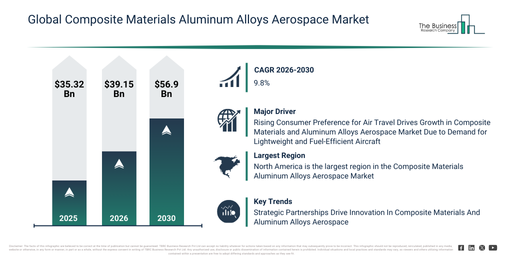
The market size for composite materials aluminum alloys aerospace has shown rapid expansion in recent years. It is projected to increase from $35.32 billion in 2025 to $39.15 billion in 2026, exhibiting a compound annual growth rate (CAGR) of 10.8%. This historical growth can be ascribed to several factors, including the growing integration of aluminum alloy composites into structural aircraft components due to their strength-to-weight benefits, an upswing in commercial aircraft production fueling demand for technical-grade aerospace aluminum materials, the expanding utilization of corrosion-resistant aluminum alloys in challenging aerospace settings, the proliferation of spacecraft and satellite manufacturing necessitating specialized lightweight alloy composites, and the advancement of industrial-grade alloy formulations to bolster durability and fatigue resistance.
The composite materials aluminum alloys aerospace market size is expected to see strong growth in the next few years. It will grow to $56.9 billion in 2030 at a compound annual growth rate (CAGR) of 9.8%. The growth in the forecast period can be attributed to growing demand for next-generation lightweight materials to improve aircraft fuel efficiency, increasing investment in advanced composite–aluminum hybrid structures for aerospace applications, rising production of new commercial and defense aircraft platforms requiring high-performance alloy materials, expanding space exploration and satellite deployment programs boosting consumption of aerospace-grade aluminum composites, continued innovation in alloy processing technologies to enhance strength and manufacturability. Major trends in the forecast period include growing demand for high-strength aluminum alloys for lightweight aircraft structures, increased adoption of advanced composite–aluminum hybrid materials, rising use of corrosion-resistant alloy grades for long-life aerospace components, expansion of aluminum alloy applications in next-generation commercial aircraft, growing requirement for high-performance alloys in military aircraft and helicopters.
Need Composite Materials Aluminum Alloys Aerospace Market Forecasts? Get Your Free Sample Report Here:
Composite Materials Aluminum Alloys Aerospace Market Growth Factors: What Is Strengthening Demand Worldwide?
Growing consumer preference for flight transportation is anticipated to propel the expansion of the composite materials aluminum alloys aerospace market. Flight transportation refers to the movement of people and goods via any mode of transportation capable of sustained controlled flight. This rise in consumer preference for air travel is attributed to increased disposable income and the expansion of the middle class, making air travel more accessible and appealing to a broader population segment. Consumer inclination toward flight transportation, driven by the demand for greater fuel efficiency, lower ticket costs, and improved environmental sustainability, directly supports the use of advanced materials such as composite materials and aluminum alloys in aerospace manufacturing. These materials facilitate lighter, stronger, and more energy-efficient aircraft designs that meet modern performance and economic expectations. For instance, in January 2025, according to the State Council of the People’s Republic of China, an official China-based government website, in 2024, China’s air-passenger trips reached about 730 million, which is up approximately 17.9% year-on-year compared with 2023. Therefore, an increase in consumer preference for flight transportation is driving the demand for the composite materials aluminum alloys aerospace market.
Composite Materials Aluminum Alloys Aerospace Market By Segment: Complete Category And Subcategory Breakdown
The composite materials aluminum alloys aerospace market covered in this report is segmented –
1) By Material Type: Aluminum Alloys, Titanium Alloys, Steel Alloys, Composites
2) By Product: Carbon Fiber Composite Materials, Glass Fiber Composite Materials, Aramid Fiber Composite Materials, Other Products
3) By Application: Commercial Aircraft, Business And General Aviation, Military Aircraft, Helicopters, Other Applications
Subsegments:
1) By Aluminum Alloys: 2000 Series (Al-Cu Alloys), 6000 Series (Al-Mg-Si Alloys), 7000 Series (Al-Zn Alloys)
2) By Titanium Alloys: Alpha Alloys, Beta Alloys, Alpha-Beta Alloys
3) By Steel Alloys: Stainless Steel Alloys, High-Strength Low-Alloy (HSLA) Steel, Carbon Steel Alloys
4) By Composites: Carbon Fiber Reinforced Composites (CFRP), Glass Fiber Reinforced Composites (GFRP), Aramid Fiber Reinforced Composites
Composite Materials Aluminum Alloys Aerospace Market Trend Outlook: Developments Defining The Forecast Period
Major companies operating in composite materials aluminum alloys aerospace are increasingly adopting a strategic partnership approach. This strategy aims to deliver multiple advantages and address the intricate demands of the aerospace market. Strategic partnerships involve companies leveraging each other’s strengths and resources to achieve mutual benefits and success. For instance, in October 2023, Solvay, a Belgium-based chemical manufacturing company, collaborated with Red Hat Inc., a US-based aerospace company. Through this partnership, they intend to supply advanced composite materials for BETA’s electric aircraft, cooperate on developing new composite materials for the advanced air mobility (AAM) market, and enhance their positions in the AAM market.
Who Is Competing For Share In The Composite Materials Aluminum Alloys Aerospace Market?
Major companies operating in the composite materials aluminum alloys aerospace market are Toray Industries Inc., Koninklijke Ten Cate B.V., Teijin Limited, Renegade Materials Corp., Materion Corp., HEXEL Works Inc., Solvay S.A., Mitsubishi Rayon Co. Ltd., SGL Group, Alcoa Corporation, Constellium SE, Kobe Steel Ltd., Novelis Inc., AMG Critical Materials NV, Allegheny Technologies Incorporated, Kaiser Aluminum Corporation, Arconic Inc., Precision Castparts Corp., Thyssenkrupp Aerospace India Pvt Ltd., United Aluminum Corporation, BAE Systems, Bombardier Inc., GE Aviation, Honeywell Aerospace, Pratt & Whitney, Rolls-Royce Holdings plc, The Boeing Company, Airbus SE, Lockheed Martin Corporation, Spirit AeroSystems Inc., Triumph Group Inc., Safran S.A.
Get The Full Picture With The Composite Materials Aluminum Alloys Aerospace Market Report:
Composite Materials Aluminum Alloys Aerospace Market Regional Snapshot: Leading Geography In 2025
North America was the largest region in the composite materials aluminum alloys aerospace market in 2025. North America is expected to be the fastest growing region in the forecast period. The regions covered in the composite materials aluminum alloys aerospace market report are Asia-Pacific, South East Asia, Western Europe, Eastern Europe, North America, South America, Middle East, Africa.
Reach Out To Our Team:
The Business Research Company: https://www.thebusinessresearchcompany.com/
Americas: +1 310-496-7795
Asia: +44 7882 955267 & +91 8897263534
Europe: +44 7882 955267
Email us at: marketing@tbrc.info
Follow us on:
LinkedIn: https://in.linkedin.com/company/the-business-research-company
YouTube: https://www.youtube.com/channel/UC24_fI0rV8cR5DxlCpgmyFQ
Global Market Model: https://www.thebusinessresearchcompany.com/global-market-model

Wasay has over a decade of experience in market research, data modelling, and analytics, with prior experience at GlobalData and Decision Tree Consulting Services. At The Business Research Company , he leads research operations across syndicated studies, customized consulting engagements, and the Global Market Model platform. His professional experience includes supporting organizations such as Boston Consulting Group, KPMG, and Ernst & Young. Wasay holds a degree in Electronics and Communications Engineering, postgraduate management qualifications from International Management Institute Belgium and Indian School of Business and Entrepreneurship, and completed the Integrated Program in Business Analytics from Indian Institute of Management Indore.