With a focus on actionable insights and strategic value, The Business Research Company’s 2026 market reports include market attractiveness scoring, total addressable market sizing, company benchmarking matrices, interactive Excel dashboards, deeper supply chain intelligence, emerging startup tracking, and granular product-level insights.
How Large Could The Drone Defense System Market Become By 2030 At A 50.2% CAGR?
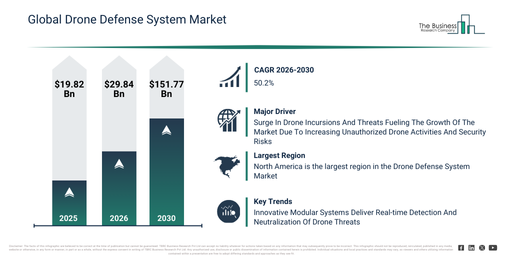
The market for drone defense systems has experienced substantial growth in recent years. It is projected to expand from $19.82 billion in 2025 to $29.84 billion in 2026, achieving a compound annual growth rate (CAGR) of 50.6%. This historical expansion is attributed to several factors, including an increase in unauthorized drone activities that prompted the early deployment of detection and monitoring solutions, the growing adoption of acoustic sensors to enhance radar and RF systems for drone identification, the development of countermeasure services such such as jamming and physical interception, the broader deployment of drone defenses at critical infrastructure and military facilities, and the proliferation of cybersecurity solutions addressing drone-related communication vulnerabilities.
The drone defense system market is projected to experience substantial growth in the coming years. It is anticipated to expand to $151.77 billion by 2030, demonstrating a robust compound annual growth rate (CAGR) of 50.2%. This growth throughout the forecast period can be attributed to several factors, including an increasing need for multi-sensor fusion systems that improve drone detection and classification accuracy, the rising adoption of mobile and quickly deployable drone defense units for event and field security, the broadening use of AI-driven threat analysis to automate responses to hostile drones, the greater integration of cyber-defense tools to counter advanced drone swarming and spoofing tactics, and the development of scalable hybrid defense architectures that combine electronic, kinetic, and cyber countermeasures. Key trends anticipated during this period include the increased deployment of layered drone defense architectures around vital infrastructure and prominent public events, a rapid transition from experimental counter-UAS initiatives to fully operational, field-proven systems supported by integrated logistics, a growing demand for mobile and rapidly deployable drone defense units for border protection, battlefield scenarios, and VIP security, an elevated emphasis on minimizing collateral interference and ensuring compliance with airspace and spectrum regulations in counter-UAS operations, and the expansion of service-based drone defense models, such as monitoring-as-a-service and managed counter-UAS operations contracts.
Get A Free Drone Defense System Market Sample With 2030 Forecast Insights:
Drone Defense System Market Outlook: Key Driver Supporting Long-Term Growth
The expanding occurrence of drone incursions and associated threats is projected to stimulate the expansion of the drone defense system market in the future. These incursions and threats signify unauthorized drone entries and activities that present security dangers or interfere with operations. This escalation in drone-related incidents stems from the broader accessibility of commercial drones, frequently exploited for purposes such as surveillance, illicit smuggling, or disturbing vital infrastructure and public gatherings. Drone defense systems are instrumental in mitigating these incursions and threats by enabling the detection, tracking, and neutralization of unauthorized drones, thereby safeguarding sensitive locations and ensuring overall safety. As an illustration, Dedrone, a technology firm based in the US, reported in February 2024 that roughly 4,000 unlawful drone incidents took place at 370 significant sporting events across almost 60 stadiums globally in 2023, indicating an increase of nearly 20% compared to 2022. Consequently, the escalating volume of drone incursions and associated threats is serving as a significant impetus for the growth of the drone defense system market.
Segmentation Of The Drone Defense System Market: Key Categories Explained
The drone defense system market covered in this report is segmented –
1) By Type: Detection systems, Countermeasure systems, Monitoring systems
2) By Technology: Radar, RF Detection, Advanced AI, Machine Learning
3) By End-Users: Military And Defense, Commercial, Homeland Security
Subsegments:
1) By Detection Systems: Radar-based Detection, Radio Frequency (RF) Detection, Acoustic Detection, Optical/Infrared (IR) Detection, Multi-sensor Fusion Detection
2) By Countermeasure Systems: Jamming Systems, Directed Energy Weapons, Net Capture Systems, Kinetic Interception Systems, Drone Spoofing Systems
3) By Monitoring Systems: Command And Control (C2) Software, Surveillance And Tracking Systems, Data Analytics And Threat Assessment Systems, Integration Platforms, Communication Monitoring Systems
Drone Defense System Market Evolving Trends: What Businesses Should Know
Leading companies within the drone defense system market are focused on developing advanced innovations, such as fully mobile counter-UAS kill chain solutions, to mitigate unauthorized drones. This ensures enhanced protection for military and critical infrastructure operating in dynamic and high-risk environments. A fully mobile counter-UAS kill chain refers to an integrated, vehicle-mounted system designed to detect, track, identify, and neutralize drone threats in real time while the vehicle is on the move. For instance, in June 2024, Dedrone, a US-based company offering drone defense systems, introduced its newest airspace security product, DedroneOnTheMove (DedroneOTM). This product is engineered for straightforward integration with any military vehicle, ensuring that forces can maintain mobility while simultaneously being protected from aerial threats. It is compatible with a wide array of platforms, including Supacat’s HMT vehicles, which are frequently used in expeditionary and high-risk operational settings.
Who Competes In The Drone Defense System Market? Major Companies Listed
Major companies operating in the drone defense system market are Raytheon Technologies Corporation, Boeing, Lockheed Martin Corporation, Northrop Grumman Corporation, BAE Systems, Thales Group, Leonardo S.p.A., Rheinmetall AG, Battelle Memorial Institute, Elbit Systems Ltd., Israel Aerospace Industries Ltd., Saab AB, Aselsan A.S., Hensoldt, QinetiQ Group plc, SRC Inc., Highlander Partners, Chess Dynamics Ltd., DroneShield Ltd., Blighter Surveillance Systems Ltd.
Read The Complete Drone Defense System Market Forecast Report Through 2030:
Drone Defense System Market Regional Ranking: Which Geography Comes First?
North America was the largest region in the drone defense system market in 2025. Asia-Pacific is expected to be the fastest-growing region in the forecast period. The regions covered in the drone defense system market report are Asia-Pacific, South East Asia, Western Europe, Eastern Europe, North America, South America, Middle East, Africa.
Reach Out To Our Team:
The Business Research Company: https://www.thebusinessresearchcompany.com/
Americas: +1 310-496-7795
Asia: +44 7882 955267 & +91 8897263534
Europe: +44 7882 955267
Email us at: marketing@tbrc.info
Follow us on:
LinkedIn: https://in.linkedin.com/company/the-business-research-company
YouTube: https://www.youtube.com/channel/UC24_fI0rV8cR5DxlCpgmyFQ
Global Market Model: https://www.thebusinessresearchcompany.com/global-market-model

Wasay has over a decade of experience in market research, data modelling, and analytics, with prior experience at GlobalData and Decision Tree Consulting Services. At The Business Research Company , he leads research operations across syndicated studies, customized consulting engagements, and the Global Market Model platform. His professional experience includes supporting organizations such as Boston Consulting Group, KPMG, and Ernst & Young. Wasay holds a degree in Electronics and Communications Engineering, postgraduate management qualifications from International Management Institute Belgium and Indian School of Business and Entrepreneurship, and completed the Integrated Program in Business Analytics from Indian Institute of Management Indore.