The Business Research Company’s 2026 market reports are designed to deliver research that is more actionable and strategically valuable. Key offerings include market attractiveness scoring, total addressable market sizing, company benchmarking matrices, interactive Excel dashboards, deeper supply chain intelligence, emerging startup tracking, and granular product-level insights.
Drone Flight Controller System Market Size Insights: Annual Growth Rate, Revenue Outlook And Forecast Drivers
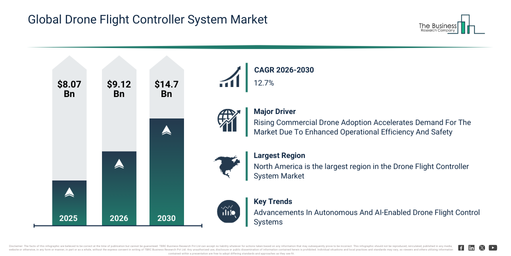
The drone flight controller system market has experienced significant expansion recently. It is projected to increase from $8.07 billion in 2025 to $9.12 billion in 2026, exhibiting a compound annual growth rate (CAGR) of 13.0%. The historical growth can be attributed to the broader application of gyroscope- and accelerometer-based stabilization systems for improved drone flight accuracy, the rising adoption of GPS-enabled flight controllers for precise navigation and positioning, the growth of real-time flight monitoring services supporting commercial and industrial drone operations, the development of firmware update and configuration tools that enhance controller performance, and the growing requirement for sensor calibration support to maintain reliable and consistent drone behavior.
The drone flight controller system market is anticipated to experience substantial expansion over the next few years. It is projected to reach $14.7 billion by 2030, demonstrating a compound annual growth rate (CAGR) of 12.7%. This growth during the forecast period is attributed to several factors, including the increasing incorporation of advanced geo-fencing capabilities to ensure regulatory compliance and operational safety, the rising adoption of obstacle avoidance technologies driven by autonomous drone applications, the broadening of payload control systems to support diverse commercial drone missions, a growing demand for high-performance flight controllers enabling long-range and high-endurance drones, and the development of AI-enabled flight algorithms that enhance autonomous decision-making and mission efficiency. Major trends foreseen for this period include the increased integration of sophisticated navigation features such as geo-fencing, return-to-home, and terrain-following into standard flight controllers; improvements in miniaturization and power efficiency that allow for high-performance controller systems in smaller and lighter drone platforms; the growing acceptance of modular, plug-and-play flight controller architectures compatible with various airframes and payload configurations; a rising demand for standardized interfaces and open ecosystems to simplify firmware updates, configuration, and sensor calibration across drone fleets; and the expansion of after-sales services, including remote diagnostics, real-time flight monitoring support, and lifecycle firmware management contracts.
Request A Free Excerpt Of The Drone Flight Controller System Global Market Report 2026:
What Will Drive Drone Flight Controller System Market Growth Through 2030?
The expansion in the commercial deployment of drones is anticipated to drive forward the growth of the drone flight controller system market. The application of drones in commercial sectors involves utilizing unmanned aerial vehicles (UAVs) for various business functions, including inspections, deliveries, surveillance, mapping, and aerial imaging across diverse industries. The increasing adoption of drones for commercial purposes is fueled by their capacity to safely reach challenging or dangerous locations, thereby minimizing risks to human personnel. Crucially, the drone flight controller system facilitates accurate navigation, steadfast stability, and automated operations, all of which are vital for dependable and efficient drone activities in commercial contexts like surveying, inspections, and deliveries. For instance, in May 2024, according to the International Trade Administration, a US-based government agency, VUL (Association of Unmanned Aviation) projects a 40% rise in the worldwide count of commercially operated drones between 2022 and 2030. Consequently, the escalating utilization of drones in commercial applications is propelling the expansion of the drone flight controller system market.
Drone Flight Controller System Market Segment Analysis Covering All Major Categories
The drone flight controller system market covered in this report is segmented –
1) By Component: Hardware, Software, Services
2) By Product: Flight controller, Speed Controller, Global Positioning System, Sensor, Other Products
3) By Technology: Autonomous, Semi-Autonomous, Manual
4) By Application: Fixed-wing Drone, Rotary Wing Drone, Hybrid Wing Drone
5) By End-User: Agriculture, Construction, Logistics, Media And Entertainment, Defense, Other End-Users
Subsegments:
1) By Hardware: Flight Controller Board, Sensors, Global Positioning System Module
2) By Software: Flight Control Software, Mission Planning Software, Navigation Software
3) By Services: Installation And Integration, Training And Consulting, Maintenance And Support
Major Trends Shaping The Future Of The Drone Flight Controller System Market
Leading companies within the drone flight controller system market are concentrating on developing technological advancements, such as next-generation controllers, to enhance autonomous navigation, improve flight stability, integrate AI-based decision-making, and support swarming capabilities for defense and commercial applications. These next-generation controllers are sophisticated drone flight control systems that incorporate AI, sensor fusion, onboard computing, and enhanced security to facilitate autonomous, precise, and adaptive flight operations. For instance, in March 2025, Passenger Drone Research Pvt. Ltd., an India-based drone technology company, launched an Ag++ (AeroFC Ag++) flight controller. This particular solution is a plug-and-play system designed specifically for agricultural drones, offering advanced sensors and seamless software integration for precise, efficient, and reliable crop spraying and mapping. Its key benefits include high-precision motion and altitude control, intuitive mission planning, real-time monitoring, and easy customization, all aimed at maximizing productivity and reducing operational complexity.
Drone Flight Controller System Market Competitive Environment And Key Companies
Major companies operating in the drone flight controller system market are Lockheed Martin Corporation, Honeywell Aerospace, Mitsubishi Heavy Industries Ltd., GE Aerospace, Kawasaki Heavy Industries Ltd., Israel Aerospace Industries Ltd, SZ DJI Technology Co. Ltd, Quantum-Systems, Parrot Drones SAS, Delair SAS, Auterion AG, MicroPilot Inc., Ascent AeroSystems Inc, Chengdu CUAV Technology Co. Ltd., Embention Sistemas Inteligentes S.L., Holybro, Sky-Drones Technologies Ltd, CubePilot Pty Ltd, Shenzhen JIYI Technology Co. Ltd., Pixhawk.
Access Expert Drone Flight Controller System Market Analysis In The Full Report:
Which Regions Are Covered In The Drone Flight Controller System Market Report?
North America was the largest region in the drone flight controller system market in 2025. Asia-Pacific is expected to be the fastest-growing region in the forecast period. The regions covered in the drone flight controller system market report are Asia-Pacific, South East Asia, Western Europe, Eastern Europe, North America, South America, Middle East, Africa.
Reach Out To Our Team:
The Business Research Company: https://www.thebusinessresearchcompany.com/
Americas: +1 310-496-7795
Asia: +44 7882 955267 & +91 8897263534
Europe: +44 7882 955267
Email us at: marketing@tbrc.info
Follow us on:
LinkedIn: https://in.linkedin.com/company/the-business-research-company
YouTube: https://www.youtube.com/channel/UC24_fI0rV8cR5DxlCpgmyFQ
Global Market Model: https://www.thebusinessresearchcompany.com/global-market-model

Wasay has over a decade of experience in market research, data modelling, and analytics, with prior experience at GlobalData and Decision Tree Consulting Services. At The Business Research Company , he leads research operations across syndicated studies, customized consulting engagements, and the Global Market Model platform. His professional experience includes supporting organizations such as Boston Consulting Group, KPMG, and Ernst & Young. Wasay holds a degree in Electronics and Communications Engineering, postgraduate management qualifications from International Management Institute Belgium and Indian School of Business and Entrepreneurship, and completed the Integrated Program in Business Analytics from Indian Institute of Management Indore.